

 10 minute read
What Is the Best Counterfeit Money Detector for High-Volume Retail?
High-volume retail environments process thousands of cash transactions daily, creating significant exposure to counterfeit currency losses. Selecting the right detection system requires balancing speed, accuracy, and operational efficiency to protect revenue without disrupting customer experience. Automatic money counters with multi-technology detection deliver the best performance for retailers processing large cash volumes.
These systems combine UV, magnetic, and infrared scanning to verify bills at speeds exceeding 1,000 notes per minute. The investment protects against both direct losses and the operational costs that multiply fraud impact by three times the face value of each counterfeit bill.
Key Takeaways
- Automatic money counters with multi-technology detection offer the highest accuracy and speed for high-volume retail environments
- UV detection accounts for 32.7% of the market but requires supplemental verification methods for comprehensive protection
- Accepting a single counterfeit bill costs three times its face value in operational disruption and productivity losses
- High-volume retail locations maintain 85-95% adoption rates for counterfeit detection tools compared to 50-65% among small businesses
- Combining visual inspection with equipment-based verification reduces vulnerability to digitally-produced counterfeits by 67%
What Are the Key Technologies in Counterfeit Money Detection?
Modern counterfeit detection systems employ multiple verification methods to identify fraudulent currency. Each technology targets specific security features embedded in genuine banknotes. Understanding how these technologies function helps businesses select appropriate counterfeit money detector comparison tools for their operational requirements.
Combining multiple detection methods creates layered protection against increasingly sophisticated counterfeiting techniques. Single-technology devices leave vulnerabilities that professional counterfeiters actively exploit.
How Does Ultraviolet (UV) Detection Work?
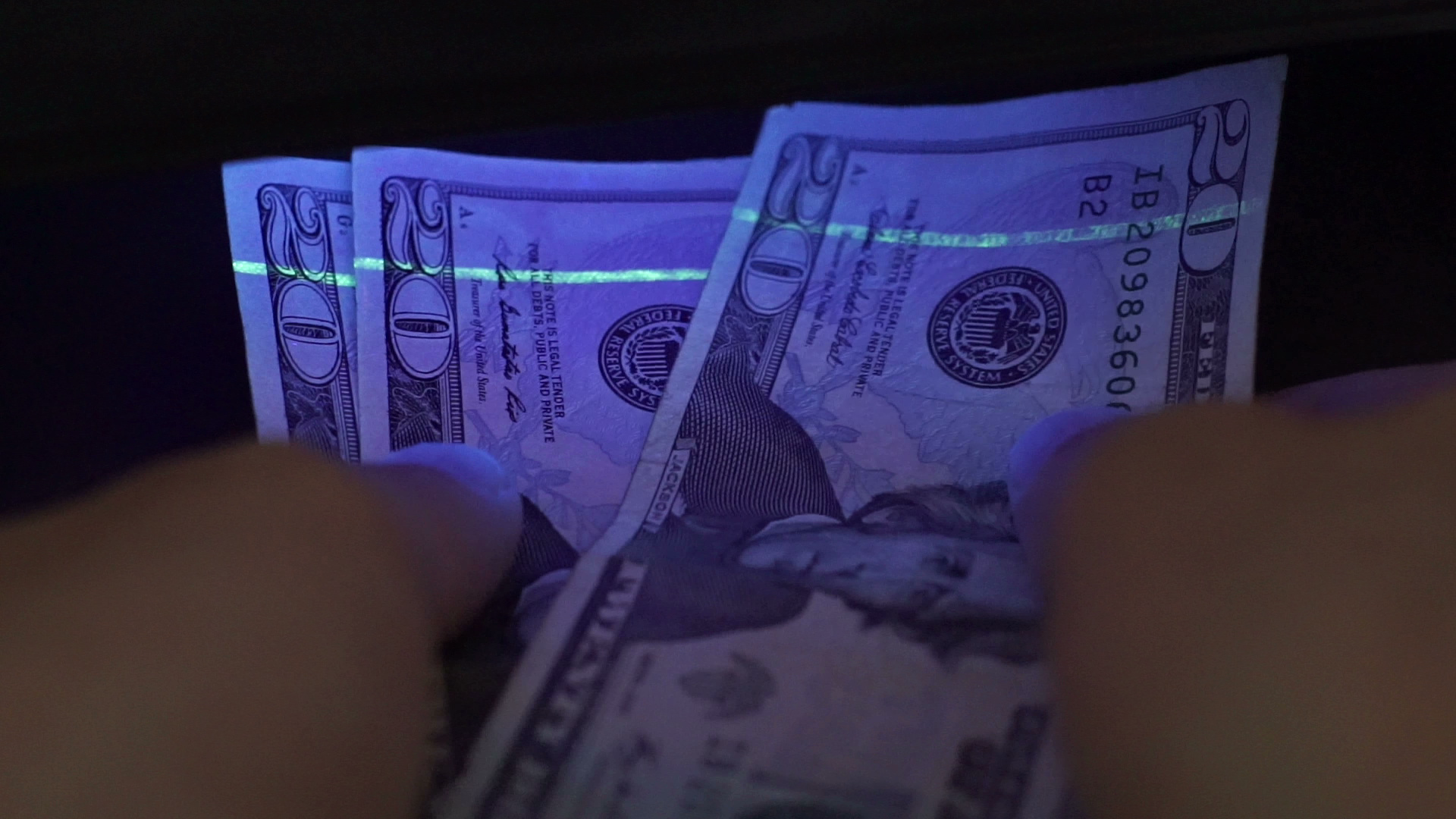
UV detectors emit ultraviolet light at approximately 365nm wavelength to reveal security features invisible under normal lighting. Fluorescent fibers and security threads embedded in genuine currency become visible under this specific light frequency. The verification process takes only 2-5 seconds per note, making UV detection suitable for point-of-sale environments.
Genuine banknotes contain strategically placed fluorescent elements that glow distinctly under UV-A illumination. Watermarks function as additional visual security features that UV light enhances for easier authentication.
What Is Magnetic Ink Detection?
Magnetic ink detectors identify the magnetic properties of genuine currency by analyzing iron-infused inks used in banknote production. Sensors measure both the presence and distribution of magnetic ink patterns unique to authentic notes. This technology proves particularly effective against digitally-produced counterfeits that lack magnetic properties.
The detection system analyzes specific magnetic signatures that vary by denomination and currency type. Advanced magnetic sensors provide audible or visual feedback when bills fail authentication tests.
What Are Automatic Money Counters with Multi-Technology Detection?
Automatic money counters combine high-speed counting functionality with multi-technology counterfeit detectors that verify bills during processing. These systems simultaneously count, sort, and authenticate currency using UV, magnetic, infrared, and dimensional analysis. Processing speeds reach 800-1,500 bills per minute while maintaining accuracy levels above 95%.
The integration of multiple verification technologies eliminates the need for separate manual inspection steps. Automatic counters generate audit trails that document both transaction volume and detected counterfeit attempts.
Why Is Speed and Accuracy Critical in High-Volume Retail?
Speed and accuracy directly impact revenue protection and customer satisfaction in retail environments processing thousands of daily transactions. Detection delays create checkout bottlenecks that reduce transaction capacity and increase customer wait times. Accuracy failures result in unrecoverable financial losses when counterfeit bills reach bank deposits.
The operational cost of accepting counterfeit money extends beyond the bill's face value. Fraud incidents trigger investigation time, productivity losses, and regulatory reporting requirements that multiply the actual financial impact.
How Does Detection Speed Affect Retail Operations?
Detection speed determines whether verification integrates seamlessly into checkout workflows or creates transaction delays. High-volume retail fraud protection requires authentication that completes within the natural rhythm of payment processing. Systems processing bills in 2-5 seconds maintain customer flow without perceived delays.
Slower verification methods force cashiers to choose between thorough authentication and checkout efficiency. This choice creates an inconsistent application of security protocols that counterfeiters exploit by targeting rushed transactions.
What Levels of Accuracy Are Required to Prevent Fraud Losses?
Professional-grade detection systems maintain accuracy levels exceeding 95% to minimize both false positives and undetected counterfeits. False positives that reject genuine currency create customer frustration and operational friction. Undetected counterfeits generate direct financial losses plus the soft costs of fraud investigation and remediation.
The accuracy requirement increases proportionally with transaction volume and average transaction size. Single detection failures in high-volume environments can produce losses exceeding the annual cost of professional detection equipment.
How Do Detection Tools Impact Checkout Efficiency?
Integrated detection tools that verify currency during natural checkout steps maintain transaction flow without additional procedural steps. Automatic counters process verification simultaneously with counting, eliminating separate authentication delays. Manual verification methods require conscious cashier intervention that extends transaction time and increases human error probability.
Equipment-based verification standardizes authentication quality across all employees and transaction types. This consistency prevents the creation of soft-target locations where less rigorous verification attracts concentrated counterfeit attempts.
What Factors Influence the Choice of Counterfeit Detectors for Retail?
Retail businesses evaluate detection equipment based on operational requirements, budget constraints, and risk exposure levels. The selection process must balance initial investment against potential fraud losses and operational efficiency gains. Different retail formats require customized solutions aligned with transaction volume, cash handling procedures, and physical space constraints.
A comprehensive buyer's guide to counterfeit detectors considers both immediate functionality and long-term operational impact. Total cost of ownership includes equipment price, training requirements, maintenance needs, and fraud prevention value.
How Important Is Ease of Use and Training?
Ease of use influences 20% of purchasing decisions because complicated systems create adoption resistance and application inconsistencies. Detection tools requiring extensive training increase onboarding costs and create vulnerability periods during staff turnover. Intuitive interfaces that provide clear authentication results enable immediate deployment with minimal instruction.
Systems featuring automatic operation and unambiguous pass/fail indicators reduce reliance on employee judgment. This design approach prevents the variability introduced when authentication quality depends on individual operator skill.
What Role Do Cost and ROI Play?
Accuracy and reliability influence 30% of purchasing decisions, while speed affects 24% of choices. Cost and ROI considerations drive 16% of decisions, particularly among budget-conscious small businesses. Durability accounts for 10% of decision weight as businesses evaluate long-term replacement costs.
The ROI calculation must compare the equipment investment against the multiplied cost of accepting counterfeit currency. Counterfeit fraud prevention systems typically achieve payback within months when fraud exposure matches high-volume retail environments.
How Does Durability Affect Long-Term Use?
Durability determines whether detection equipment maintains performance standards throughout years of continuous operation. High-volume retail environments subject equipment to thousands of daily verification cycles that stress mechanical components. Professional-grade devices built for commercial applications resist degradation that renders consumer-grade units ineffective.
Equipment failures create security gaps that expose businesses to fraud until replacement or repair completion. Extended warranty coverage and manufacturer support responsiveness become critical factors in total ownership cost calculations.
How Do Market Trends and Adoption Patterns Shape Detector Use?
The global counterfeit money detection market reached USD 4.3 billion in 2025 and is projected to grow to USD 7.0 billion by 2035. This 5.0% CAGR reflects increasing counterfeit sophistication and expanding retail infrastructure across emerging markets. The absolute dollar opportunity of USD 2.7 billion over the forecast period drives continuous innovation in detection technologies.
Market expansion accelerates as counterfeiting transitions from centralized criminal operations to localized digital production. The US market alone grew from USD 0.98 billion in 2023 toward projected values exceeding USD 1.33 billion by 2032.
What Are Regional and Demographic Adoption Differences?
North America maintains a 75% adoption rate among cash-handling businesses, while Europe reaches 70% adoption. Asia-Pacific markets show 65% adoption but represent the fastest-growing segment, driven by retail expansion. Urban areas demonstrate 70-80% adoption rates compared to 40-50% in rural locations.
Urban businesses predominantly select automatic or hybrid detection systems aligned with higher transaction volumes. Rural operations favor manual or portable solutions that balance functionality with lower investment requirements.
How Do High-Volume Retail Needs Differ from Small Businesses?
High-volume retail operations maintain 85-95% adoption rates for detection equipment compared to 50-65% among small businesses. Large retailers require processing speeds of 800-1,500 bills per minute that only automatic counters deliver. Small businesses typically manage with standalone UV or magnetic detectors that verify individual bills.
The operational scale dictates technology selection based on transaction volume and cash processing workflow integration. Retail fraud prevention strategies must align detection capabilities with specific business models and risk profiles.
What Emerging Technologies Are Influencing the Market?
UV technology accounts for 32.7% of total revenue in 2025, maintaining dominance through widespread applicability and cost-effectiveness. Magnetic ink detection captures approximately 20% of the market with superior reliability against digitally-produced counterfeits. Infrared scanning accounts for 15% of the market, offering specialized authentication of advanced security features.
Multi-technology integration represents the primary innovation trend as single-method detection proves insufficient against sophisticated counterfeits. AI-enabled systems entering the market promise enhanced pattern recognition that adapts to emerging counterfeiting techniques.
How Do Different Detector Types Compare for High-Volume Retail?
Different detection technologies offer distinct advantages that align with specific operational requirements and budget constraints. UV detectors provide fast, affordable verification suitable for moderate transaction volumes. Magnetic detectors deliver higher reliability against advanced counterfeits but require greater investment.
Automatic counters represent the premium solution for retail cash security solutions in high-volume environments. The technology comparison must evaluate speed, accuracy, cost, and operational integration to determine the optimal fit.
What Are the Advantages and Disadvantages of UV Detectors?
UV verification takes 2-5 seconds per note, enabling rapid authentication during checkout processes. UV detectors vulnerable to sophisticated counterfeits using fluorescent inks require supplemental verification methods. Single-feature checks through UV detection leave gaps that professional counterfeiters exploit using enhanced materials.
Manual interpretation by operators introduces variability based on employee attention and training quality. Compared to magnetic verification, UV detection offers faster processing but lower reliability against advanced counterfeiting techniques.
How Do Magnetic Detectors Perform in Retail Settings?
UV detectors cost $25-$800 while magnetic detectors range from $80-$1,000+, reflecting enhanced detection capabilities. Magnetic detectors require calibration for different currencies, creating operational complexity in multi-currency environments. The technology excels at identifying altered or washed notes that pass UV inspection.
Magnetic detection provides audible and visual feedback that removes interpretation ambiguity present in UV systems. Bulk counterfeit detection capabilities make magnetic technology essential for environments processing large cash volumes.
When Are Automatic Counters the Best Option?
Automatic counters process 800-1,500 bills per minute while maintaining accuracy above 95%. These systems cost $300-$2,500+ compared to detection pens at $10-$50. Automatic counters require dedicated space and regular maintenance, unlike portable manual detectors.
The lack of portability limits automatic counters to fixed locations with consistently high-volume processing needs. Money counters deliver optimal ROI when daily transaction volumes justify the investment through time savings and fraud prevention.
How Are Businesses Successfully Implementing Counterfeit Detection?
Real-world implementations demonstrate how different business models adapt detection technologies to their specific operational requirements. BrightMart Retail Chain implemented high-speed, multi-test counterfeit detection devices with QR codes linking to online training. The approach drastically reduced counterfeit acceptance while minimizing training investment and operational disruption.
A New York City Sports Bar eliminated over $10,000 in counterfeit losses during the first year using high-powered UV detectors. A Mobile Food Truck saved over $2,000 in fake currency losses within six months using compact, battery-powered dual detectors.
What Are Case Studies Demonstrating High-Volume Retail Solutions?
The BrightMart implementation combined UV, watermark, and ink detection in high-speed devices that maintained checkout efficiency. QR-linked training enabled rapid employee onboarding without classroom instruction costs. The multi-test approach addressed the limitation that 67% of digitally-produced counterfeits mimic visual security features.
The sports bar case demonstrated UV detector effectiveness in low-light, fast-paced environments where traditional inspection proves impractical. The mobile food truck solution proved that battery-powered portable detectors serve businesses without reliable electrical infrastructure.
How Do Portable Vs. Fixed Devices Fit Various Business Models?
Detection pens require no power, while electronic detectors need electricity, creating deployment constraints based on the operational environment. Urban businesses prefer automatic or hybrid systems that integrate with point-of-sale infrastructure and cash management workflows. Rural businesses favor manual or portable solutions aligned with lower transaction volumes and limited infrastructure.
Portable devices enable authentication flexibility across multiple service points without equipment duplication. Fixed installations provide superior capabilities but require dedicated space and permanent positioning.
What Training and Integration Strategies Improve Effectiveness?
Effective training emphasizes multi-layer verification that combines visual inspection with equipment-based authentication. QR code systems linking to video demonstrations reduce training time while maintaining consistency across locations. Integration strategies that embed detection into existing checkout workflows prevent procedural friction that reduces compliance.
Regular refresher training maintains authentication vigilance as employee attention naturally declines over time. Standardized protocols across all locations eliminate soft-target vulnerabilities that arise from inconsistent application.
What Are the Best Practices for Detecting Counterfeit Money at the Register?
Cashiers represent the first defense against counterfeit currency entering business operations. Effective detection combines human observation with equipment-based verification to create layered protection. Single verification methods prove insufficient as counterfeiters develop techniques that defeat individual authentication approaches.
The best practices framework addresses both detection accuracy and operational efficiency. Properly implemented protocols prevent fraud without creating checkout delays that degrade customer experience.
How Should Cashiers Be Trained for Multi-Layer Verification?
Training programs must teach sequential verification that begins with visual inspection and progresses to equipment authentication. Cashiers learn to identify suspicious bills based on feel, appearance, and customer behavior patterns. Equipment verification follows initial visual assessment to confirm or reject suspected counterfeits.
Multi-layer training prevents over-reliance on any single detection method that creates exploitable vulnerabilities. Regular practice sessions maintain skill retention and build confidence in authentication procedures.
What Tools Should Be Combined for Optimal Detection?
Visual inspection checks watermarks and color-shifting ink before equipment verification using UV and magnetic detection. Single-test methods provide limited protection against sophisticated counterfeits that replicate specific security features. The combination approach addresses the reality that 67% of counterfeits produced digitally can mimic visual security elements.
Equipment verification removes human judgment variability that allows counterfeits to pass during busy periods. The tool combination strategy, proven through industry retail applications, balances thoroughness with practical implementation.
How Can Detection Minimize Financial and Operational Risks?
Soft costs of fraud include lost time, reduced productivity, wasted resources, and operational disruption beyond the bill's face value. Two-thirds of domestically printed counterfeit bills in the U.S. are produced using laser and ink-jet home printer technologies. These accessible production methods transform counterfeiting from organized crime to opportunistic individual acts.
Soft costs of fraud typically equal more than three times the face value of the fraud itself. Accepting a fake bill costs three times its face value in operational impact, making prevention significantly more cost-effective than remediation.
Best Counterfeit Money Detectors for High-Volume Retail: Synthesis and Practical Insights
High-volume retail environments require detection systems that balance speed, accuracy, and seamless operational integration. Automatic money counters with multi-technology verification deliver optimal performance for businesses processing thousands of daily transactions. These systems prevent both direct counterfeit losses and the multiplied soft costs that extend fraud impact beyond the bill's face value.
UV detection provides essential first-line authentication when combined with magnetic and infrared verification in multi-technology platforms. Standalone UV or magnetic detectors serve smaller operations where transaction volume doesn't justify an automatic counter investment. The selection process must align detection capabilities with specific transaction volumes, cash handling workflows, and budget parameters.
Successful implementation requires comprehensive training that establishes multi-layer verification as a standard procedure across all locations. Equipment-based authentication removes the judgment variability that allows sophisticated counterfeits to penetrate manual inspection. Businesses using counterfeit detectors with proven multi-technology capabilities protect revenue while maintaining the checkout efficiency that customer experience demands.
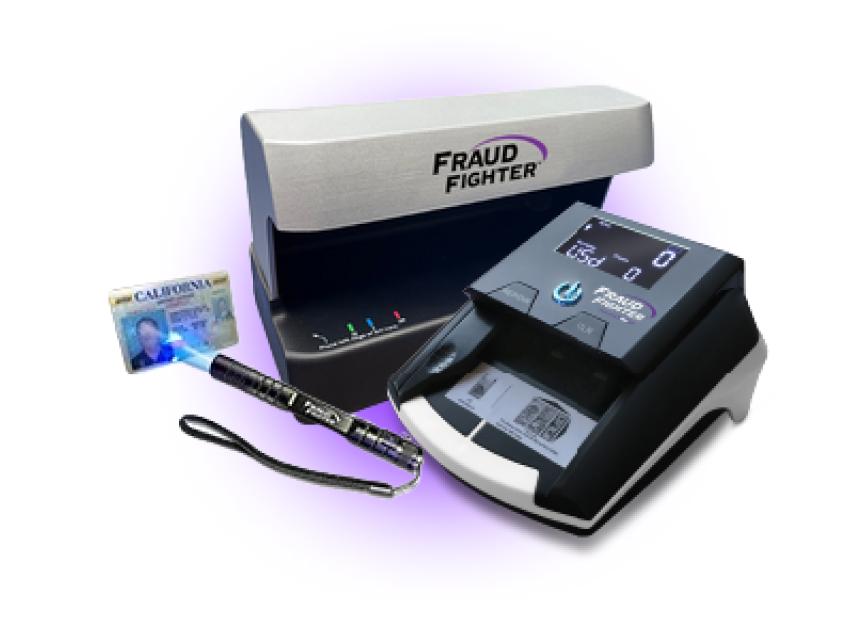
FraudFighter™ has provided specialized fraud prevention solutions for over 24 years, helping retail operations eliminate preventable losses. The combination of proven technology and straightforward implementation protocols delivers measurable ROI within months of deployment.
Ready to Protect Your High-Volume Cash Operation?
Counterfeit losses don't have to be a cost of doing business. For over 24 years, FraudFighter has equipped retailers, banks, and enterprises — including Wells Fargo, Kroger, Petco, and T-Mobile — with point-of-sale counterfeit detection that verifies currency in seconds and trains any employee in minutes. A 30-day trial of 100 UV units at Wells Fargo prevented nearly $200,000 in fraud — a return of more than 2,000% in a single month.
Protect your retail operation from counterfeit currency losses that threaten both revenue and operational efficiency. Contact FraudFighter™ to discuss detection solutions designed for your specific transaction volume and cash handling requirements.