


 8 minute read
How Do You Detect Counterfeit Money at the Register?
Detecting counterfeit money at the register requires understanding security features and using verification tools during transactions. Cashiers serve as the first line of defense against fraud, making proper counterfeit money detection methods essential for protecting business revenue.
Register fraud prevention combines visual inspection with technology-based authentication to identify fake bills before completing sales. Businesses lose not only the face value of counterfeit currency but also incur operational costs that typically exceed three times the amount of the fraud itself.
Key Takeaways
- Genuine currency contains watermarks, security threads, color-shifting ink, and fluorescent fibers that are difficult to replicate
- UV detectors reveal security features in 2-5 seconds, but work best when combined with magnetic or infrared verification
- Automatic money counters process 800-1,500 bills per minute with 95%+ accuracy for high-volume environments
- Multi-layer verification is critical because two-thirds of domestic counterfeits now use digital printing technology
- Soft costs of accepting fake bills equal three times the face value due to lost time and operational disruption
What Are the Common Features of Genuine Currency?
Authentic bills contain multiple security features designed by government mints to prevent counterfeiting. These features include watermarks, security threads, color-shifting ink, and fluorescent fibers that work together to create a multi-layered authentication system.
Modern currency incorporates both visible and hidden elements that require specific tools or lighting conditions to verify. Understanding these features helps cashiers perform quick checks without slowing down transactions.
How Do Watermarks and Security Threads Work?
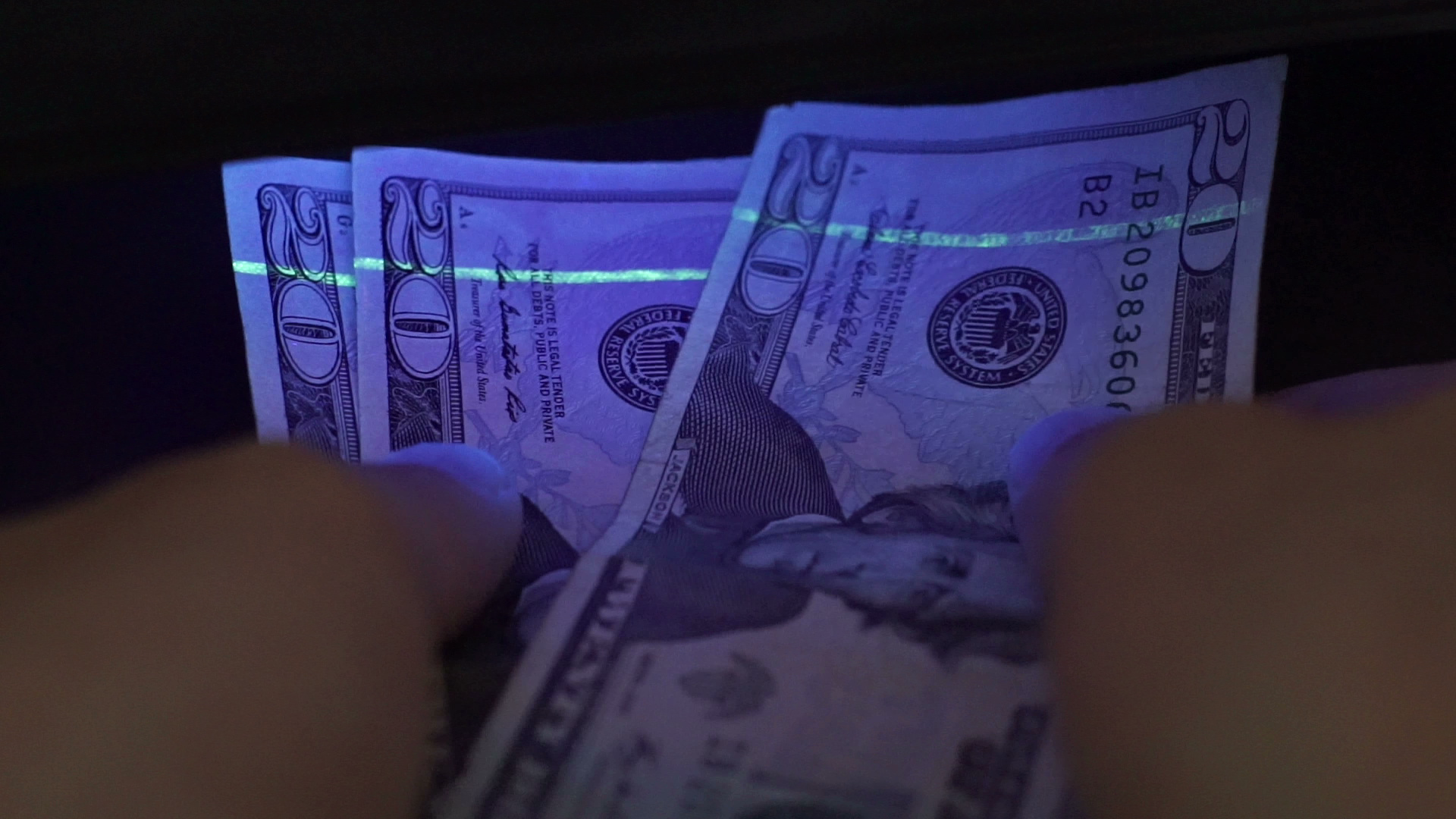
Watermarks appear as faint images embedded in paper that become visible when held up to light. Security threads are thin strips woven into genuine bills that glow specific colors under ultraviolet light.
These elements cannot be reproduced by standard copying or printing equipment. The watermark matches the portrait on the bill and appears on the right side of genuine U.S. currency.
What Is Color-Shifting Ink and How Is It Used?
Color-shifting ink changes appearance when viewed from different angles, typically shifting between copper and green. This ink is used on denomination numbers in bills $10 and higher in U.S. currency.
The color change occurs due to optical interference properties in specialized pigments. Counterfeiters cannot replicate this feature using standard home or commercial printing equipment.
Why Are Fluorescent Fibers Important?
Fluorescent fibers are tiny colored threads embedded randomly throughout genuine paper that glow under UV light. These fibers appear as red and blue strands when exposed to ultraviolet illumination.
Counterfeit paper either lacks these fibers or contains printed imitations that do not fluoresce properly. The random distribution pattern of authentic fibers is extremely difficult to duplicate convincingly.
What Technologies Are Used to Detect Counterfeit Money?
Front‑line retail security relies on verification technologies that identify authentic security features in seconds. Modern detection devices use ultraviolet light, magnetic ink sensing, and infrared scanning to authenticate currency automatically.
These technologies provide objective verification that reduces reliance on cashier training and visual inspection alone. Combining multiple detection methods significantly improves accuracy against sophisticated counterfeits.
How Does Ultraviolet (UV) Detection Work?
UV detectors emit ultraviolet light at approximately 365nm wavelength to reveal security features invisible to the naked eye. Genuine currency contains fluorescent fibers and security threads that glow under UV illumination, while counterfeit bills typically do not.
This technology accounts for 32.7% of total market revenue in 2025 due to its cost-effectiveness and speed. UV verification takes only 2-5 seconds per note, making it practical for busy retail environments.
What Is Magnetic Ink Detection?
Magnetic ink detectors identify iron-infused inks used in authentic banknote production through specialized sensors. These devices analyze magnetic patterns specific to genuine currency that digital printers cannot reproduce.
Magnetic ink detection captures approximately 20% of the counterfeit detection market. However, these detectors require calibration for different currencies to maintain accuracy.
How Do Automatic Money Counters Enhance Detection?
Automatic money counters combine high-speed counting functionality with multi-technology verification systems. These machines process 800-1,500 bills per minute while checking for UV, magnetic, and infrared security features simultaneously.
Professional-grade money counters achieve accuracy rates exceeding 95% in commercial environments. However, automatic counters require dedicated space and regular maintenance to function properly.
How Do Different Detection Tools Compare by Use Case?
Business size and transaction volume determine which detection method provides the best return on investment. Small operations benefit from portable tools, while high-volume retailers require automated verification systems.
Matching detection technology to operational needs prevents both overspending on unnecessary features and underinvestment in inadequate protection. Each tool category serves specific business environments and fraud risk profiles.
When Should You Use Detection Pens?
Detection pens use iodine-based chemical reactions to identify paper composition differences between genuine and counterfeit bills. The ink produces dark marks on starch-based counterfeit paper while leaving minimal marks on authentic currency.
These pens have limited effectiveness against sophisticated counterfeits printed on genuine paper or treated with starch-blocking chemicals. Detection pens also produce false positives on worn or damaged genuine bills.
What Are the Benefits of Portable UV Detectors?
Portable UV detectors provide quick authentication without requiring electrical outlets or dedicated counter space. These compact devices fit easily at checkout stations and verify bills in seconds using battery power.
A penlight detector offers mobility for businesses with multiple payment points or outdoor operations. However, UV-only verification should be supplemented with visual checks for comprehensive security.
Why Are Multi-Technology Counters Preferred in High-Volume Retail?
Multi-technology counters verify multiple security features simultaneously, reducing false acceptance rates below single-method detection. These systems check UV properties, magnetic ink, infrared patterns, and physical dimensions during each bill scan.
High-volume retailers achieve 85-95% adoption rates for automated counters because they prevent significant fraud losses. QSR cash handling operations particularly benefit from the speed and accuracy that manual verification cannot match.
How Do Cashiers Perform Effective Counterfeit Verification?
Cashiers must follow systematic verification protocols that balance thoroughness with transaction speed. Proper training reduces the risk that sophisticated counterfeit money passes through undetected at the register.
Consistent verification habits create observable fraud deterrence that discourages criminals from targeting specific locations. Employees who check every large bill signal that the business takes currency authentication seriously.
What Visual Checks Should Cashiers Perform First?
Cashiers should examine visible security features by denomination before accepting bills during transactions. Initial visual inspection includes checking for watermarks, security threads, and color-shifting ink within seconds.
The feel of genuine currency paper also provides immediate feedback about authenticity. Counterfeit bills often feel smoother or thicker than authentic currency due to paper composition differences.
How Can Detection Devices Be Integrated at the Register?
Detection devices should be positioned within easy reach of cashiers to encourage consistent use during transactions. POS counterfeit guard systems work best when integrated into checkout workflows rather than requiring separate verification steps.
Mounting UV detectors near cash registers allows verification without disrupting customer interactions. Automatic scanners can be placed adjacent to registers for quick bill authentication between transactions.
What Training Is Needed for Cashiers to Spot Fakes?
Cashiers need hands-on practice identifying security features on genuine bills across all denominations. Training should demonstrate how authentic watermarks, threads, and color-shifting ink appear under normal and UV light.
Effective programs require only minutes to teach basic verification steps, making them practical for high-turnover environments. Regular refresher sessions help maintain detection skills and update employees on emerging counterfeit techniques.
What Challenges Arise from Sophisticated Counterfeiting?
Modern counterfeiting techniques have evolved beyond traditional offset printing to include digital methods accessible to individual criminals. These advances make visual-only detection increasingly unreliable without technology assistance.
The democratization of printing technology means businesses face threats from both organized operations and opportunistic individuals. This shift requires updated detection strategies that address digitally produced fakes.
How Do Digital Printing Techniques Affect Detection?
Two-thirds of domestically printed counterfeit bills in the U.S. use laser and inkjet home printer technologies. These digital methods produce fakes that can mimic basic visual features convincingly enough to fool untrained cashiers.
Digital counterfeits often fail under UV or magnetic testing despite appearing authentic to the naked eye. This reality makes technology-based verification essential rather than optional for businesses handling cash.
Why Is Multi-Layer Verification Critical?
Multi-layer verification combines visual inspection with UV, magnetic, and infrared checks to catch sophisticated fakes. Relying on single verification methods creates vulnerabilities that counterfeiters exploit through targeted feature replication.
Comprehensive counterfeit fraud prevention strategies reduce false acceptance rates to near zero. Businesses implementing multiple detection layers demonstrate measurably lower fraud losses than those using single-method verification.
How Does the Soft Cost of Counterfeit Loss Impact Businesses?
Soft costs of fraud typically equal more than three times the face value of the fraud itself. Accepting counterfeit bills results in total loss of the bill's value plus operational disruption from investigation and reporting.
Lost time, reduced productivity, and wasted resources from fraud incidents compound direct financial losses. These hidden costs make prevention investments more cost-effective than dealing with fraud consequences.
How Does Business Size Influence Detection Method Choice?
Small businesses prioritize affordability and portability, while large retailers require speed and automation. Understanding how adoption rates vary by business size helps match detection solutions to operational realities.
Investment decisions depend on transaction volume, average bill denominations, and fraud risk exposure. Properly scaled solutions deliver protection without creating unnecessary operational friction.
What Solutions Fit Small and Medium Enterprises?
Small business adoption rates range from 50-65% for basic counterfeit detection tools. Portable UV detectors and detection pens provide entry-level protection at price points under $150.
Mid-sized businesses often implement hybrid solutions combining UV verification with occasional magnetic testing. These setups balance cost constraints with the need for reliable authentication during peak transaction periods.
What Are the Needs of High-Volume Retailers?
High-volume retail adoption rates reach 85-95% for automated detection systems integrated into cash handling workflows. These businesses require counterfeit detectors capable of processing hundreds or thousands of bills daily without slowing operations.
Automatic counters with multi-technology verification prevent significant fraud losses while reducing manual counting labor. The investment typically pays for itself within months through prevented losses and operational efficiency gains.
How Do Mobile or Remote Businesses Detect Counterfeits?
Mobile businesses require battery-powered detection tools that function without electrical infrastructure. Portable UV detectors and detection pens allow verification at farmers' markets, food trucks, and outdoor events.
One mobile food truck saved over $2,000 in fake currency losses within six months using compact dual detectors. Battery operation eliminates dependence on power outlets while maintaining authentication capability.
How Is Technology Adoption Varying by Region and Industry?
Regional adoption patterns reflect infrastructure maturity, regulatory requirements, and counterfeit threat levels. North America leads global markets in detection technology deployment across cash-handling businesses.
Industry-specific adoption rates vary based on cash transaction volume and fraud exposure risk. Understanding these patterns helps businesses benchmark their security investments against industry standards.
Which Regions Lead in Detection Technology Use?
North America achieves a 75% adoption rate among cash-handling businesses for counterfeit detection technology. Europe follows at 70% adoption, driven by regulatory compliance requirements and standardized currency security features.
Asia-Pacific demonstrates 65% adoption but represents the fastest-growing market due to retail expansion. Regional differences reflect varying counterfeit threat levels and regulatory enforcement intensity.
How Does Adoption Differ Between Urban and Rural Areas?
Urban adoption rates reach 70-80% due to higher transaction volumes and concentrated retail infrastructure. Large retail chains in metropolitan areas universally implement automated detection systems.
Rural adoption rates range from 40-50% as smaller businesses face lower transaction volumes and budget constraints. However, rural businesses accepting counterfeit bills often experience greater financial impact due to thinner profit margins.
What Industry Sectors Drive Growth in Detection Tools?
The global counterfeit money detection market reached USD 4.3 billion in 2025. Projected growth to USD 7.0 billion by 2035 represents a compound annual growth rate of 5.0%.
The U.S. market specifically grew from USD 0.98 billion in 2023 to USD 1.33 billion by 2032. Banking, retail industry operations, and hospitality sectors account for the majority of detection technology investments.
Integrating Counterfeit Detection at the Register for Effective Loss Prevention
Comprehensive detection programs combine employee training with appropriate technology for business size and transaction volume. Multi-layer verification approaches significantly reduce fraud acceptance rates while maintaining checkout efficiency.
Businesses that implement systematic verification protocols protect revenue and avoid the operational disruption that fraud incidents create. The investment in detection tools consistently delivers returns through prevented losses within months of deployment.
FraudFighter has helped businesses prevent millions in counterfeit losses through verified detection solutions deployed at point-of-sale locations. Proper implementation transforms registers into secure verification points that protect both immediate transactions and long-term business reputation.
Protect Every Register Against Counterfeit Losses
Counterfeit bills accepted at the point of sale cost businesses three times their face value once operational disruption is factored in. FraudFighter has helped Wells Fargo, Capital One, Disneyland, T-Mobile, and thousands of businesses prevent counterfeit currency losses through proven UV detectors and automatic counterfeit detection devices deployed directly at the register.
Our detection solutions verify currency in seconds, require only minutes of cashier training, and integrate into existing checkout workflows without slowing transactions. With 25+ years of point-of-sale fraud prevention experience and over 25,000 units installed nationwide, FraudFighter delivers measurable ROI within the first month of deployment.
To protect your business from counterfeit currency at the register, contact FraudFighter for a free, no-obligation consultation and find the detection solution that fits your transaction volume and operational needs. High-volume registers often bring in a reliable CountEasy Money Counter alongside detection, turning end-of-shift counts into a quick, hands-off step instead of a nightly bottleneck.