


 11 minute read
What Counterfeit Detection Solutions Work Best for Banks?
Financial institutions face mounting pressure to prevent currency fraud while maintaining efficient transaction processing. The global anti-counterfeiting solutions market reached USD 199.9 billion in 2025 and will grow to USD 456.2 billion by 2032. Banking and financial institutions control 55.1% of this market, reflecting the critical importance of counterfeit detection in protecting institutional assets and customer trust.
Key Takeaways
- Banking and financial institutions hold 55.1% of the counterfeit detection market, valued at USD 199.9 billion in 2025
- Multi-detection systems integrate UV, magnetic, infrared, and dimensional checks for comprehensive currency authentication
- Large enterprises show 92% adoption rates compared to 38% for small businesses
- North America leads with 38.5% revenue share, while Asia-Pacific grows fastest at 6.9% CAGR
- AI and machine learning applications reduced fraudulent transactions by $6 million in documented case studies
What Are Counterfeit Detection Solutions and Their Purpose?
Definition and Key Components of Counterfeit Detection
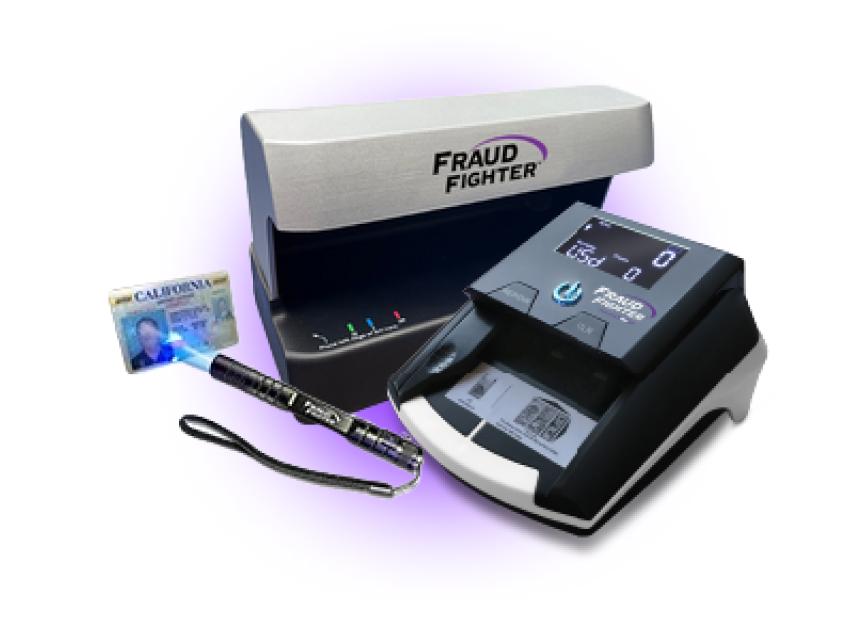
Counterfeit detection solutions authenticate currency and financial documents through specialized hardware and software technologies. UV detectors use ultraviolet light to reveal invisible security features such as fluorescent fibers and security threads. Magnetic detection devices recognize magnetic properties embedded in genuine currency ink that counterfeiters struggle to replicate. Multi-detection systems integrate UV, magnetic, infrared, and dimensional checks for comprehensive authentication across multiple verification layers.
RFID uses Radio Frequency Identification tags embedded in products for wireless verification without line-of-sight requirements. NFC uses Near Field Communication tags for cryptographically protected verification that consumers access using smartphones. These counterfeit detectors form the foundation of bank teller counterfeit protection strategies deployed across financial institutions globally.
Purpose and Importance in the Banking Sector
The counterfeit money detection market was valued at USD 4.10 billion in 2025 and will reach USD 5.31 billion by 2030. Market projections indicate a compound annual growth rate of 12.5% through 2032, driven by increasing counterfeiting sophistication. Two-thirds of consumers reported being duped into buying counterfeits online, according to Michigan State University research. A retail banking case study showed a $6 million reduction in fraudulent transactions using machine learning models.
Banking adoption reflects direct exposure to currency fraud and regulatory compliance requirements under BSA/AML frameworks. The Wells Fargo benchmark case demonstrated deployment of 25,000 units, preventing $200,000 in losses within 30 days. Financial institutions prioritize counterfeit detection solutions because every dollar of fraud costs $4.61 total when accounting for chargebacks and operational expenses.
Differences Between Hardware and Software Solutions
Software and SaaS platforms represent the fastest-growing segment at 6.5% CAGR compared to traditional hardware deployments. Currency-detector machines maintain 39.4% market share due to established reliability and minimal training requirements for frontline staff. Hardware solutions provide immediate verification without internet connectivity requirements that can delay processing during network outages.
Software solutions require recurring subscription costs ranging from $500 to $10,000 monthly, depending on transaction volume and features. Implementation complexity increases with software deployments requiring IT integration and staff training across multiple locations. Hardware platforms offer a lower total cost of ownership for institutions with limited IT infrastructure or rural branches with unreliable connectivity.
Which Technologies Are Commonly Used for Counterfeit Detection in Banks?
Ultraviolet (UV) and Magnetic Detection Devices
UV scanners account for 28.6% of the counterfeit money detection market, serving as first-line verification tools. These devices reveal security features invisible to the naked eye, including fluorescent fibers and embedded security threads. UV detectors remain vulnerable to sophisticated counterfeits using fluorescent ink that mimics authentic currency. Magnetic detectors identify authentic bills through magnetic ink signatures that vary by denomination and currency type.
Single-technology detectors perform limited verification checks that sophisticated counterfeiters can circumvent with proper materials. Magnetic detection cannot identify all security features, including watermarks, microprinting, and color-shifting ink. Banks deploy UV and magnetic devices primarily at teller-line security technology stations where transaction speed outweighs comprehensive verification requirements.
Multi-Detection Systems and Their Advantages
Multi-detection systems combine four or more verification technologies to achieve superior accuracy across diverse counterfeit methods. These platforms check UV fluorescence, magnetic signatures, infrared patterns, and physical dimensions simultaneously within processing times under 10 seconds. Budget multi-detection units cost $150-$300 while premium systems exceed $1,500 with advanced features including multi-currency capability and automatic bill counting.
Higher initial costs offset long-term savings from prevented losses and reduced manual verification time. Multi-detection systems require periodic maintenance, including sensor calibration and software updates to recognize new currency designs. Larger footprints necessitate dedicated counter space at teller stations that may conflict with workspace constraints in compact branch layouts.
Software Solutions and AI-Driven Platforms
Machine vision and AI solutions grow at 5.6% CAGR by learning new counterfeit patterns through continuous data analysis. These platforms analyze product images and documentation using algorithms that adapt to emerging fraud techniques without hardware replacement. Software solutions carry recurring costs from $500 to $10,000 monthly compared to one-time hardware purchases averaging $300-$600. Internet connectivity requirements create vulnerability during network outages that can halt transaction processing.
Implementation complexity increases with software deployments requiring integration with existing banking systems and staff training programs. Cloud-based platforms provide centralized monitoring across branch locations, enabling fraud pattern detection that isolated hardware systems cannot identify. Financial institutions implementing types of fraud prevention increasingly adopt hybrid approaches combining hardware and software for layered security.
How Do Banks Prioritize Features When Selecting Detection Solutions?
Accuracy and Speed Requirements
Accuracy ranks as the top priority with a 95% importance score among financial institution decision-makers. Processing times under 10 seconds prove critical for note recycling and ATM loading operations handling high transaction volumes. Multi-currency capability enables verification of foreign currency at international banking centers and tourist-heavy locations. Speed requirements balance fraud prevention with customer service expectations that deteriorate when verification delays exceed 15 seconds per transaction.
Banks require false positive rates below 0.1% to prevent customer friction from legitimate bills incorrectly flagged as counterfeit. Detection sensitivity must identify sophisticated counterfeits while avoiding excessive alerts that slow throughput during peak hours. Institutions with identity authentication requirements prioritize systems offering integrated ID verification alongside currency detection to streamline dual-verification processes.
Cost and User-Friendliness Considerations
Cost considerations rank third at 82% importance factoring both initial investment and total cost of ownership over equipment lifecycles. User-friendliness scores 78% importance reflecting high employee turnover requiring minimal training for new teller staff. Budget constraints at community banks favor UV detection units costing $50-$100 over premium multi-detection systems exceeding $1,500. Return on investment calculations demonstrate that preventing a single $10,000 counterfeit loss justifies detection equipment costing under $500 annually.
Institutions measure user-friendliness by time-to-competency metrics targeting same-day operational capability for newly hired tellers. Intuitive interfaces with visual pass/fail indicators reduce decision burden on frontline staff during high-stress periods. Training requirements exceeding two hours per employee create operational friction in high-turnover environments experiencing 40% annual staff replacement.
Integration with Note Recycling and ATM Systems
Integration capabilities rank fifth at 75% importance among banks deploying automated transaction processing technologies. Approximately 68% of US retail chains use integrated detection in POS systems demonstrating widespread adoption. Note recycling systems require seamless detection integration to automatically reject counterfeit bills without manual intervention. ATM loading procedures incorporate detection to prevent counterfeit currency from entering cash dispensing inventory that could damage institutional reputation.
API compatibility enables detection systems to communicate with core banking platforms for centralized fraud reporting and pattern analysis. Legacy system constraints at established banks create integration challenges requiring middleware solutions that increase implementation complexity and cost. Modern banking platforms prioritize vendor solutions offering plug-and-play integration reducing deployment timelines from months to weeks.
What Are the Adoption Patterns of Counterfeit Detection in Banking?
Influence of Business Size on Adoption Rates
Large enterprises with 1,000+ employees demonstrate 92% adoption rates driven by substantial revenue exposure and brand protection requirements. Mid-market companies operating 100-999 employees show 68% adoption reflecting moderate fraud risk and available capital budgets. Small businesses with 10-99 employees achieve 38% adoption limited by budget constraints and competing priorities. Micro-businesses employing 1-9 staff lag at 15% adoption due to perceived low fraud risk and insufficient capital.
Enterprise banks deploy standardized detection solutions across hundreds of branch locations to ensure consistent fraud prevention protocols. Regional banks with 20-50 branches balance centralized purchasing with location-specific needs based on fraud incident history. Community banks and credit unions often adopt detection technology reactively following fraud incidents rather than proactive risk management strategies.
Regional and Urban Vs. Rural Distribution
North America leads global adoption with 38.5% revenue share in 2024, supported by stringent regulatory frameworks and high awareness. Europe follows with 28.0% market share, reflecting mature banking infrastructure and cross-border currency verification requirements. Asia-Pacific projects expansion at 6.9% CAGR through 2030, driven by rapid industrialization and retail sector modernization. Latin America and Africa show lower adoption, correlating with cash-based economies and limited banking infrastructure.
Urban banking adoption reaches 92% compared to 45% in rural areas, reflecting transaction volume disparities and infrastructure access. Urban retail adoption achieves 85% versus 32% rural deployment, creating geographic fraud vulnerability where detection technology remains absent. Rural locations face challenges, including limited technical support, higher equipment costs from low-volume purchasing, and staff training accessibility.
Demographic Trends Affecting Detection Needs
Younger consumers demonstrate higher counterfeit purchase frequency than older demographics, according to Michigan State University survey data from 13,000 participants. Males show a greater likelihood of purchasing counterfeits compared to females across 17 countries surveyed in 2023. Lower-income households exhibit higher counterfeit purchase rates driven by price sensitivity and limited authentication knowledge. Larger households display greater prevalence in counterfeit purchases, reflecting increased consumption volume and budget constraints.
These demographic patterns influence counterfeit fraud prevention strategies as banks serving younger, price-conscious customer bases face elevated fraud exposure. Financial institutions in college towns and urban centers with large millennial populations deploy more comprehensive detection technologies. Banks in affluent suburban markets report lower counterfeit incident rates but maintain robust detection as brand protection insurance.
How Does Consumer Behavior Impact Bank Counterfeit Detection Strategies?
Insights from Global Consumer Counterfeit Purchase Trends
More than half of global consumers knowingly purchase counterfeit products, according to Michigan State University research. The 2023 survey involving over 13,000 participants across 17 countries revealed widespread acceptance of counterfeit goods purchasing. Online shopping platforms account for two-thirds of instances where consumers were duped into buying counterfeits unintentionally. These behavioral patterns demonstrate that counterfeit currency enters circulation through diverse channels requiring multi-layered institutional defenses.
Banks face counterfeit exposure from both intentional fraud attempts and innocent deposits from customers unknowingly possessing fake bills. Detection strategies must account for seasonal variations, including holiday shopping periods, when counterfeit circulation increases by 40%. Geographic hotspots near tourist attractions and international airports require enhanced detection capabilities for foreign currency verification and high-volume transactions.
Hedonic Vs. Economic Motivations Behind Counterfeiting Risk
Consumer motivation research identifies hedonic factors, including impulse buying and shopping rituals, as primary drivers of counterfeit purchases. Economic benefits rank secondary to emotional satisfaction derived from acquiring luxury-branded products at accessible price points. This behavioral insight reveals that price alone does not explain counterfeit demand, requiring banks to anticipate fraud regardless of economic conditions. Impulse purchases create unpredictable counterfeit circulation patterns that automated detection systems must identify without relying on predictable fraud cycles.
Financial institutions serving retail-heavy markets face greater exposure to counterfeit deposits from consumers who purchased fake products unknowingly. Detection protocols must process all currency transactions uniformly without profiling customers based on transaction size or demographic characteristics.
Implications for Detection Solution Design and Deployment
Consumer behavior research informs detection solution deployment, prioritizing high-traffic branch locations and customer-facing transaction points. Banks concentrate detection resources at branches serving demographics showing elevated counterfeit purchase rates, including college campuses and urban centers. Automated detection integration into self-service banking terminals addresses 24/7 transaction processing without staff supervision. Mobile banking expansion creates a new vulnerability requiring digital authentication methods, complementing physical currency detection.
Financial institution fraud guard strategies increasingly incorporate customer education programs explaining counterfeit risks alongside detection technology deployment. Banks position detection as customer protection rather than surveillance creating positive messaging around fraud prevention investments. Multi-channel approaches combining in-branch detection, ATM integration, and digital authentication create comprehensive coverage across evolving banking service delivery models.
What Are the Pricing Tiers and Product Categories Available to Banks?
Budget to Premium Hardware Options
UV detection pricing ranges from budget units at $50-$100, mid-range devices at $100-$200, and premium models at $200-$350+. Magnetic detection systems cost $60-$120 for budget options, $120-$250 mid-range, and $250-$400+ for premium configurations. Multi-detection platforms span budget tier $150-$300, mid-range $300-$600, and premium $600-$1,500+ reflecting feature sophistication. Budget hardware provides basic verification suitable for low-volume locations processing under 50 transactions daily.
Mid-range equipment offers enhanced accuracy and multi-currency capability appropriate for moderate-volume branches handling 50-200 daily transactions. Premium systems deliver maximum accuracy with automatic bill counting, denomination sorting, and integration capabilities for high-volume processing centers. Price-performance analysis demonstrates that mid-range multi-detection systems provide optimal value for most banking applications balancing cost with fraud prevention effectiveness.
Software-as-a-Service (SaaS) and Cloud Solutions Pricing
Software and SaaS pricing structures include budget tier at $500-$2,000 monthly, mid-range $2,000-$10,000 monthly, and premium $10,000+ monthly. Subscription costs scale with transaction volume, number of monitored locations, and advanced features including machine learning and predictive analytics. Cloud solutions eliminate upfront hardware investment while creating ongoing operational expenses that accumulate over multi-year deployment periods. Total cost of ownership calculations must factor subscription fees over five-year equipment lifecycles to enable accurate cost comparisons.
Budget SaaS platforms provide basic image analysis suitable for single-location operations with under 100 monthly transactions. Mid-range offerings include centralized monitoring across 10-50 locations with automated reporting and compliance documentation. Premium enterprise solutions support unlimited locations with custom API integration, dedicated support, and advanced fraud pattern recognition algorithms.
Integrated POS and Advanced Authentication Technologies
Integrated POS systems cost $50,000-$500,000+ for enterprise deployments across multi-location banking and retail operations. RFID tags range from $0.50-$5+ per unit with infrastructure costs of $5,000-$100,000+ for reader networks and backend systems. NFC technology provides cryptographically protected verification that consumers access through smartphone tap-to-verify interactions without specialized equipment. Approximately 68% of US retail chains deploy integrated detection in POS systems demonstrating mainstream adoption.
Advanced authentication technologies combine physical and digital verification creating layered security that sophisticated counterfeiters cannot easily circumvent. Banks investing in counterfeit detector selection increasingly evaluate total security architecture rather than isolated point solutions. Integrated approaches deliver superior fraud prevention while streamlining operations through automated workflows and reduced manual verification requirements.
What Recent Trends Are Shaping Counterfeit Detection in Banking?
Rise of AI and Machine Learning Applications
Artificial intelligence applications grow rapidly, with machine vision solutions expanding at 5.6% CAGR through emerging pattern recognition capabilities. Machine learning algorithms analyze thousands of counterfeit samples to identify subtle variations that human inspectors cannot detect reliably. A documented case study demonstrated a $6 million reduction in potential fraudulent transactions using semi-supervised ML models in retail banking. AI-powered systems continuously improve accuracy through exposure to new counterfeit techniques without requiring hardware replacement.
Cloud-based AI platforms enable smaller financial institutions to access enterprise-grade detection capabilities through subscription models, eliminating six-figure capital investments. Real-time threat intelligence sharing across banking networks creates a collective defense, identifying emerging counterfeit patterns within hours. Machine learning integration represents the most significant technological advancement in counterfeit detection since the introduction of UV verification technology.
Integration with POS and Banking Systems
Seamless integration with core banking platforms eliminates manual data entry, reducing transaction processing time by 60-70% compared to standalone detection. API-enabled detection systems automatically log verification results in customer transaction records, creating comprehensive audit trails for compliance reporting. Integrated workflows prevent teller discretion errors where staff override detection alerts based on customer relationships or time pressure. Centralized monitoring dashboards provide real-time visibility into fraud attempts across branch networks, enabling rapid response to coordinated attacks.
Modern banking systems prioritize vendor solutions offering plug-and-play integration, reducing implementation timelines from six months to four weeks. Legacy system constraints require middleware solutions, adding $10,000-$50,000 to total implementation costs for established institutions. Cloud-native banking platforms enable detection integration through simple API connections, eliminating custom development expenses and accelerating deployment.
Shift Toward Multi-Layered Security Approaches
Multi-layered security strategies combine physical hardware detection with digital tracking, creating comprehensive protection against diverse fraud methods. Banks deploy UV and magnetic detection at teller lines while implementing software analytics for pattern detection across transaction histories. RFID and NFC technologies supplement traditional currency verification with supply chain tracking, preventing counterfeit introduction upstream of banking deposits. Layered approaches acknowledge that no single technology provides absolute protection, requiring defense-in-depth strategies.
Financial institutions recognize that counterfeiters continuously adapt, requiring dynamic security postures that evolve faster than criminal innovation cycles. Industry collaboration through threat intelligence sharing networks enables rapid countermeasure deployment across banking sectors within days. Regulatory frameworks increasingly mandate multi-factor verification for high-value transactions, creating compliance drivers for layered security adoption.
Evaluating Counterfeit Detection Solutions for Banks: A Comprehensive Perspective
Banks must evaluate counterfeit detection solutions through frameworks balancing accuracy, cost, and operational integration across diverse branch environments. The market offers technologies spanning simple UV detectors at $50 to integrated enterprise platforms exceeding $500,000 for multi-location deployments. Financial institutions achieve optimal fraud prevention by matching detection capabilities to specific risk profiles, including transaction volumes, currency types, and demographic exposure.
Large enterprises demonstrate 92% adoption rates while smaller institutions lag at 38%, reflecting budget constraints and competing priorities. North America leads with 38.5% market share, though Asia-Pacific grows fastest at 6.9% CAGR through 2030. Urban banking adoption reaches 92% compared to 45% rural deployment, creating geographic vulnerability requiring targeted infrastructure investment.
FraudFighter has specialized in bank teller counterfeit protection for over two decades, serving financial institutions across North America with proven solutions. The Wells Fargo benchmark case demonstrated measurable results with 25,000 units deployed preventing $200,000 in losses within 30 days. Industry data confirms that every dollar invested in detection prevents $4.61 in total fraud costs including chargebacks and operational expenses.
Build Multi-Layered Counterfeit Defense Across Every Branch
Your institution's exposure to currency fraud compounds with every transaction, every new teller hire, and every counterfeit upgrade fraudsters deploy. FraudFighter has equipped financial institutions like Wells Fargo, Capital One, and Bank of America with point-of-sale counterfeit detection for more than 24 years, backed by SOC 2 Type II compliance, same-day teller training, and over 25,000 units deployed nationwide.
Whether you're evaluating UV scanners for a community branch, automatic multi-detection units for a regional network, or integrated authentication across hundreds of locations, our team will match the right configuration to your transaction volume, compliance requirements, and budget — without the guesswork. To protect your branches, your customers, and your institution's reputation, contact FraudFighter for a free, no-obligation consultation.