


 10 minute read
UV Counterfeit Detector Selection for Convenience Stores: A Holiday Surge Procurement Guide
Key Takeaways
- UV counterfeit detectors cost USD 20-100 per device and catch 70-85% of amateur counterfeits using 365-nanometer ultraviolet light
- Holiday shopping volumes run 3-5 times baseline periods, with counterfeit revenue losses rising nearly 30% during Black Friday week
- Hybrid currency counters process 100-1,500 bills per minute at 95%+ counterfeit detection accuracy, for USD 300-1,500 per device
- Multi-location stores should add 10-20% detection capacity at high-volume sites and pilot before full rollout
- Advanced multi-spectral systems reach 98-99.5% accuracy but require USD 2,000-5,000 and 4-8 hours of staff training
The global counterfeit money detection market reached USD 4.10 billion in 2025 and will grow to USD 5.31 billion by 2030. A UV counterfeit detector sits at the entry point of that market, because it costs little and takes minutes to learn. Convenience stores face heightened counterfeit exposure during Q4, when transaction volumes surge 3-5 times above baseline. The Federal Reserve recorded a 19% jump in counterfeit incident reports during early 2024, and retailers absorb nearly 30% higher counterfeit revenue losses during Black Friday week. Small stores need cost-effective counterfeit detection that works alongside high turnover and limited technical expertise.
Below, you'll find a technology comparison across UV, hybrid, multi-spectral, and software-based options, a weighted scoring framework for procurement decisions, a 90-day Q4 readiness plan, and standardization guidance for convenience store networks running 50 to 100 sites.
UV Counterfeit Detector Technology and How It Works
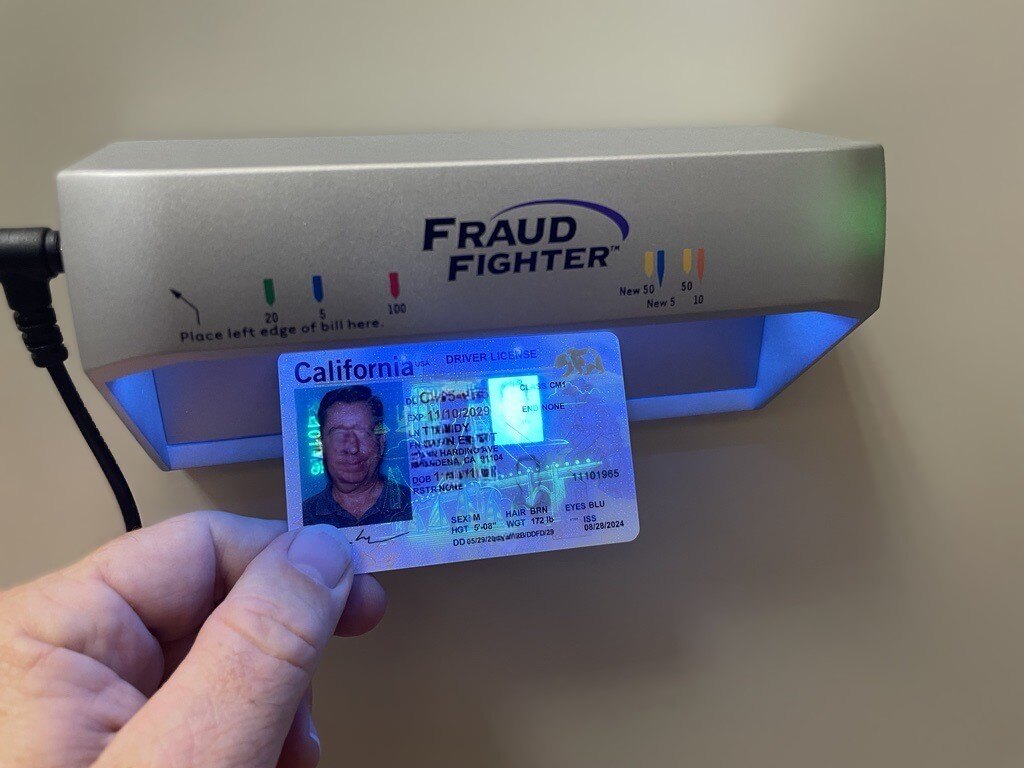
A UV counterfeit detector identifies fake currency by illuminating security features embedded in genuine banknotes. These portable devices use 365-nanometer LED technology to reveal fluorescent security threads and inks that stay invisible under normal lighting. Verification takes 1-5 seconds per note, and UV LED lifespan exceeds 20,000 hours.
Core Features and Operating Principles of Portable UV Detectors
Portable UV counterfeit detector units reach 70-85% accuracy against amateur counterfeits. The device directs concentrated ultraviolet light onto the banknote surface and triggers a fluorescent response from genuine security features. At USD 20-100 per device, they are the most accessible tier of counterfeit detectors for small retailers.
The method works because legitimate currency contains specialized inks and threads that glow under ultraviolet exposure, and counterfeiters usually lack those proprietary materials. Advanced forgeries increasingly carry fluorescent compounds that defeat basic screening.
Advantages and Limitations of UV Detection Technology
Staff training takes 15-30 minutes, which supports rapid deployment. The devices cannot detect sophisticated supernotes that replicate fluorescent security features, and they produce high false-positive rates on worn genuine notes where fluorescent materials have degraded.
UV detectors examine fluorescence only and ignore magnetic ink, infrared features, and watermarks, so counterfeits printed with commercially available fluorescent ink bypass them entirely.
Ideal Customer Profiles for UV Detector Deployment
Small convenience stores run on high turnover and limited technical expertise, so operators want low-cost tools that keep training simple and fit existing checkout workflows. UV detectors suit sites processing fewer than 500 cash transactions daily, and a 50-100 store network can deploy UV screening for USD 1,500-3,000 in hardware. Compact units such as the UV-4 fit this profile at the cash wrap.
UV Counterfeit Detector Comparison Against Other Detection Technologies
UV counterfeit detectors sit in the entry-level segment of a market spanning several price and capability tiers. Selection depends on transaction volume, counterfeit sophistication, accuracy requirements, and cost tolerance. The table below compares the four tiers convenience store operators evaluate most often.
|
Technology tier |
Price per device |
Detection accuracy |
Speed |
Staff training |
|---|---|---|---|---|
|
UV counterfeit detector |
USD 20-100 |
70-85% (amateur counterfeits) |
1-5 seconds per note |
15-30 minutes |
|
Hybrid currency counter |
USD 300-1,500 |
95%+ counterfeit, 99.5%+ genuine |
100-1,500 bills per minute |
2-4 hours |
|
Advanced multi-spectral |
USD 700-5,000 |
98-99.5% |
200-500 milliseconds per note |
4-8 hours |
|
SaaS authentication |
USD 50-500 per month |
Varies with database coverage |
Smartphone capture |
Varies by platform |
Hybrid Currency Counters With Counterfeit Detection
Hybrid currency counters combine bill counting with multi-sensor analysis of UV, magnetic, infrared, and color features at once, which speeds cash reconciliation during peak periods. Price tracks sensor sophistication and supported currencies. Models such as the CT-600 serve stores handling several currencies.
Accuracy holds across mixed denominations, but the trade-off is upkeep. These systems need periodic calibration and sensor cleaning to hold their published specifications, and training runs hours rather than minutes.
Advanced Multi-Spectral Detection Systems
Multi-spectral technology analyzes banknotes across 8-12 wavelength bands covering UV, infrared, magnetic, color imaging, and 3D surface topology. Advanced systems hold 15-20% market share and command premium pricing.
Accuracy comes from machine-learning algorithms trained on sample databases updated via cloud connectivity. The tier suits large chains and banking institutions processing thousands of daily cash transactions, not single-site stores.
Software and SaaS Authentication Platforms
SaaS authentication platforms use smartphone cameras and cloud verification databases to check currency without dedicated hardware. Software solutions hold 8-12% market share and grow at a 6.5% CAGR, faster than hardware. Blockchain authentication holds a 2-5% share but expands at a 15-20% CAGR as luxury goods manufacturers adopt supply chain transparency.
The catch for convenience stores is integration. SaaS platforms must connect to existing POS systems, and that work often exceeds what a small operator can support.
Key Selection Factors for Convenience Store Procurement
Technology selection needs a structured evaluation balancing accuracy, throughput, usability, integration, and total ownership cost against real operating profiles. Multi-location retailers should score vendors on weighted criteria. A counterfeit detector buyer's guide helps teams structure the first pass.
|
Evaluation criterion |
Recommended weight |
Why it carries that weight |
|---|---|---|
|
Accuracy and false-accept control |
30% |
Direct impact on fraud losses |
|
Throughput and processing speed |
20% |
Transaction delays degrade customer experience |
|
POS and ERP integration |
18% |
Centralized loss prevention and reporting |
|
Ease of use and training |
14% |
High staff turnover at convenience stores |
|
Five-year total cost |
12% |
Maintenance, calibration, and refresh cycles |
Accuracy, Throughput, and False-Positive Rates
Accuracy carries the heaviest weight because it maps directly to fraud losses. UV detectors clear notes in 1-5 seconds, enough for checkout lanes running 10-30 transactions per hour, so throughput rarely constrains a small store.
False-positive rates climb with worn genuine currency whose fluorescent features have degraded, which pushes staff to reject legitimate cash and creates friction at the counter. Hybrid counters cut false positives through multi-sensor verification, at higher cost.
Ease of Use and Staff Training Requirements
Training complexity matters because turnover runs high and cost multiplies across networks with hundreds of frontline employees. UV detector performance depends heavily on training quality, especially during holiday surges staffed by seasonal hires. Standardized curricula and video materials keep deployment consistent across sites.
Integration With Existing Retail Systems and Reporting
Integration weight rises for retailers running centralized loss prevention platforms. Advanced detector machines connect to POS terminals, inventory systems, and central reporting databases, and SaaS platforms add API development work as well.
UV detectors run standalone, which simplifies deployment but removes centralized incident reporting. Multi-location stores gain from dashboards tracking counterfeit incidents, false-positive rates, and device performance.
Q4 Holiday Surge Preparation for Convenience Stores
Holiday shopping generates 3-5 times higher transaction volumes than baseline, which raises counterfeit exposure and capacity requirements. U.S. Customs and Border Protection seized 32.0 million counterfeit items in Fiscal Year 2024. Convenience stores need a structured 90-day plan covering procurement, training, and monitoring, because buying ahead of the surge leaves room for testing before peak demand. FraudFighter™ counterfeit fraud prevention resources cover the protocols behind each phase.
|
Phase |
Window |
Focus |
|---|---|---|
|
Phase 1 |
Early September |
Procurement, vendor negotiation, delivery scheduling |
|
Phase 2 |
Late September to October 15 |
Installation, testing, pilot at 5-10 representative sites |
|
Phase 3 |
October 16 to November 15 |
Training execution and readiness drills at all sites |
|
Phase 4 |
November 16 to December 31 |
Real-time monitoring, daily briefings, incident reporting |
Equipment Procurement and Capacity Planning
Add 10-20% detection capacity at high-volume sites through extra devices or extended hours. A 100-location network can complete a UV detector rollout for USD 1,500-3,000 in hardware, with USD 2,000-3,000 more for standardized training.
Pilot deployments at 5-10 representative sites validate performance and surface implementation problems before network-wide rollout. Vendors typically offer volume discounts on multi-location purchases, which rewards centralized negotiation.
Staff Training and Readiness Drills
Phase 3 sessions should cover device operation, security feature recognition, escalation procedures, and compliance documentation. Daily pre-shift briefings through November flag recent threats and reinforce protocols. Role-playing exercises let staff practice escalation with supervisors and law enforcement, and mock drills expose gaps before peak season.
Real-Time Monitoring and Incident Reporting Procedures
Phase 4 runs live dashboards tracking detection rates, false positives, and device performance. Daily calls with regional managers review incident patterns and equipment failures needing fast response. Centralized reporting documents every incident, including detection method and outcome, for post-holiday analysis.
Standardization Across Multi-Location Convenience Store Networks
Standardization delivers consistent detection protocols, central policy enforcement, and uniform training quality across distributed operations. It also reduces support fragmentation, unlocks bulk discounts, and supports live performance monitoring. Networks running 50-100 sites need frameworks covering technology architecture, training, and maintenance.
Centralized Policy and Technology Architecture
Direct OEM sales represent 66.7% of 2024 counterfeit detection revenue, which reflects relationship-driven procurement and volume discount negotiation. Negotiate multi-year contracts that secure pricing and guaranteed service levels. Units such as the ULED-1500 and ULED-2000 standardize the counter footprint across sites.
Central procurement keeps hardware and software versions consistent, which cuts support complexity and training fragmentation. Refresh cycles should align across the network to prevent patchwork deployments with incompatible equipment.
Standardized Training and Compliance Programs
Standardized curricula hold competency levels even across sites. Video materials and laminated reference cards support fast onboarding during high-turnover periods, and annual refresher assessments maintain verification quality.
Central training platforms track completion, test scores, and certification status. Compliance monitoring generates monthly reports comparing branch performance and flagging outliers that need support.
Maintenance, Calibration, and Technology Refresh Cycles
Hardware refresh cycles for hybrid counters span 7-10 years, while multi-spectral systems need replacement every 5-7 years. Regulators set the pace elsewhere: the Reserve Bank of India requires quarterly calibration of note-sorting machines.
Set preventive maintenance schedules covering sensor cleaning, firmware updates, and spare parts inventory. Capex budgets must spread replacement cost across fiscal years so entire networks do not reach end-of-life at once.
Market Landscape, Pricing Models, and Emerging Detection Trends
Currency-detector machines captured 39.4% market share in 2024, the largest product segment in counterfeit detection. UV technology holds 28.6% share, the most widely deployed method. Banking holds 55.1% of end-user share on the back of compliance mandates, though retail adoption grows faster.
Vendor Channels and Market Share Distribution
Industry benchmarks show established hardware manufacturers competing against SaaS providers pursuing subscription revenue. Direct OEM sales dominate at 66.7% revenue share, while online marketplaces grow at a 7.2% CAGR and widen access for smaller operators. Industry data also points to partnerships embedding authentication inside POS terminals.
Pricing Models and Total-Cost-of-Ownership Considerations
Total cost runs well past the sticker price. A 25-location chain buying hybrid counters incurs USD 40,000-75,000 in hardware plus USD 10,000-20,000 for installation and training, then USD 5,000-10,000 annually for calibration, updates, and spare parts. A 500-location chain deploying multi-spectral systems at regional processing centers requires USD 100,000-500,000 in hardware. SaaS platforms charge USD 50-500 monthly per location, which reaches USD 48,000 in annual recurring cost for a 200-store network.
Emerging Trends and Technology Innovations
Central Bank Digital Currencies represent programmable digital money that removes physical counterfeiting risk and may constrain long-term market growth, as do broader shifts toward cashless payment. Machine-vision and AI solutions grow at a 5.6% CAGR and address multilayer forgeries that bypass rule-based thresholds. Contact Image Sensor technology enables high-speed imaging inside hybrid counters and multi-spectral systems.
Consumer and Retailer Preferences That Shape Detector Adoption
Demographics and store setting influence technology acceptance. Michigan State University's 2023 survey found that 70% of consumers have been deceived into buying counterfeit products online. Age cohorts diverge sharply, as the ratings below show.
|
Cohort or setting |
Method |
Suitability rating (1-5) |
|---|---|---|
|
Rural consumers, 55 and older |
Manual and UV verification |
5 |
|
Rural consumers, 55 and older |
AI and mobile authentication |
1 |
|
Urban consumers, 18-34 |
AI and mobile authentication |
5 |
|
Urban consumers, 18-34 |
UV detection |
2 |
|
Urban consumers, 35-54 |
Hybrid currency counters |
5 |
Demographic Variations in Technology Acceptance
Stores serving younger urban customers may gain from mobile authentication that supports customer self-verification. Rural sites with older customer bases suit simpler UV detector deployments matching manual verification habits. Networks should segment deployment by demographic profile rather than push one uniform solution.
Retail Setting-Based Suitability and Usage Patterns
Peak throughput at high-volume sites exceeds 1,000 notes per minute during holiday surges, which calls for automated counting. Small stores processing fewer than 500 daily cash transactions find UV detectors sufficient for amateur counterfeit screening. Staff can pair them with a driver license UV security feature guide when checking age-restricted purchases.
Large stores and travel centers running 1,000+ daily transactions need hybrid counters combining speed with multi-sensor accuracy. Regional processing centers consolidating cash from distributed branches deploy multi-spectral systems.
Impact of Holiday Shopping Behavior on Detection Strategies
Holiday behavior concentrates transaction surges into Black Friday, Cyber Monday, and late December, exactly when enforcement resources stretch thin. Counterfeiters exploit that congestion and reduced moderation capacity to push fraudulent goods during peak demand. Of the roughly 100,000 suspect listings tracked during the 2024 holiday season, only 31% came down in time.
UV Counterfeit Detector Selection: A Holiday Surge Procurement Framework
The counterfeit money detection market will expand to USD 5.31 billion by 2030, a 5.3% CAGR driven by compliance mandates and rising counterfeit sophistication. Convenience store operators should evaluate detection technology inside a structured framework balancing accuracy, throughput, training complexity, integration, and total ownership cost.
UV detectors carry the lowest acquisition cost and the shortest training, which suits small networks under budget pressure. Hybrid counters automate verification for mid-size chains with moderate cash volumes. Multi-spectral systems deliver premium accuracy for large networks that need central reporting and threat intelligence.
Holiday preparation runs on a 90-day cycle: procurement in September, training complete by mid-November, monitoring through December. Add 10-20% capacity at high-volume sites and pilot at representative branches first. Standardization prevents exploitable gaps, direct OEM relationships unlock volume discounts, and centralized reporting gives loss prevention teams real visibility into incident rates and device performance.
Protect Your Registers This Holiday Season With FraudFighter™
FraudFighter™ has built point-of-sale counterfeit detection since 2000, with more than 25,000 units installed across banks, retail chains, and convenience store networks. We engineer and manufacture our products in-house from Santa Ana, California, and our identity authentication systems carry SOC 2 Type II certification. If Q4 volumes are about to hit your registers, contact FraudFighter™ and request more information.
Call 1-800-883-8822 (international: 626-332-3398) or request a quote to reach a specialist. We will walk through UV counterfeit detector options for your store profile, volume pricing across multi-location networks, and a rollout schedule that finishes before peak season starts.
Frequently Asked Questions About UV Counterfeit Detectors
Q1. How much does a UV counterfeit detector cost for a convenience store?
A. A single UV counterfeit detector costs USD 20-100 depending on build quality, diode count, and mounting style. A 50-100 store network can complete a full rollout for USD 1,500-3,000 in hardware, plus USD 2,000-3,000 for standardized training. Vendors typically discount multi-location purchases, so centralized procurement lowers the per-unit price. Against that, a single counterfeit $100 bill accepted at the register is an unrecoverable loss.
Q2. How accurate is UV detection against counterfeit bills?
A. UV detectors catch 70-85% of amateur counterfeits by exposing fluorescent security threads and inks. They miss sophisticated supernotes that replicate those features, and they cannot check magnetic ink, infrared markers, or watermarks. They also produce false positives on worn genuine notes. Stores needing higher confidence move to hybrid counters at 95%+ accuracy or multi-spectral systems at 98-99.5%.
Q3. How long does it take to train staff on a UV counterfeit detector?
A. Training on a UV counterfeit detector takes 15-30 minutes per employee. Hybrid currency counters require 2-4 hours, and advanced multi-spectral systems require 4-8 hours. That gap matters at convenience stores, where turnover is high and seasonal hires arrive right before the Q4 surge. Video-based curricula and laminated reference cards keep quality consistent across a distributed network.
Q4. When should a convenience store order detection equipment for the holiday season?
A. Procurement should start in early September so equipment arrives, is installed, and passes testing before October. Run a pilot at 5-10 representative sites through mid-October. Finish training across all locations by November 15, then activate enhanced monitoring from November 16 through December 31. Stores that order in November usually miss the testing window and deploy untested equipment into peak volume.
Q5. Can a UV counterfeit detector check driver's licenses as well as currency?
A. Yes. State-issued driver licenses carry UV security features that fluoresce under a 365-nanometer light, so the same device supports age-restricted sales and check acceptance. Staff needs a reference guide showing what each issuer prints, because features differ by state and issue year. UV screening confirms those features exist but does not read the barcode or validate the document against issuer data. Stores requiring full document authentication use dedicated ID authentication scanners instead.