


 10 minute read
Black Friday Counterfeit Prevention: A Store Manager's Checklist for the Holiday Rush
Black Friday counterfeit prevention fails when it depends on busy cashiers remembering complex rules under pressure. Retail sales in 2026 are expected to grow 4.4% over 2025 to $5.6 trillion, according to the National Retail Federation, concentrating more transactions into fewer peak shopping days. Holiday sales surpassed $1 trillion for the first time in 2025.
Here’s what we break down: the security features that separate genuine currency from counterfeit, when to verify currency and IDs at checkout, which detection tools fit each lane, and how stores calculate ROI before investing in equipment. Start with our counterfeit detector buyer’s guide to match tools to your registers before the rush begins.
Key Takeaways
- Black Friday's transaction volume amplifies small verification gaps, with 2025 holiday sales expected to surpass $1 trillion for the first time
- Federal Reserve guidance recommends checking watermarks and security threads rather than relying solely on counterfeit detection pens
- Free training materials from the U.S. Currency Education Program provide cashier-ready reference cards that improve frontline recognition
- Equipment selection should match lane volume, with UV detectors for manual checks and automatic authenticators for high-volume cash lanes
- ROI calculations based on prevented incidents help justify equipment investments by showing break-even points specific to store traffic patterns
Black Friday Counterfeit Prevention Becomes Critical as Transaction Volume Surges
Counterfeit prevention becomes critical during Black Friday because small verification failures compound quickly when transaction volume surges. A single overlooked counterfeit bill represents unrecoverable loss, as counterfeit notes cannot be exchanged for genuine currency.
Store managers cannot rely on "just be careful" when checkout lines extend and seasonal staff handle unfamiliar payment documents without standardized escalation procedures.
More traffic creates more pressure to override normal verification steps. Managers who treat counterfeit detection as a low-frequency problem discover too late that holiday weekend losses hit the cash drawer before controls can be adjusted.
Unique Risks Increase During the Holiday Rush
Higher transaction volume during Black Friday concentrates a full year's preventable mistakes into a few peak shopping days, amplifying shopping risks at every register. More temporary staff join the floor without adequate time to learn security features or escalation rules, creating inconsistent document handling across registers.
Cashiers become reluctant to perform verification when lines extend beyond normal capacity. Pressure to keep transactions moving leads staff to override normal verification steps, allowing suspicious bills and altered identity documents to pass through without proper review.
Transaction Volume Directly Impacts Counterfeit Detection
Higher transaction volume compresses more payment handling into fewer peak days. Fraud attempts may be small per transaction but repeated enough to matter during a high-volume weekend.
Many small transactions become easy to overlook but add up across thousands of store transactions when verification gaps remain unaddressed. Each skipped security-feature check multiplies the risk that counterfeit currency or fake identity documents will be accepted during peak hours.
Black Friday Counterfeit Prevention Starts With Recognizing Genuine Security Features
Genuine currency contains layered security features built for quick visual and tactile verification at checkout. The Federal Reserve states that a reliable way to determine if a banknote is genuine is to check the watermark and security thread. Store managers should train cashiers to check these marks before accepting large-denomination bills, especially when line pressure creates shortcuts.
Recognition of counterfeit money depends on comparing observed features against documented standards rather than relying solely on feel or instinct. Identity documents similarly contain UV-reactive elements, microprinting, and holographic overlays that become visible under proper lighting and inspection conditions.
Watermarks and Security Threads Outperform Counterfeit Detection Pens
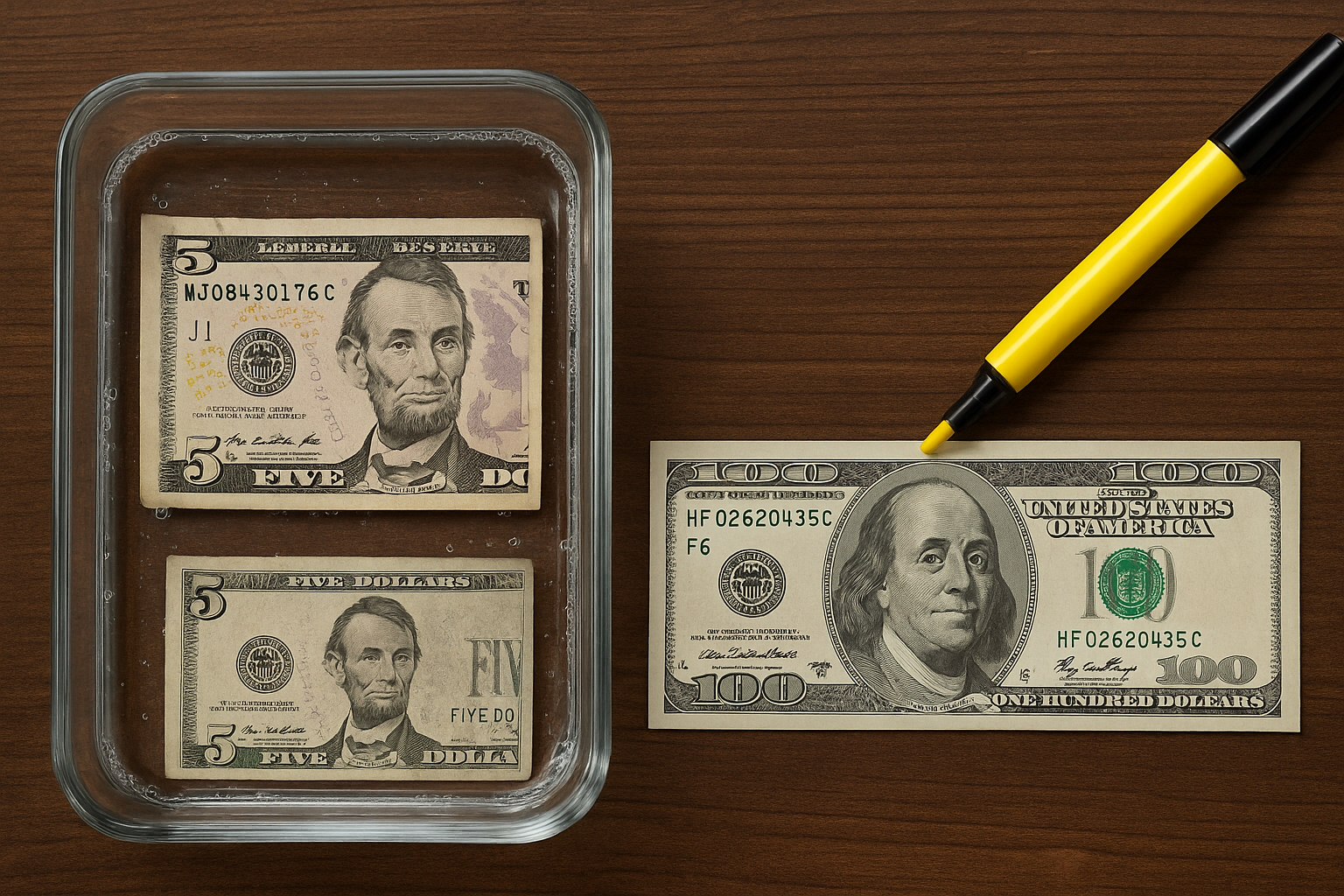
Counterfeit detection pens are not always accurate and may give false results, according to Federal Reserve guidance. The recommended approach involves checking watermarks and security threads, which counterfeiters find difficult to replicate. Pens test paper composition but fail to detect sophisticated counterfeits printed on genuine currency paper or bleached lower-denomination bills reprinted as higher values.
Relying solely on chemical-reaction pens creates false security when line pressure encourages staff to skip additional checks. Multiple authentication methods layered together—visual inspection, tactile feedback, UV features, and automated scanning—provide stronger protection than single-point verification during the holiday rush.
Official Training Materials Improve Staff Readiness
Free U.S. Currency materials include the Cashier Toolkit, Teller Toolkit, Quick Glance Reference Card, Know the $20, and denomination-specific security feature brochures available in multiple languages. Placing a Quick Glance Reference Card or Know the $20 guide near each register gives cashiers immediate visual confirmation tools without requiring manager assistance.
Running a 15-minute training session using official currency guides one week before Black Friday establishes consistent procedures across all staff. Reviewing $20, $50, and $100 note features before the rush reduces hesitation during live transactions.
Stores Verify Currency and Identity Documents at Predefined Checkout Triggers
Stores should verify currency and documents when transaction characteristics trigger predefined risk thresholds rather than relying on cashier intuition alone. ID check scenarios extend beyond age-restricted purchases to include buy-online-pickup-in-store orders, returns without receipts, high-value pickups, financing applications, and account changes requiring positive identity confirmation.
Deciding before opening which denominations require extra checks prevents real-time decision paralysis when lines are long. Predefining which cases require UV or automatic verification creates consistent standards that reduce reliance on individual judgment during peak hours.
Certain Denominations and Document Types Require Extra Scrutiny
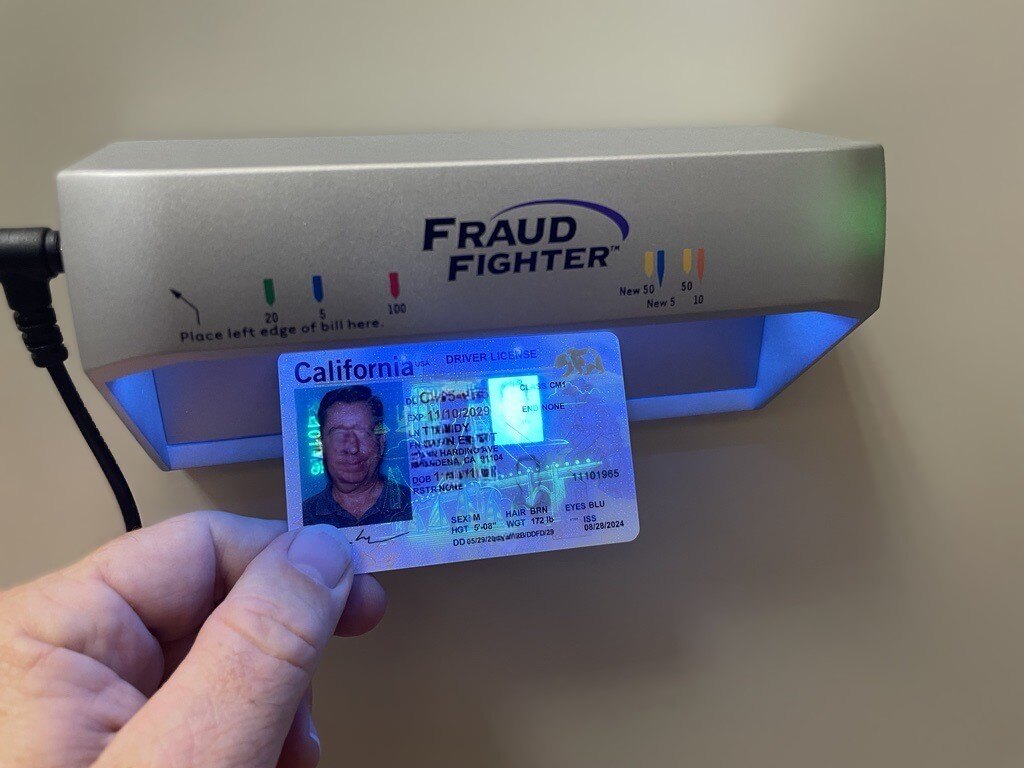
UV detectors validate multiple document types beyond currency, including credit cards, driver's licenses, traveler's checks, money orders, passports, and Social Security cards. Store managers should decide before doors open which denominations and ID scenarios warrant additional authentication steps.
Predefining suspicious cases that require UV examination or automatic verification removes ambiguity from checkout procedures. Using UV counterfeit detectors for predefined transaction types ensures consistent application of security protocols across all registers and shifts.
Fake IDs and Altered Payment Documents Require Calm Escalation
Knowingly passing counterfeit currency is illegal, placing both the customer and the store in a difficult position. Store managers should show staff how to escalate suspicious documents without directly accusing customers of intentional fraud, preserving relationships while protecting the business.
Rehearsing neutral escalation language helps staff respond calmly: "I need my manager to verify this quickly" avoids confrontation while initiating proper review. Training employees to verify the document rather than the person reduces tension and maintains professional customer interactions even when fake IDs or altered payment instruments are presented.
Counterfeit Detection Tools Match Store Lanes and Transaction Volumes
Counterfeit detection tools should match lane characteristics, with manual UV devices serving lower-volume checkpoints and automatic authenticators handling high-speed cash lanes.
Using appropriate counterfeit detectors for each lane type balances cost against detection reliability and checkout speed. Stores with diverse lane formats benefit from tiered equipment strategies rather than uniform deployment across all registers.
Manual UV Detection Fits Lower-Volume Lanes
UV detectors provide low-cost frontline defense against counterfeit fraud when deployed in appropriate environments. FraudFighter recommends using UV devices in dark or dimly lit settings because ambient light reduces UV feature visibility. Manual UV checks work well at service desks, return counters, or lower-volume lanes where transaction pace allows time for deliberate inspection.
The UV-4 depends on ambient light conditions and performs most effectively in dark or dimly lit environments where fluorescent security features stand out clearly. Manual UV device effectiveness depends on staff training and visibility, requiring consistent technique to catch sophisticated counterfeits.
Automatic Banknote Authentication Fits High-Volume Cash Lanes
The CT-600 uses infrared, magnetic, optical, spectrum, and paper quality assessment combined with thickness authentication for comprehensive verification. Automatic detection becomes necessary for high-volume or cash-heavy lanes where checkout speed cannot accommodate manual inspection delays. Selecting the right counterfeit money detector depends on balancing authentication depth against transaction throughput across cash-heavy retail and hospitality environments.
A reliable money scanner maintains line speed while performing multiple authentication checks simultaneously. Automatic money detector technology removes human judgment variability, particularly valuable during peak hours when fatigue reduces manual inspection consistency.
ID Authentication Scanning Depends on Equipment Placement
Keeping a money detector or ID scanner within reach ensures cashiers do not have to leave registers during verification, since checks get skipped when lines extend. The ID-150 becomes valuable in age-restricted retail, vehicle rentals, hotel check-ins, and financial-service locations where identity confirmation drives compliance.
Implementation success depends on placing equipment within arm's reach of the transaction point. Physical accessibility determines whether protocols are followed consistently or abandoned under pressure, making equipment positioning as important as equipment selection.
Store Managers Maintain Checkout Speed With a Two-Step Escalation Process
Store managers maintain checkout speed by using a two-step escalation process where cashiers check obvious features and managers handle suspect documents. A verification process that adds excessive friction will be bypassed when holiday crowds create pressure to keep transactions moving regardless of policy.
Practical counterfeit fraud prevention balances loss protection against operational flow by standardizing which checks happen at which points. Clear protocols prevent both under-checking that exposes the store and over-checking that creates customer frustration during peak hours.
Escalation Scripts Help Manage Suspicious Transactions Calmly
Using a two-step process allows cashiers to check obvious security features while managers handle suspect documents requiring deeper review. Keeping one manager or lead assigned to lane support during peak hours ensures immediate assistance when unusual bills or identity documents appear. Staff trained to use neutral escalation language maintain customer relationships while protecting the business.
A process that introduces excessive friction will be bypassed when checkout lines extend beyond visible range. Rehearsing calm escalation phrases before Black Friday reduces hesitation when real suspicious transactions occur during the busiest shopping hours.
Staff Document and Report Suspicious Activity Consistently
Staff should document incidents consistently using predefined forms or digital logs that capture transaction details without disrupting checkout flow. Recording denomination, serial number, transaction time, register number, and staff initials creates an audit trail that helps identify patterns if multiple suspicious incidents occur during the same shift. Consistent documentation transforms individual suspicious events into analyzable data.
Documentation procedures should take less than 60 seconds to complete after the transaction concludes. Overly complex reporting requirements encourage staff to skip documentation entirely when holiday volume creates competing time pressures.
Stores Calculate ROI on Counterfeit Prevention Equipment and Training
Stores calculate ROI by comparing equipment and training costs against avoided losses from prevented counterfeit acceptance during peak sales periods, strengthening payment-fraud operations well beyond the holiday season. ROI varies significantly by store traffic patterns, cash transaction share, average ticket size, and fraud exposure history rather than following a single industry average. No reliable public data provides a universal Black Friday counterfeit loss figure, so calculations should stay location-specific.
Break-even analysis shows how many prevented incidents justify equipment investment before net savings begin. Stores operating in retail environments with higher cash volume reach positive ROI faster than predominantly card-based operations, making equipment selection dependent on payment-mix analysis.
Avoided Loss Estimates Depend on Store-Specific Assumptions
Three example scenarios show how these variables interact:
|
Store Profile |
Avg. Suspicious Transaction |
Monthly Incidents |
Prevention Rate |
Setup Cost |
Break-Even Incidents |
|
Small specialty store |
$75 |
4 |
50% |
$350 |
9.3 |
|
Mid-volume store |
$125 |
10 |
60% |
$650 |
8.7 |
|
High-volume, cash-heavy store |
$50 |
25 |
70% |
$250 |
7.1 |
ROI varies by traffic volume, cash share, ticket size, and fraud exposure, so equipment decisions should rest on a location-specific assessment.
Break-Even Points Show When Equipment Investment Pays Off
Break-even points indicate how many prevented counterfeit incidents must occur before equipment costs are recovered through avoided losses. Stores with higher cash volume and larger average transactions reach break-even faster than predominantly card-based operations. A 7.1-incident break-even means positive ROI after eight prevented incidents, while a 9.3-incident break-even needs higher fraud exposure or a longer amortization period.
Investment interpretation should consider equipment lifespan beyond a single holiday season since authentication devices serve year-round fraud prevention. Multi-year ROI calculations show equipment paying for itself within two holiday seasons continues generating value for several additional years without additional capital outlay.
Closing Procedures Secure Counterfeit-Sensitive Materials
Sound closing procedures include separating suspect notes and documents from regular deposits to prevent contamination and preserve evidence. Staff should bag, document, and escalate suspect notes separately per store policy at shift end rather than mixing them into cash deposits where they cannot be traced. Suspect notes mixed into deposits create accounting discrepancies and eliminate the ability to analyze counterfeit patterns.
Accountability at shift end depends on clear handoff procedures between outgoing and incoming staff. Written logs showing which register contained suspect currency and which manager took possession establish chain of custody for investigation purposes.
Suspect Notes and Documents Require Separate Handling and Escalation
Bagging, documenting, and escalating suspect notes separately per store policy at shift end maintains chain of custody for investigation. Suspect notes should never be mixed into regular deposits where they become indistinguishable from genuine currency and create irreconcilable cash shortages. Each suspect note requires documentation of the denomination, serial number, register, transaction time, and handling manager.
Physical separation prevents accidental reintroduction into circulation while preserving evidence for law enforcement reporting. Sealed evidence bags with external labeling allow secure storage until proper authorities can examine suspect documents.
Clear Policies Ensure Accountability at Shift End
Policies ensuring accountability include requiring manager sign-off on all suspect document reports before cashiers complete shift-end procedures. Dual verification, where both the discovering cashier and reviewing manager document the incident independently, prevents disputes. Register-specific tracking helps identify whether problems cluster around particular staff, time periods, or transaction types.
Shift-end checklists that explicitly include counterfeit-document review ensure the topic receives attention even during rushed closing procedures. Making suspect-note handling a required checklist item increases compliance when staff is tired after long holiday shifts.
Black Friday Counterfeit Prevention: a Comprehensive Store Manager's Operational Checklist
Store managers preparing for Black Friday and other high-volume sale events should implement a layered verification strategy matching equipment to lane characteristics and transaction volume, as the table below shows.
|
Equipment |
Ideal Lane Type |
Key Capabilities |
|
UV-4 (manual UV check) |
Service desks, return counters, lower-volume lanes |
Ambient-light-dependent fluorescent security-feature detection |
|
CT-600 (automatic authenticator) |
High-volume, cash-heavy lanes |
Infrared, magnetic, optical, spectrum, and paper-quality assessment |
|
ID-150 (identity-document scanner) |
Age-restricted retail, vehicle rentals, BOPIS pickups |
Verifies IDs in seconds for compliance-driven transactions |
Tiered equipment strategies allow budget-conscious deployment where manual UV checks address basic needs, automatic currency authentication protects cash-intensive operations, and ID authentication scanning covers specialized verification requirements. Store managers, district and regional managers, and loss-prevention teams all benefit from matching tool selection to specific operational risks.
Black Friday counterfeit prevention requires practical operational planning rather than complex security theater that staff will bypass under pressure. Store managers who train seasonal employees, predefine which transactions require verification, position equipment within arm's reach, and document suspicious incidents consistently turn fraud prevention into repeatable checkout procedures. These controls protect cash drawers during the year's highest transaction volume without driving customers away or burning out staff.
Protect Your Store This Black Friday with FraudFighter™
Holiday shopping volume does not wait for a training plan to catch up, and neither should your fraud prevention. The right equipment, placed in the right spot, keeps checkout moving while closing the gaps that sale events expose. FraudFighter™ has protected point-of-sale transactions for retailers, banks, and casinos for more than 24 years. To build a layered defense for your store, call 888.664.9214, contact FraudFighter™, or request a quote and our specialists will help you get equipped before the rush begins.
Frequently Asked Questions
Q1. How much does Black Friday counterfeit detection equipment cost for a small store?
A. Entry-level manual UV detectors typically cost under $100, while automatic banknote authenticators such as the CT-600 run several hundred dollars per unit. A single prevented $100 counterfeit bill often covers a UV detector's cost within the first few weeks of use. Location-specific ROI models help determine the right investment level before Black Friday.
Q2. Is it illegal to unknowingly accept counterfeit currency?
A. No, accepting counterfeit currency without knowledge is not a crime, but the loss is still unrecoverable once discovered, since banks will not exchange counterfeit notes for genuine ones. Knowingly passing counterfeit currency after accepting it is illegal and can expose the store to legal liability. Training staff to verify before completing the sale remains the only way to avoid the loss entirely.
Q3. How long does it take to train seasonal staff on counterfeit detection?
A. Most cashiers can learn basic UV detector use and currency security-feature recognition in under 15 minutes using free reference materials from the U.S. Currency Education Program. Automatic detectors such as the CT-600 require even less training since the device performs the verification and displays a pass or fail result. Store managers should schedule a short training session about one week before Black Friday so staff can practice before live transactions begin.
Q4. Do UV counterfeit detectors work in brightly lit stores?
A. UV detectors depend on dim or dark conditions to make fluorescent security features clearly visible, so ambient light can reduce their effectiveness. Stores with bright sales floors should position UV devices at shaded checkout areas or service desks rather than under direct lighting. Automatic authenticators such as the CT-600 fit brightly lit, high-traffic lanes better since they do not rely on visual inspection under low light.
Q5. What should a cashier do after spotting a suspicious bill or ID during Black Friday?
A. Cashiers should pause the transaction and use neutral escalation language, such as asking a manager to verify the item, rather than directly accusing the customer of fraud. The suspect note or document should be set aside from the register drawer and documented with the denomination, serial number, and transaction time. A manager should complete verification and sign off on the incident before the shift ends.