


 11 minute read
Multi-Location Retailer Counterfeit Standardization: Closing Gaps Across Branches
Multi-location retailer counterfeit standardization has moved from a preference to a budget line. Sophisticated forgeries now outpace the detection habits that individual branches built on their own. The global counterfeit money detection market reached USD 4.10 billion in 2025 and is projected to grow at a 5.3% CAGR through 2030, driven by regulatory mandates and "supernotes" produced with AI-driven image processing. Banking and financial institutions hold 55.1% of end-user market share, while retail chains adopt counterfeit detection technology to protect revenue and meet government requirements.
Pressure peaks in Q4, when transaction volumes run 3-5 times the baseline. Nearly 100,000 suspect listings appeared during the 2024 holiday season, and only 31% were removed before reaching consumers. Below, you’ll find the detection technologies chains actually deploy, the governance and training frameworks that make them consistent across sites, a 90-day Q4 readiness plan, and the procurement math behind each decision.
Key Takeaways
- Multi-location retailer counterfeit standardization removes the branch-by-branch gaps that fraudsters map and return to
- Hybrid currency counters hold 39.4% market share, clearing 100-1,500 bills per minute at 99.5%+ accuracy on genuine notes
- UV technology covers 28.6% of the market, verifies a note in 1-5 seconds, and costs USD 20-100 per device
- A 90-day Q4 plan starting September 1 adds 10-20% detection capacity at high-volume locations before peak
- The Federal Reserve recorded a 19% jump in counterfeit incident reports during early 2024, pulling upgrade cycles forward
Multi-Location Retailer Counterfeit Standardization Starts With Five Core Technologies
Retailers select from five technology categories based on transaction volume, staff expertise, and budget. Hardware dominates: currency-detector machines captured 39.4% market share in 2024, while software platforms advanced at 6.5% annual growth. Prices run from USD 20 for a portable UV device to USD 5,000 for an advanced multi-spectral analyzer.
Banking institutions and large chains deploy hybrid counters and multi-spectral systems supporting 100+ currencies with real-time threat database updates. Small convenience stores favor portable UV detectors that need almost no integration work. Transportation ticketing kiosks are the fastest-growing segment at 6.0% annual growth.
|
Technology |
Verification speed |
Accuracy |
Cost per device |
Staff training |
|---|---|---|---|---|
|
Portable UV detector |
1-5 seconds per note |
70-85% against amateur fakes |
USD 20-100 |
15-30 minutes |
|
Hybrid currency counter |
100-1,500 bills per minute |
99.5%+ genuine, 95%+ counterfeit |
USD 300-1,500 |
2-4 hours |
|
Multi-spectral system |
200-500 milliseconds per note |
98-99.5% |
USD 700-2,500 |
4-8 hours |
|
SaaS authentication |
Real time, smartphone camera |
Model dependent, updated in cloud |
USD 50-500 per month per location |
1-2 hours |
|
Blockchain authentication |
Ledger lookup |
Provenance record, not note level |
USD 100,000-500,000+ upfront |
Varies by platform |
Portable UV Detectors Fit Small Stores and Low-Volume Registers
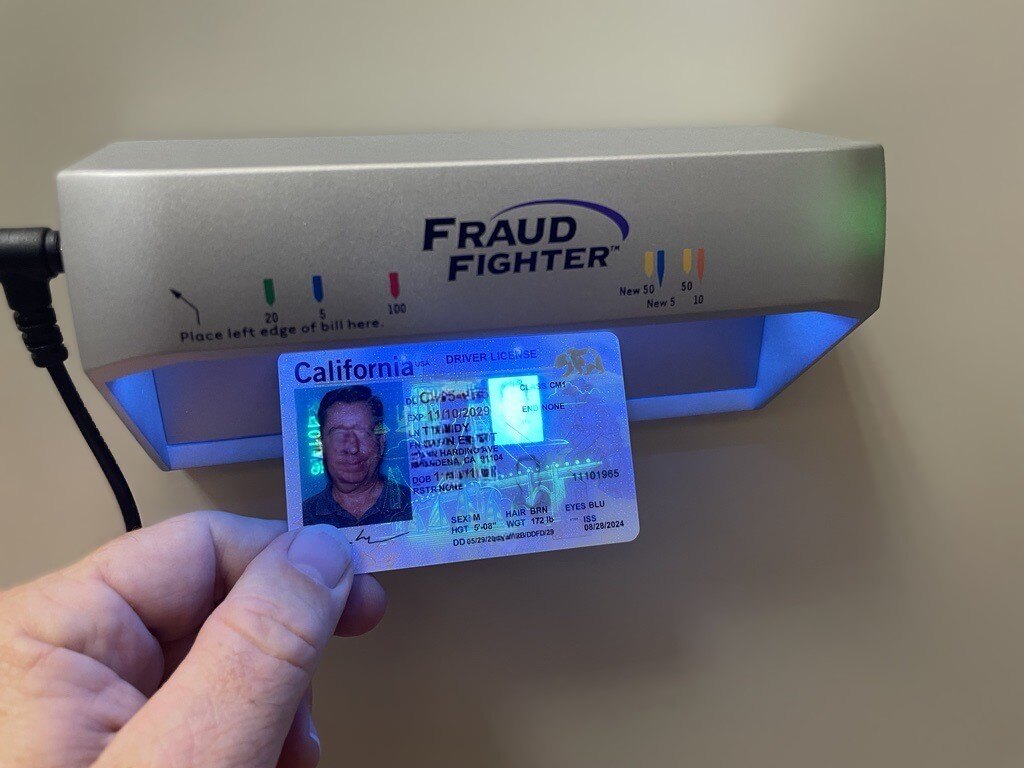
UV detectors use 365-nanometer LED ultraviolet light to reveal the fluorescent security threads and inks embedded in genuine banknotes. They catch amateur counterfeits reliably but have limited effect against multilayer forgeries. The 365nm LEDs deliver a 20,000+ hour lifespan, so there are no bulbs to replace.
UV technology holds 28.6% market share, making it the most deployed detection method across small retailers and hospitality venues. False positives on worn genuine notes are common, so operators still need to know what authentic currency looks like. FraudFighter has designed and manufactured its counterfeit detectors in-house since 2000, with more than 25,000 units installed across US retail, banking, and hospitality sites.
Hybrid Currency Counters Serve Mid-Market Chains
Hybrid currency counters combine bill counting with multi-sensor detection across UV, magnetic, infrared, and color imaging. These money counters read a note and count it in one pass. Magnetic sensor arrays typically use 5-8 heads to read ink patterns, while infrared verification identifies features invisible in the visible spectrum.
A 25-location supermarket chain deploying 40-50 hybrid units invests USD 40,000-75,000 in hardware plus USD 10,000-20,000 for installation. Mid-market retailers reduce cash handling errors by 40% and counterfeit losses by 95% through automated sorting.
Multi-Spectral Systems Support Large Retail Networks
Multi-spectral systems read 8-12 wavelength bands across the UV, infrared, and visible spectrum at once, using convolutional neural networks trained on genuine and counterfeit samples. GPU-accelerated processing handles the analysis in real time while cloud integration delivers algorithm updates as new forgery methods appear.
These detectors support 100+ currencies through firmware updates. Large retail chains deploy 50-100 systems at regional cash-processing centers, investing USD 100,000-500,000 in hardware plus USD 50,000-100,000 for integration. Banking networks reach 99%+ detection with threat intelligence shared through centralized cloud platforms.
Multi-Location Retailer Counterfeit Standardization Now Includes Software and Blockchain Tools
Cloud platforms and distributed ledger technology introduce scalable alternatives to hardware-dependent verification. Software and SaaS platforms advance at 6.5% annual growth while capturing 8-12% market share. Blockchain-based authentication shows 15-20% growth potential in luxury goods and pharmaceutical supply chains that need immutable product journey records.
Subscription pricing lets retailers add authentication without high upfront capital. API integration connects these platforms to retail POS and inventory systems for centralized reporting.
SaaS Platforms Add Cloud Verification Across Locations
SaaS authentication platforms use smartphone cameras and cloud threat databases to verify products and currency in real time. Computer vision algorithms read security features using image recognition trained on millions of samples. Subscription pricing shifts the spend from capital to operating budget.
A 200-location luxury retailer paying USD 200 monthly per store spends USD 48,000 annually plus USD 20,000-50,000 for integration. Threat database updates handle emerging counterfeit variants without hardware replacement.
Blockchain Records Supply Chain Provenance
Blockchain-based authentication writes the product journey from manufacture to retail point-of-sale into an immutable ledger. Distributed ledger technology maintains decentralized authentication records accessible through cryptographic verification. Smart contracts execute self-verifying code at each supply chain step and flag anomalies automatically.
Zero-knowledge proofs enable verification without exposing sensitive supply chain data. Public blockchain platforms and watermark-enabled mobile validation extend the same records to consumer-facing checks. The upfront investment keeps this concentrated in luxury goods and pharmaceutical counterfeiting prevention for now.
Standardization Closes the Branch Gaps Counterfeiters Look For
Distributed networks with inconsistent protocols create exploitable openings. Fraudsters test locations, find the soft ones, and return to them. Centralized policy enforcement sets minimum accuracy thresholds, standard escalation procedures, and uniform compliance documentation. The multi-location retail standardization market, valued at USD 24.97 billion in 2025, reflects how quickly chains are centralizing loss prevention.
U.S. Customs seized 32.0 million counterfeit items in Fiscal Year 2024, with an estimated genuine value of USD 5.4 billion. Retailers operating without standardized counterfeit fraud prevention protocols absorb outsized losses during peak seasons. Regulators expect documented risk assessments backed by audit trails.
Centralized Governance Sets the Minimum Standard
Standardization tools cover inventory, loss prevention, cash handling, and store standardization from a single control point. Retail management software is forecast to reach USD 46.5 billion by 2030 at a 13.2% annual growth rate. Centralized procurement keeps hardware versions consistent, which reduces support fragmentation and earns volume discounts.
Cloud-connected reporting captures counterfeit incidents, false-positive rates, and device performance in live dashboards. Retailers pilot at 5-10 representative locations before full rollout. Disneyland reported that counterfeit activity was almost eliminated park-wide once merchandise locations ran one consistent protocol.
Training and Compliance Reporting Follow One Curriculum
Hybrid counters require 2-4 hours of training covering operation, security feature recognition, and escalation. Advanced systems require 4-8 hours, including calibration and algorithm updates. Video modules and laminated reference cards keep onboarding fast in stores with high turnover.
Annual refresher training and competency assessments hold proficiency steady across branches. The Reserve Bank of India requires quarterly calibration of note-sorting machines against defined soil, limpness, and tear parameters. Cash-handling records tie back to customer identification program requirements at financial institutions.
Q4 Holiday Surge Preparation Runs on a 90-Day Cycle
A 90-day Q4 plan starting September 1 addresses the transaction volumes and counterfeit supply that arrive with the holidays. Retailers increase detection capacity by 10-20% at high-volume locations through additional devices and extended operating hours.
|
Phase |
Window |
Work |
|---|---|---|
|
1. Assessment and planning |
September 1-15 |
Current capability audit, holiday volume forecast, gap list by location |
|
2. Equipment and infrastructure |
September 16 - October 15 |
Device procurement, preventive maintenance, POS integration checks |
|
3. Training and readiness |
October 16 - November 15 |
Mandatory cashier training, mock counterfeit incident drills |
|
4. Peak season execution |
November 16 - December 31 |
Real-time monitoring dashboards, daily escalation review |
Store Format and Customer Profile Drive Technology Adoption
Store type and customer behavior drive technology selection across convenience stores, mid-market chains, and enterprise networks. Michigan State University research found that 70% of consumers have been deceived into purchasing counterfeit products online. Urban consumers aged 18-34 respond well to smartphone-based authentication and QR code verification.
Banking and financial institutions hold 55.1% of end-user market share and need mixed-denomination authentication. Hardware still dominates, with direct OEM sales at 66.7% of 2024 revenue.
Detection Methods Aligned to Store Type
Convenience stores with high turnover and limited technical staff favor portable UV detectors. Grocery and supermarket chains with 10-50 locations deploy hybrid counters at high-volume lanes while keeping UV detectors at standard registers. Large chains run multi-spectral systems at regional processing centers with centralized cloud reporting.
Fare collection and casino floors need throughput above 1,000 notes per minute, which points to high-speed hybrid counters or multi-spectral analyzers. Banking networks prioritize accuracy over cost, while retail chains balance detection performance against training load.
Operational Priorities Shape Procurement Decisions
Cash volumes decline in developed economies as payments shift to cards and wallets, which constrains long-term growth. Holiday volumes still run 3-5 times baseline and create surge capacity requirements. The Federal Reserve recorded a 19% jump in counterfeit incident reports during early 2024, accelerating upgrade cycles.
Retailers negotiate multi-year contracts securing volume discounts and performance guarantees, then run pilot deployments at representative locations to test workflow impact before rollout. Procurement evaluation frameworks assign measurable weight to each criterion.
|
Criterion |
Weight |
What it measures |
|---|---|---|
|
Detection accuracy |
30% |
False negatives on counterfeits, false positives on worn genuine notes |
|
Throughput |
20% |
Notes per minute measured against peak lane volume |
|
POS-ERP integration |
18% |
API fit with existing systems and centralized reporting |
|
Ease of use |
14% |
Training hours and error rate for new hires |
|
Total cost |
12% |
Hardware, integration, and maintenance across the refresh cycle |
|
Service coverage |
6% |
Response times and spare part availability |
Procurement and Total Cost of Ownership: Decide Long-Term Value
Refresh cycles, maintenance, and integration complexity drive total cost of ownership more than sticker price. Counterfeit solutions for business must demonstrate quantifiable ROI through loss prevention and compliance protection. A Wells Fargo 30-day trial of 100 UV units, one per location, prevented almost USD 200,000 in fraud, a return above 2,000% in a single month. Our retail fraud prevention case study documents the same pattern across store networks.
|
Deployment |
Hardware |
Integration and training |
Ongoing |
|---|---|---|---|
|
25-location supermarket chain, hybrid counters |
USD 40,000-75,000 |
USD 10,000-20,000 |
USD 5,000-10,000 per year maintenance |
|
200-location retailer, SaaS authentication |
None |
USD 20,000-50,000 |
USD 48,000 per year subscription |
|
500-location chain, multi-spectral at regional centers |
USD 100,000-500,000 |
USD 50,000-100,000 |
USD 20,000-50,000 per year platform and support |
Evaluation Criteria for Multi-Location Retail
A 5-7 year refresh cycle for advanced systems and a 7-10 year cycle for hybrid counters put lifecycle planning in the capital budget. Preventive maintenance on every device before peak season protects uptime when it matters.
Contact Image Sensor (CIS) or CCD cameras support high-speed verification above 1,000 notes per minute. Magnetic sensor arrays with 5-8 heads read security ink patterns across currency types. Support for 100+ currencies through firmware updates reduces obsolescence risk.
Pricing Models and Integration Costs Shape Buyer Decisions
Installation and training add USD 10,000-20,000 to a mid-market hybrid counter rollout, covering device setup, POS integration, and staff onboarding. Enterprise integration adds USD 50,000-100,000 for API development and technical staff certification.
Buyers weigh recurring subscription cost against a hardware refresh they would otherwise fund every 5-7 years. Both models need a documented ROI case before finance signs.
Competitive Dynamics and Regulatory Mandates Shape the Market
Established hardware manufacturers compete with emerging software platforms and blockchain-based authentication providers. Direct OEM sales capture 66.7% of 2024 revenue through relationship-driven selling. Online marketplaces grow at 7.2% annually, which lets small retailers source plug-and-play devices.
Regulation sets the floor. Retailers maintain audit trails demonstrating compliance with regional rules, including FACTA Red Flag Rules for credit-issuing businesses.
|
Authority or rule |
Requirement |
|---|---|
|
U.S. Treasury Order 101-17 |
Sub-second authentication of mixed-denomination notes at depository institutions |
|
European Central Bank |
Documented performance tests for euro processing devices against accuracy thresholds |
|
Reserve Bank of India |
Quarterly calibration of note-sorting machines for soil, limpness, and tear parameters |
|
FACTA Red Flag Rules |
Written identity theft prevention program for credit-issuing retailers |
|
Customer Identification Program |
Documented identity verification records at financial institutions |
Future Trends Will Change Detection and Standardization
Artificial intelligence and machine learning move detection from rule-based thresholds to statistical inference across multiple wavelength bands. Machine-vision and AI solutions expand at 5.6% annual growth, addressing sophisticated multilayer forgeries. Quantum-algorithm research funded by the U.S. Department of Homeland Security explores speed improvements for high-volume operations.
Central Bank Digital Currencies (CBDCs) represent programmable money that removes counterfeiting risk through cryptographic verification. Polymer banknote adoption by central banks worldwide requires algorithm updates and hardware recalibration.
AI and Machine Learning Improve Detection Accuracy
Convolutional neural networks trained on genuine and counterfeit samples recognize patterns at the pixel level. Concordia University research showed over 90% accuracy in coin authentication using fuzzy association rule mining. Cloud architecture delivers algorithm updates as forgery techniques change.
Supernotes are sophisticated multilayer forgeries built with AI-driven image processing and commercial inkjet technology to replicate micro-printing. Advanced detection systems employing 8-12 wavelength bands achieve 98-99.5% accuracy against supernotes through multi-layer feature verification.
Emerging Technologies Reshape Retail Counterfeit Prevention
CBDCs remove note-level counterfeiting through cryptographic consensus mechanisms, though physical cash will circulate alongside them for years. Public blockchain platforms record product journeys immutably for supply chain transparency. Watermark-enabled mobile validation allows consumers to authenticate through a smartphone camera.
Brand-protection SaaS monitors marketplaces in real time during peak shopping seasons, according to market surveys of the category. Smart contracts execute self-verifying code at each supply chain step and automate authentication documentation.
Standardization Practices That Close Detection Gaps Across Branches
Multi-location retailers standardize detection through centralized policy, consistent technology architecture, and one training program. Pilot deployments at representative locations test device performance before network rollout.
Technology selection balances detection accuracy, training load, and total cost of ownership. Integration with PCI payment card industry standards keeps fraud prevention consistent across cash and electronic transactions.
FraudFighter has delivered counterfeit prevention across Fortune 500 retail networks since 2000, holds SOC 2 Type II certification under AICPA standards, and supports more than 25,000 installed units. Standardized frameworks combining centralized governance, consistent architecture, and one training curriculum close the vulnerability that inconsistent protocols create.
Standardize Counterfeit Detection Across Every Branch With FraudFighter
You already know which locations worry you. Getting every branch onto the same protocol is the harder part, and it is the part we have handled for banks, casinos, theme parks, and retail chains since 2000. A 30-day trial across a sample of your stores produces the loss-prevention numbers finance needs before a full rollout.
Talk to a FraudFighter specialist about the mix of UV detectors, hybrid counters, and multi-spectral systems your network needs before Q4 volumes arrive. Call 1-800-883-8822, or 626-332-3398 internationally, Monday through Friday, 8:00 AM to 5:00 PM Pacific. You can also contact FraudFighter™ and request more information or request a quote for your locations.
Frequently Asked Questions
Q1. What does counterfeit standardization mean for a multi-location retailer?
A. It means every branch runs the same detection protocol, escalation steps, and documentation, regardless of cash volume or staff experience. Standardization sets a minimum accuracy threshold that applies at a 200-transaction rural store and a 2,000-transaction urban flagship alike. Centralized procurement keeps hardware versions consistent, which keeps support and training simple. Without it, fraudsters test locations until they find the one with no protocol, then return to it.
Q2. How much does it cost to standardize counterfeit detection across 25 stores?
A 25-location chain deploying 40-50 hybrid currency counters invests USD 40,000-75,000 in hardware, plus USD 10,000-20,000 for installation and staff onboarding. Annual maintenance adds USD 5,000-10,000 for calibration, spare parts, and firmware updates. Chains that mix hybrid counters at high-volume lanes with UV detectors at standard registers bring that figure down considerably. A 30-day trial across a sample of locations gives finance the loss-prevention data it needs first.
Q3. When should retailers start preparing for Q4 counterfeit surges?
A. September 1 is the working start date for a 90-day cycle. Assessment and volume forecasting run through September 15, procurement and preventive maintenance to October 15, and cashier training with mock incident drills through November 15. Peak execution starts November 16 with real-time monitoring dashboards. Retailers add 10-20% detection capacity at high-volume locations before volumes reach 3-5 times the baseline.
Q4. Do UV detectors still work against modern counterfeits?
A. UV detectors catch 70-85% of amateur counterfeits in 1-5 seconds and remain the most deployed method at 28.6% market share. They are limited against supernotes, which use AI-driven image processing to replicate micro-printing. Multilayer forgeries call for systems reading 8-12 wavelength bands, which reach 98-99.5% accuracy. Most chains run both: UV at standard registers, automated detection wherever cash concentrates.
Q5. What records do regulators expect from a multi-location retailer?
A. Regulators expect documented counterfeit risk assessments, written escalation procedures, and audit trails showing each verification. Depository institutions authenticate mixed-denomination notes in under a second under U.S. Treasury Order 101-17. Credit-issuing retailers maintain a written identity theft prevention program under FACTA Red Flag Rules. Cloud-connected reporting produces this evidence automatically rather than through spreadsheets assembled after the fact.