

 10 minute read
Money Scanner Vs. UV Light: Which Counterfeit Detector Fits Your Business?
Businesses handling cash transactions face critical decisions when selecting counterfeit detection equipment to protect revenue. The choice between money scanners and UV light detectors affects detection accuracy, processing speed, operational efficiency, and long-term fraud prevention costs. Understanding the technical capabilities and practical limitations of each technology helps organizations match detection tools to their specific transaction volumes, staff expertise, and budget constraints.
The money scanner comparison reveals distinct operational profiles designed for different business environments. Small retail operations typically prioritize affordability and ease of use, making UV light counterfeit detection an attractive entry-level solution. High-volume businesses require automated processing and multi-technology verification systems that integrate with point-of-sale infrastructure while maintaining transaction speed.
Key Takeaways
- UV light detectors verify bills in 2-5 seconds using fluorescent security features, while money scanners combine multiple detection technologies for 95%+ accuracy
- Accepting counterfeit currency costs businesses three times the bill's face value when accounting for operational disruption and resource losses
- High-volume retailers achieve 85-95% adoption rates with automatic counters processing 800-1,500 bills per minute, compared to 50-65% adoption among small businesses
- UV detectors range from $25-$800 and suit low-volume operations, while automatic money scanners cost $300-$2,500+ for high-speed environments
- Regional adoption varies from 75% in North America to 65% in Asia-Pacific, with urban businesses demonstrating 70-80% implementation compared to 40-50% in rural areas
What Are Money Scanners and UV Light Detectors?
Money scanners and UV light detectors represent two primary categories of counterfeit detectors used across retail, banking, and hospitality sectors. UV detectors use ultraviolet light to reveal hidden security features embedded in genuine currency. Money scanners employ multiple verification technologies, including magnetic ink detection, infrared scanning, and dimensional analysis, to authenticate bills automatically.
How Do UV Light Detectors Work?
UV detectors emit ultraviolet light at approximately 365nm wavelength to reveal security features invisible under normal lighting. The technology exposes fluorescent fibers and security threads embedded in authentic banknotes during printing. UV verification typically requires 2-5 seconds per note, making it suitable for moderate transaction volumes where speed remains important but automation is unnecessary.
What Is a Money Scanner and Its Core Technologies?
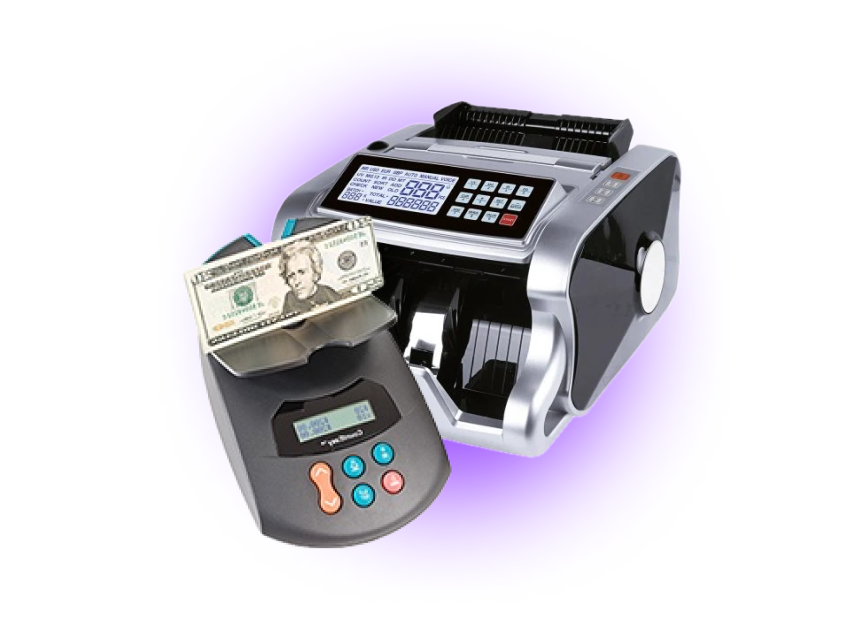
Magnetic ink detectors identify genuine currency by analyzing iron-infused inks distributed in specific patterns across authentic banknotes. These devices measure magnetic field strength and pattern distribution to distinguish real bills from digitally-produced counterfeits. Automatic money counters integrate high-speed counting with multi-technology verification, combining UV, magnetic, infrared, and size detection in single-pass processing.
Detection pens use iodine-based chemical reactions to identify counterfeit money by testing paper composition. The iodine solution reacts with starch present in standard paper, producing a dark mark on counterfeit bills. Magnetic ink detectors analyze both the presence and spatial distribution of magnetic patterns, providing verification independent of visual inspection.
What Features Differentiate These Two Detector Types?
UV detectors rely on single-feature verification, examining only fluorescent elements visible under ultraviolet illumination. Money scanners perform simultaneous multi-point verification across magnetic, infrared, dimensional, and UV spectrums. UV devices require manual interpretation by operators who must recognize authentic security features under UV exposure.
Money scanners provide automated pass/fail determinations without requiring operator expertise in currency authentication. Detection speed varies significantly, with UV verification completing in seconds while automatic scanners process hundreds of bills per minute. Portability and power requirements differ substantially, as UV lights operate on batteries while most money scanners require electrical connections.
Why Is Counterfeit Detection Important for Businesses?
Counterfeit currency acceptance creates direct financial losses and indirect operational costs that multiply the initial impact. Businesses accepting fake bills cannot recover face value and must absorb additional expenses related to the incident investigation. Detection technology serves as a preventative infrastructure protecting revenue while maintaining customer service standards.
What Risks Do Counterfeit Bills Pose?
The soft costs of fraud typically equal more than three times the face value of the fraud itself. Accepting a fake bill generates cascading expenses, including employee time spent on incident reporting, management attention diverted to investigation, and potential law enforcement involvement. Two-thirds of domestically printed counterfeit bills in the U.S. are produced using laser and ink-jet home printer technologies.
This democratization of counterfeiting transforms fraud from organized crime to localized, opportunistic incidents requiring consistent frontline detection. Approximately 67% of counterfeits are produced digitally, creating realistic reproductions that bypass visual inspection by untrained staff. The financial multiplier effect makes prevention through detection equipment significantly more cost-effective than the absorption of fraud losses.
How Does Detection Impact Business Operations?
Detection systems reduce reliance on employee judgment and visual inspection, standardizing verification across all transaction points. Consistent authentication protocols eliminate vulnerabilities created by staff turnover, varying experience levels, and inconsistent training. Automated detection maintains transaction speed while providing reliable verification, preventing workflow disruptions that manual inspection introduces.
Real-time fraud prevention protects customer relationships by avoiding confrontational situations where businesses must refuse suspicious bills without technical verification. Detection equipment provides objective evidence supporting rejection decisions, reducing interpersonal conflict during transactions. Documentation capabilities in advanced systems create audit trails supporting loss prevention analysis and regulatory compliance.
What Are Typical Use Cases by Business Size?
High-volume retail environments exhibit 85-95% adoption rates for automated detection systems integrated with cash handling workflows. These businesses process sufficient transaction volumes to justify equipment investment through measurable fraud prevention. Small businesses demonstrate 50-65% adoption rates, typically implementing portable UV detectors or detection pens offering basic protection.
Mid-sized operations occupy a transitional space where transaction volumes support detection equipment investment but may not require full automation. Regional variations in retail fraud prevention practices influence adoption patterns, with urban businesses facing higher counterfeit exposure. Business size suitability extends beyond employee count to encompass transaction volume, average transaction value, and cash handling frequency.
How Do Money Scanners and UV Lights Compare in Accuracy and Speed?
Accuracy and processing speed represent critical performance dimensions determining detection technology suitability for different operational environments. UV detectors provide reliable verification for common counterfeits but remain vulnerable to sophisticated reproductions incorporating fluorescent elements. Money scanners employ multiple simultaneous verification methods, reducing false acceptance rates through redundant authentication layers.
Which Detector Offers Higher Accuracy?
Automatic money counters process 800-1,500 bills per minute while maintaining 95%+ accuracy through multi-technology verification. These systems combine UV, magnetic, infrared, and dimensional analysis to identify counterfeits that might pass individual verification methods. UV detectors depend on operator skill in recognizing authentic security features under ultraviolet light, introducing human error variables.
Detection accuracy suffers when operators lack training in currency-specific security features or work under time pressure. Money scanners eliminate interpretation requirements by providing automated pass/fail determinations based on multiple simultaneous tests. The feature-by-feature review shows magnetic and infrared detection identify digitally-produced counterfeits that replicate UV-visible security features.
How Does Detection Speed Affect Business Efficiency?
UV verification takes 2-5 seconds per note, making it viable for businesses processing moderate transaction volumes without queue formation. Manual verification speed depends on operator familiarity with security features and confidence in making acceptance decisions. Automatic money scanners process large bill volumes continuously, completing tasks requiring hours of manual verification.
Processing speed directly impacts customer wait times during checkout and influences peak-hour capacity at cash-intensive businesses. High-volume operations benefit from speed advantages that reduce labor costs while maintaining consistent verification standards. Small businesses with intermittent cash transactions achieve adequate fraud protection with slower UV verification methods.
What Are the Challenges in Using Each Technology?
UV detectors remain vulnerable to sophisticated counterfeits using fluorescent inks that mimic genuine security features. These single-method devices rely on manual interpretation, creating consistency problems across different operators and shifts. Detection pens can produce false positives on worn bills where paper degradation alters chemical composition.
UV detectors require operators to recognize authentic security feature appearance under UV illumination, demanding training and experience. Magnetic detectors require calibration for different currencies when businesses accept international payments. Single-technology solutions create exploitable vulnerabilities that sophisticated counterfeiters target through feature replication.
What Are the Cost and Usability Differences?
Total cost of ownership extends beyond purchase price to include maintenance, training, and operational efficiency impacts. UV detectors offer lower entry costs with minimal training requirements, appealing to budget-conscious small businesses. Money scanners represent higher initial investments justified by processing speed improvements and reduced labor requirements in high-volume environments.
How Do Purchase and Maintenance Costs Compare?
UV detectors cost $25-$800 compared to magnetic ink detectors priced at $80-$1,000+, depending on sensitivity and currency compatibility. Automatic counters range from $300-$2,500+ based on processing speed, detection technology integration, and durability specifications. Detection pens represent the most affordable option at $10-$50 but provide limited protection against modern counterfeits.
UV lights priced between $50-$150 suit small businesses needing quick verification without significant capital investment. Money scanners costing $600+ become necessary for high-volume retailers where processing speed and accuracy directly affect profitability. Maintenance requirements differ substantially, with UV devices requiring occasional bulb replacement while automatic counters need regular calibration and cleaning.
What User Skill Levels Are Required?
UV detectors require operators to recognize authentic security features under ultraviolet illumination, demanding initial training and periodic refreshers. Staff must understand which fluorescent elements indicate genuine currency for specific denominations handled. Money scanners eliminate specialized knowledge requirements by providing automated pass/fail determinations without operator interpretation.
Detection pens offer the simplest operation, requiring only marking the bill and observing the color reaction. Training complexity affects businesses with high staff turnover, where repeated instruction increases operational costs. Automatic systems reduce training burden to basic loading procedures and error response protocols.
How Portable and Space-Efficient Are These Devices?
UV detectors provide maximum portability, with handheld models operating on battery power suitable for mobile businesses and outdoor events. These compact devices require minimal counter space and function without electrical infrastructure. Money scanners require dedicated counter space and electrical connections, limiting placement flexibility in retail environments.
Portable UV solutions suit food trucks, farmers' markets, and seasonal businesses where permanent installation remains impractical. Space constraints in small retail environments favor compact UV devices over larger automatic counters. Multi-location businesses balance portability needs against centralized verification points where space accommodates automated equipment.
How Do Business Types Influence Detector Choice?
Transaction volume, average transaction value, and operational environment characteristics determine optimal detection technology selection. Small retail operations with limited cash handling prioritize affordability and portability over processing speed. High-volume businesses require automation to maintain transaction throughput while ensuring consistent verification standards.
What Detectors Suit Small and Mobile Businesses?
Small businesses handling intermittent cash transactions achieve adequate protection with portable UV detectors priced under $150. These operations process transaction volumes where 2-5 second verification per bill maintains acceptable service speeds. Mobile businesses benefit from battery-powered UV devices functioning without an electrical infrastructure at temporary locations.
Detection pens provide baseline protection for businesses with minimal counterfeit exposure, willing to accept limited effectiveness. Compact UV/pen combination devices offer dual verification methods in portable formats suitable for mobile operations. Small businesses need to prioritize low initial cost and zero training requirements over processing speed.
Which Solutions Fit High-Volume Retailers?
High-volume retailers require automatic money counters processing 800-1,500 bills per minute with integrated multi-technology detection. These businesses handle sufficient transaction volumes to justify equipment costs through labor savings and fraud prevention. Automated systems maintain checkout speed during peak periods while ensuring consistent verification across all transactions.
Large retailers benefit from audit trail capabilities documenting all bills processed for loss prevention analysis. Integration with existing point-of-sale and cash management systems streamlines operations and reporting. The decision matrix for fraud tools in high-volume environments prioritizes speed, accuracy, and integration capabilities over initial purchase price.
Are Hybrid or Multi-Technology Devices a Good Middle Ground?
Hybrid systems priced at $200-$500 offer middle-ground solutions for mid-sized retailers seeking enhanced accuracy without full automation. These devices combine UV and magnetic detection in desktop units, providing dual verification methods manually. Multi-technology verification improves counterfeit detection rates compared to single-method UV devices while maintaining lower costs than automatic counters.
Mid-sized businesses operating multiple transaction points benefit from hybrid devices, balancing cost against verification reliability. These solutions suit operations where transaction volumes justify improved detection but automated counting remains unnecessary. Hybrid devices provide upgrade paths as businesses grow and transaction volumes increase.
What Insights Can Be Gleaned from Real-World Business Use?
Implementation case studies demonstrate measurable fraud prevention outcomes and operational efficiency improvements across different business types. Real-world deployments reveal cost-benefit relationships between equipment investment and fraud loss reduction. Industry-specific applications highlight how detection technology selection aligns with operational characteristics and risk exposure.
How Have Retail Chains Benefited from Advanced Detectors?
BrightMart Retail Chain implemented high-speed, multi-test counterfeit detection devices with QR codes linking to online training resources. The integrated training approach reduced counterfeit bill acceptance while improving cashier efficiency without disrupting customer experience. Advanced detection systems proved cost-effective by minimizing training investment while maximizing detection accuracy across multiple locations.
Standardized detection protocols eliminated inconsistency between locations and shifts that created exploitable vulnerabilities. The system's speed maintained checkout efficiency during peak periods while providing comprehensive verification. Multi-location deployments demonstrated the scalability of centralized detection standards supporting growth without proportional fraud risk increases.
What Success Stories Highlight UV Light Use?
A New York City sports bar eliminated over $10,000 in counterfeit losses in the first year using high-powered UV detectors. The fast detection process maintained service speed during crowded events without slowing bartender workflow. UV technology proved ideal for low-light, fast-paced environments where manual inspection remains impractical.
The venue prevented dozens of fraudulent transactions while maintaining customer service standards during high-volume periods. Battery-powered UV devices provided verification flexibility at multiple service points without electrical infrastructure requirements. Simple operation allowed rapid staff training despite high turnover in hospitality environments.
How Do Portable Detectors Serve Mobile Enterprises?
A mobile food truck saved over $2,000 in fake currency losses within six months using compact, battery-powered dual detectors. The portable UV/pen combination provided instant bill verification before providing change to customers. Lack of electrical outlet dependence made the solution perfect for mobile operations and outdoor events.
Lightweight detection equipment integrated seamlessly into limited workspace environments characteristic of mobile businesses. Quick verification maintained service speed during peak meal periods when customer queues formed. The investment paid for itself within months through direct fraud prevention and improved operator confidence.
What Factors Should Guide Your Detector Purchase Decision?
Equipment selection requires balancing accuracy requirements, processing speed needs, budget constraints, and operational environment characteristics. Priority weighting differs across business types based on transaction volumes, staff capabilities, and fraud exposure levels. Systematic evaluation of performance dimensions ensures technology alignment with specific operational requirements.
How Do Accuracy, Speed, and Cost Prioritize Your Needs?
Accuracy and reliability influence 30% of purchasing decisions among businesses implementing detection technology. Speed of detection affects 24% of purchase decisions, particularly in high-volume retail environments, prioritizing checkout efficiency. Cost and return on investment considerations drive 16% of purchasing decisions, especially among small businesses with limited capital budgets.
Ease of use influences 20% of purchasing decisions, where staff training costs and turnover rates affect operational efficiency. Priority weighting shifts based on business size, with small operations emphasizing cost while large retailers prioritize speed. The decision matrix for fraud tools must account for both immediate needs and future growth trajectories.
What Are the Trade-offs Between Manual and Automatic Detection?
Manual UV detection provides lower initial costs but requires operator training and introduces human error variables. Automatic systems eliminate interpretation requirements while demanding higher capital investment and dedicated counter space. Manual methods suit low-volume operations where processing speed remains secondary to equipment affordability.
Automatic detection maintains consistent standards across shifts and employees, eliminating performance variation from manual verification. Labor cost reduction in high-volume environments often justifies automatic equipment investment within months. Manual devices retain advantages in portability and operational flexibility for businesses with variable transaction locations.
How Does Regional and Demographic Context Affect Choice?
North America demonstrates 75% adoption rates among cash-handling businesses, driven by mature retail infrastructure and fraud awareness. Europe shows 70% adoption, while the Asia-Pacific region maintains 65% implementation rates with rapid growth trajectories. Urban areas demonstrate 70-80% adoption rates compared to 40-50% in rural areas, where transaction volumes remain lower.
Regional counterfeiting patterns influence technology selection, with some areas experiencing higher sophisticated counterfeit prevalence. Demographic factors, including average transaction values and cash usage frequency, affect detection technology justification. Local regulatory requirements may mandate specific detection capabilities in certain industries.
Choosing Between Money Scanners and UV Light Detectors for Your Business
Selecting appropriate counterfeit detection technology requires matching equipment capabilities to specific operational requirements and fraud risk exposure. Small businesses with limited transaction volumes achieve adequate protection with UV detectors offering affordability and portability. High-volume retailers require automated counterfeit detectors that maintain processing speed while providing multi-technology verification.
The optimal solution balances initial investment against long-term fraud prevention and operational efficiency gains. Businesses should evaluate transaction volumes, average bill values, staff training capabilities, and available counter space when selecting equipment. Implementation of appropriate detection technology protects revenue, maintains customer service standards, and reduces reliance on employee judgment in currency authentication.
Organizations implementing counterfeit detection systems like those offered by FraudFighter benefit from decades of specialized fraud prevention expertise and quantified loss reduction outcomes. The investment in appropriate detection technology typically achieves return on investment within months through direct fraud prevention and operational efficiency improvements. Systematic equipment selection ensures sustainable fraud protection that scales with business growth and adapts to evolving counterfeiting methods.
Find the Right Counterfeit Detector for Your Business
Whether you process dozens of cash transactions a day or thousands, choosing the correct detection technology protects your revenue, your staff, and your customers. FraudFighter has helped retailers, banks, casinos, and hospitality groups select and deploy counterfeit detection solutions for more than 25 years — from compact UV detectors for mobile vendors and small retailers to automatic money scanners built for high-volume environments.
To protect your business, contact FraudFighter for a free consultation and a product recommendation matched to your transaction volume and operational requirements. If verifying customers is part of the picture too, our purpose-built id scanner solutions read and authenticate a license in seconds at the counter, so the person presenting it gets checked as closely as the cash.