

 11 minute read
How Do Money Detectors Stop Fake Bills Before They Hit the Deposit?
Money detectors identify counterfeit currency by verifying security features embedded in genuine bills before cash reaches the bank deposit. Detection systems prevent businesses from absorbing unrecoverable losses when banks reject fake bills during processing. The counterfeit money detection market reached USD 4.10 billion in 2025 as fraud incidents increased 19% in early 2024.
Businesses implement counterfeit detection systems to protect against financial losses averaging $254,445 per fraud incident for small and medium-sized businesses. Every dollar lost to fraud costs U.S. retailers $4.61 in total expenses. Detection technologies range from $5 chemical pens to $5,000+ automated counters, depending on transaction volume and accuracy requirements.
Key Takeaways
- Money detectors use UV, magnetic, and infrared technologies to verify currency security features before deposit
- Counterfeit detection delivers 229% ROI by preventing fraud losses that cost businesses $4.61 per dollar lost
- Detector pens cost $5-$50 while high-speed counters range from $1,500-$5,000+ depending on volume needs
- AI-based detection systems reduce false positives by over 80% through continuous machine learning
- Businesses must match detector type to transaction volume and staff training capacity for effective fraud prevention
What Are Money Detectors and How Do They Work?
Money detectors are specialized devices that verify currency authenticity by examining security features before bills enter the deposit. These systems scan for watermarks, security threads, color-shifting ink, and magnetic properties that counterfeiters cannot replicate. Detection occurs in seconds, allowing businesses to reject fake bills at the point of transaction rather than discovering losses after bank processing.
Modern counterfeit detectors combine multiple verification methods to reduce false positives and false negatives. Multi-spectral devices check UV patterns, magnetic ink distribution, and infrared properties simultaneously to confirm authenticity. This layered approach increases detection accuracy beyond 99% while processing up to 1,300 bills per minute.
What Technologies Are Used in Money Detectors?
Detector pens utilize a chemical iodine solution that reacts with starch in standard paper. The solution leaves a dark mark on counterfeits while remaining clear or amber on genuine currency paper manufactured without starch. UV scanners use ultraviolet light to verify security features invisible under normal lighting.
Multi-spectral analysis combines Ultraviolet, Magnetic Ink, and Infrared technologies to verify multiple security features simultaneously. Currency counters with integrated detection combine rapid counting with advanced multi-spectral scanning and image processing. Software platforms utilize machine learning and cloud-based algorithms for real-time anomaly detection and predictive analytics.
What Security Features Do Money Detectors Verify?
Money detectors examine watermarks that appear when bills are held against the light. Security threads embedded in currency contain microprinting visible only under magnification or UV light. Color-shifting ink changes appearance when the bills are tilted at different angles.
Magnetic ink detection identifies patterns printed using magnetized materials specific to genuine currency. Infrared scanning reveals security features that reflect or absorb infrared light differently from visible light. Multi-spectral devices verify all these features in under two seconds per bill.
What Types of Money Detectors Exist?
Currency counters with integrated detection represent 39.4% of the market segment for high-volume banking operations. UV scanners represent 28.6% of the market segment, favored by small and medium retailers. Software platforms are growing at 6.5% CAGR as businesses adopt data-driven fraud prevention strategies.
The global counterfeit money detection market was valued at USD 4.10 billion in 2025, with projections to reach USD 5.31 billion by 2030, driven by regulatory requirements and rising fraud incidents.
Why Is Detecting Counterfeit Bills Important for Businesses?
Detecting counterfeit bills prevents unrecoverable financial losses when banks reject fake currency during deposit processing. Businesses cannot retrieve funds from the payer after accepting counterfeits, making prevention the only defense. Fraud incidents create operational disruptions requiring staff time for investigation and reporting beyond direct monetary loss.
Cash deposit security becomes critical as 66% of consumers lose trust in brands after counterfeit incidents. Reputational damage affects long-term revenue as 76% of customers become less likely to buy from brands associated with counterfeit goods. Businesses face regulatory scrutiny and potential compliance violations when counterfeit acceptance patterns suggest inadequate fraud prevention controls.
What Are the Financial and Reputational Risks of Counterfeiting?
The average cost of fraud for SMBs reaches $254,445 per incident, including direct losses and remediation expenses. Every $1 lost to fraud costs U.S. retailers $4.61 in total costs. An estimated USD 70-200 million in forged U.S. notes remain in circulation, creating ongoing exposure for cash-handling businesses.
Consumer trust erosion occurs when 66% of consumers lose confidence in brands after counterfeit incidents. Brand avoidance increases as 76% of affected customers reduce purchases from companies associated with counterfeits.
How Does Counterfeit Detection Impact Business Operations?
Counterfeit incident reports increased 19% in early 2024, requiring businesses to allocate resources for investigation. Operational disruption occurs when staff must process fraud reports, contact authorities, and implement corrective measures. Customer remediation costs accumulate when businesses must refund legitimate customers affected by fraud-related delays.
Businesses implement counterfeit fraud prevention protocols to maintain operational continuity and preserve customer trust. Detection systems reduce the training burden required for staff to identify sophisticated counterfeits manually.
What Is the Return on Investment for Money Detectors?
Enterprise retail fraud prevention achieved 229% ROI by reducing false positives and chargebacks through AI-powered detection. A small retail store invested $200 in UV detectors and prevented $400-$1,200 monthly losses from counterfeit acceptance, delivering 12-72x annual ROI by eliminating unrecoverable losses at the point of sale.
A regional bank's $10,000 investment in high-speed counters yielded over 300% annual ROI through labor reduction. Processing speed increased from 200 to 1,300 bills per minute across five branches, reducing manual labor costs by 85% while achieving 100% regulatory compliance and preventing deposit-handling fraud failures.
How Do Different Money Detection Technologies Compare?
Detection technologies vary in price, accuracy, speed, and operational requirements based on business needs. Portable detector pens serve micro-businesses with minimal cash volume, while enterprise counters process thousands of bills hourly. Technology selection depends on transaction volume, staff training capacity, and accuracy requirements.
Desktop UV detectors balance affordability with accuracy for small to medium retailers handling moderate cash volumes. High-speed money counters with multi-spectral detection serve banks and large retailers requiring automated verification. Software platforms provide scalability and data analytics for multi-location operations requiring centralized fraud monitoring.
How Do Portable Detector Pens Function?
Detector pens use chemical iodine solutions to identify non-genuine currency paper through starch detection. These devices cost $5-$50 per unit, making them accessible for micro-businesses with limited budgets. Detection accuracy exceeds 99% for traditional counterfeits but remains less effective against bleached bills reused for counterfeiting.
The manual process requires staff to mark each bill individually, limiting throughput for high-volume operations. Detector pens authenticate only paper composition without verifying security threads, watermarks, or magnetic ink. Speed constraints make pens suitable only for businesses processing fewer than 50 bills daily.
How Do Desktop UV and Multi-Spectral Detectors Operate?
Desktop UV detectors range from $100-$800 per unit, depending on multi-spectral capabilities and build quality. These devices achieve 99%+ accuracy when combining UV, magnetic, and infrared verification technologies. Processing speed reaches 0.5-2 seconds per note, enabling verification during customer transactions without significant delays.
Desktop detectors require moderate counter space and electrical connections for continuous operation. The devices support multiple currency types, making them suitable for businesses serving international customers. Operational cash control improves as staff can verify bills immediately rather than discovering counterfeits during bank deposits.
How Do High-Speed Currency Counters with Detection Work?
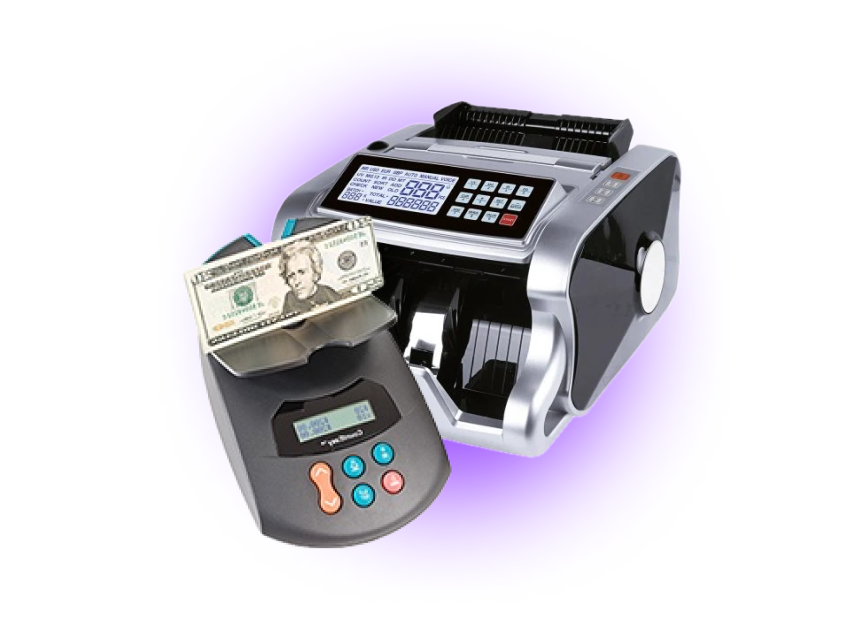
High-speed currency counters cost $1,500-$5,000+ per unit, depending on detection capabilities and throughput capacity. These systems process up to 1,300 bills per minute with integrated multi-spectral counterfeit verification, increasing processing speed while maintaining accuracy rates exceeding 99%.
Capital costs limit adoption to high-volume operations like banks and large retail chains. Regular maintenance and trained operators are required to maintain accuracy and prevent mechanical failures. The money detector workflow automates verification, counting, and sorting functions to streamline cash handling operations.
When Should Businesses Choose Software or AI-Based Detection Solutions?
Software solutions suit multi-location operations requiring centralized fraud monitoring and data analytics capabilities. Cloud-based platforms enable real-time anomaly detection across distributed locations, identifying fraud patterns invisible to individual sites. AI systems continuously improve detection accuracy through machine learning algorithms that adapt to emerging counterfeit techniques.
Subscription-based pricing reduces capital expenditure compared to purchasing hardware for every location. Businesses prioritizing scalability and integration with existing point-of-sale systems benefit from software platforms. However, internet connectivity requirements limit effectiveness in areas with unreliable network infrastructure.
What Are the Benefits of Software/SaaS Platforms?
Software platforms cost $50-$500 monthly per subscription, depending on features and user licenses. Detection accuracy starts at 90% with continuous learning improvements as algorithms process more transaction data. Subscription pricing eliminates large upfront capital costs, making advanced detection accessible to growing businesses.
Cloud-based systems provide real-time fraud alerts across multiple locations, enabling immediate response to counterfeit attempts. Data analytics capabilities identify fraud patterns and high-risk transaction types, improving fraud prevention strategies. Integration with existing point-of-sale systems streamlines the pre-deposit counterfeit check process without disrupting customer experience.
How Do AI and Machine Learning Enhance Counterfeit Detection?
AI systems reduce false positives by over 80% compared to rule-based detection methods. Machine learning algorithms analyze thousands of data points per transaction, identifying subtle anomalies that human inspectors miss. Continuous learning enables systems to detect emerging counterfeit techniques before they become widespread.
Pattern recognition capabilities identify coordinated fraud attempts across multiple locations targeting the same business. Predictive analytics forecast high-risk periods and locations, enabling proactive staff training and resource allocation.
What Are the Limitations of Software Solutions?
Software solutions require internet connectivity, making them unsuitable for locations with unreliable network infrastructure. Ongoing subscription costs accumulate over time, potentially exceeding the total cost of hardware ownership. System effectiveness depends on data quality, requiring accurate transaction recording and regular validation.
Implementation complexity increases when integrating with legacy point-of-sale systems lacking modern APIs. Staff training requirements grow as interfaces become more sophisticated than simple hardware devices. Businesses must evaluate the total cost of ownership, including subscription fees, integration costs, and training expenses.
How Do Consumer Preferences and Business Size Influence Detector Choice?
Accuracy and reliability drive 35% of purchasing decisions, as ineffective systems create false confidence and missed counterfeits. Cost and ROI considerations represent 25% of decision factors, particularly for small businesses with limited budgets. Ease of use accounts for 20% of priorities, as complex systems lead to user error in high-turnover environments.
Speed and throughput requirements represent 12% of purchasing criteria for high-volume operations processing thousands of bills daily. Support and maintenance considerations comprise 8% of decision factors valued by enterprise clients requiring guaranteed uptime. A comprehensive counterfeit detector buyer’s guide helps businesses match technology to operational requirements.
What Factors Drive Purchasing Decisions for Money Detectors?
Decision priorities rank as Accuracy/Reliability (35%), Cost/ROI (25%), Ease of Use (20%), Speed/Throughput (12%), and Support/Maintenance (8%). Hardware device buyers prioritize accuracy over cost, with 85% refusing to sacrifice detection effectiveness for savings. Software solution purchasers focus on ease of integration, with 70% prioritizing seamless deployment.
Budget-conscious buyers accept reduced accuracy as 45% sacrifice some detection effectiveness for significant cost savings. Enterprise buyers require compliance certifications, with 90% demanding documented regulatory alignment and audit trails.
How Do Preferences Vary Between Micro, Small, Medium, and Enterprise Businesses?
Micro businesses with 1-10 employees show 15-25% adoption rates with annual spending of $50-$300 on basic detection tools. Small businesses demonstrate 35-50% adoption, investing $300-$1,500 in desktop UV and magnetic ink detectors. Medium-sized operations achieve 60-75% adoption rates, spending $1,500-$5,000 on high-speed counters with integrated detection.
Enterprise organizations maintain 85%+ adoption rates with annual spending exceeding $5,000-$50,000 for comprehensive fraud prevention systems. Budget constraints drive micro-business choices while medium enterprises prioritize throughput and data capabilities. Enterprise buyers focus on compliance, multi-location standardization, and centralized reporting accessible through user guides and training resources.
How Do Regional and Demographic Differences Affect Detection Needs?
North American markets represent 38.5% market share, driven by regulatory compliance requirements and advanced technology adoption. The Asia-Pacific region experiences 6.9% CAGR growth fueled by retail modernization and cash-heavy economies. Cash accounted for 14% of all consumer payments in 2024, sustaining demand for physical currency authentication.
Baby Boomers use cash for 28-35% of transactions, creating higher counterfeit exposure for businesses serving older demographics. Rural areas maintain 9.2% unbanked rates compared to 5.7% in urban areas, driving sustained cash usage. Regional differences affect technology adoption as rural areas prefer simple, low-cost solutions while urban centers adopt integrated systems.
What Are the Best Practices for Implementing Money Detectors in Various Settings?
Implementation strategies must match detector complexity to staff training capacity and transaction volume patterns. Businesses should establish verification protocols requiring consistent application regardless of customer demographics or transaction size. Regular staff training sessions maintain detection effectiveness as employee turnover reaches 70% annually in retail environments.
Verification procedures should integrate seamlessly into existing transaction workflows, minimizing customer wait times while balancing fraud prevention effectiveness against customer experience. Testing procedures should verify detector functionality before each shift, ensuring equipment remains calibrated and operational.
How Should Micro and Small Businesses Deploy Detectors?
Micro-businesses should implement detector pens immediately as the $5-$50 investment delivers 300-1,200% annual ROI through loss prevention. Staff training requires five minutes of demonstrating pen application and result interpretation. Small to medium retailers should invest in desktop UV and magnetic ink detectors costing $100-$800 for comprehensive verification.
Installation at point-of-sale terminals enables real-time verification during customer transactions without creating separate inspection steps. Businesses should verify high-denomination bills and suspicious currency while balancing customer service considerations.
What Are Recommended Strategies for High-Volume Banks and Retailers?
High-volume operations should deploy high-speed counters with multi-spectral detection processing 1,300+ bills per minute. Dedicated verification stations separate cash counting from customer-facing transactions, maintaining service speed while ensuring thorough verification. Back-office processing eliminates customer wait times while achieving 99%+ detection accuracy.
Regular calibration schedules maintain detector accuracy, preventing drift that creates false positives or missed counterfeits. Businesses should establish escalation procedures when detectors identify suspicious bills, including management notification and law enforcement contact. Documentation requirements support regulatory compliance and provide evidence for prosecution.
How Can Businesses Integrate Detection with Staff Training?
Complex systems lead to user error, requiring simplified training focused on essential verification steps. Role-based training should target frontline staff on basic detection, while managers receive advanced troubleshooting instruction. Regular refresher sessions combat skill degradation in high-turnover environments where staff tenure averages less than six months.
Visual aids posted at verification stations provide quick reference guides, reducing reliance on memory during busy periods. Simulation exercises using training bills build staff confidence in identifying counterfeit characteristics. Performance monitoring identifies staff requiring additional training, preventing fraud exposure from inadequate verification practices.
How Do Money Detectors Fit Into Broader Anti-Counterfeit Measures?
Money detectors represent one layer in comprehensive fraud prevention strategies combining technology, training, and process controls. Detection devices verify currency authenticity while security inks and anti-counterfeit materials prevent counterfeit production at the source. Regulatory compliance requirements mandate specific verification procedures that detection technology helps businesses satisfy efficiently.
Integration between detection devices and broader fraud prevention systems creates defense-in-depth, protecting against multiple attack vectors. Layered approaches reduce dependency on any single control point, creating resilience against emerging fraud techniques.
What Role Do Security Inks and Anti-Counterfeit Materials Play?
The security inks market reached USD 4.5 billion in 2024, with projections of USD 7.0 billion by 2035. Luminescent inks, holograms, and microprinting embedded in currency make replication extremely difficult for counterfeiters. These preventive measures reduce counterfeit production at the source while detection devices identify bills that bypass these protections.
High research and development costs make security ink technology inaccessible to end-user businesses. Currency producers and government treasuries implement these measures during manufacturing rather than point-of-sale verification. Detection devices verify the presence and authenticity of these security features, confirming currency legitimacy before acceptance.
How Do Detection Devices Complement Currency-Level Security?
Detection devices verify security features embedded during currency production, identifying sophisticated counterfeits. Multi-spectral analysis confirms watermarks, security threads, and color-shifting inks meet specifications for genuine currency. Integration between production-level security and point-of-sale verification creates comprehensive protection against counterfeit circulation.
Technological advancement in both security features and detection capabilities drives an ongoing arms race with counterfeiters. Regular updates to detection algorithms ensure devices recognize new security features as currency designs evolve.
What Is the Importance of Regulatory Compliance and Certification?
Regulatory requirements mandate specific fraud prevention procedures for businesses handling cash transactions above threshold amounts. Bank Secrecy Act and Anti-Money Laundering regulations require the detection and reporting of suspicious currency transactions. Financial institutions face audit requirements verifying the implementation of adequate counterfeit detection controls.
Compliance certifications demonstrate adherence to industry standards, reducing liability exposure for businesses implementing best practices. Documentation of detection procedures and staff training supports regulatory audits, providing evidence of good-faith prevention efforts. Failure to implement adequate controls creates exposure to fines, sanctions, and reputational damage beyond direct fraud losses.
How Money Detectors Safeguard Businesses by Preventing Fake Bills Before Deposit
Money detectors protect businesses by identifying counterfeit currency before bills reach bank deposits, where losses become unrecoverable. Implementation of appropriate detection technology based on transaction volume prevents financial losses averaging $254,445 per fraud incident. Businesses achieve an ROI exceeding 229% through direct loss prevention, labor savings, and regulatory compliance maintenance.
Organizations across industries rely on proven fraud prevention expertise to protect revenue and maintain customer trust. FraudFighter has delivered measurable results for financial institutions and retailers through comprehensive detection solutions since 2000. Effective counterfeit prevention requires matching technology capabilities to operational requirements while maintaining ease of use for frontline staff.
Businesses seeking to eliminate deposit-handling fraud prevention failures should evaluate detection options based on volume, accuracy requirements, and integration needs. Implementing layered verification protocols combining technology and training creates resilient fraud protection, adapting to emerging counterfeit techniques.
Protect Every Deposit with FraudFighter
Counterfeit bills caught at the register cost you nothing. The same bills caught at the bank become unrecoverable losses you absorb directly off your bottom line. Since 2000, FraudFighter has helped Wells Fargo, Capital One, Disneyland, Kroger, and thousands of other businesses verify currency at the point of sale — with more than 25,000 units installed nationwide and SOC 2 Type II–certified security backing every transaction.
Whether your team processes 50 bills a day or 1,300 a minute, there is a detection solution matched to your volume, your staff turnover, and your compliance requirements. UV scanners. Automatic multispectral detectors. Cloud-connected verification platforms with centralized reporting across every location.
To protect your business, contact FraudFighter for a free, no-obligation consultation. A specialist will review your transaction environment, identify where counterfeit exposure is highest, and recommend the right detection setup before another fake bill reaches your deposit. While they're mapping your cash exposure, it's worth looking at where fake IDs create the same risk — our real-time identity authentication solutions close that gap, verifying every document at the counter before a transaction clears.