


 8 minute read
ID Authentication for Banks: Year-End Documentation for BSA/AML Audits
|
Required Element |
Documentary Verification |
Nondocumentary Verification |
|
Name |
Unexpired government-issued photo ID |
Credit bureau or public record match |
|
Date of birth (individuals) |
Driver's license or passport data page |
Independent database check |
|
Residential or business address |
ID document address field or utility record |
Address verification data source |
|
Identification number (TIN, SSN, or passport number) |
Card or document number capture |
Issuer or agency validation source |
|
Government list comparison |
Not applicable |
Screening against designated federal lists |
ID Authentication for Banks at Year-End: Why the Review Matters
Year-end is a reconciliation checkpoint between policy and proof: what the CIP says should happen versus what branch, remote, and back-office teams actually do. Compliance teams can prepare one controlled evidence package before auditors, examiners, or internal risk committees request it, which reduces the risk of incomplete or inconsistent documentation during examinations. Branch operations and remote account opening require separate documentation review because workflows, system touchpoints, identity document types, and verification methods often differ between in-person and client-not-present scenarios.
BSA/AML risk often appears in the exceptions rather than in clean approvals, which makes exception handling and SAR escalation a critical part of audit evidence and connects identity controls to everyday fraud monitoring. Procedures must describe when a Suspicious Activity Report should be filed, and year-end review should confirm that failed verifications, temporary account restrictions, account closures, and escalation decisions were handled consistently and documented appropriately. Reviewing exceptions at year-end helps institutions identify whether procedural gaps exist, whether staff followed written procedures, and whether management oversight of high-risk cases was adequate.
Channel differences change the evidence an examiner can reasonably expect to see:
|
Review Area |
Branch Account Opening |
Remote Account Opening |
|
Primary method |
Physical document inspection at the counter |
Real-time identity verification and image or data capture |
|
Evidence produced |
Scan or check result, teller ID, timestamp |
System log, session record, verification response |
|
Common failure point |
Reliance on unaided visual inspection |
Poor image quality or mismatched data sources |
|
Exception trigger |
Document rejected or flagged at the counter |
Verification score below threshold or data conflict |
|
Escalation record |
Supervisor override note in the account file |
Workflow queue assignment and reviewer decision |
Documentation Institutions Need to Demonstrate CIP Compliance
Identity authentication documentation should include what was collected, what was verified, which document type was used, whether any image or data capture occurred, who reviewed it, and what happened if verification failed. ID authentication for banks involves creating a verifiable audit trail that connects each customer account to the identity information collected, the verification method applied, the result of that verification, and the timestamp and employee or system involved. CIP procedures must address when an account should not be opened if identity cannot be verified, and documentation should show how those decisions were made in practice.
Procedures must describe terms under which a customer may use an account while identity is being verified and when an account should be closed after verification attempts fail. Year-end documentation should include a sample of cases where verification was delayed, restricted, or resulted in account closure, along with notes explaining the basis for each decision. Identifying information must be retained for five years after the account is closed, or for credit card accounts five years after closure or dormancy, while descriptions of documents and verification measures must be retained for five years after the record is made.
Retention periods differ by record type, so schedules should be written at that level of detail:
|
Record Type |
Retention Period |
Trigger Date |
|
Identifying information collected at account opening |
Five years |
After the account is closed |
|
Credit card account identifying information |
Five years |
After closure or account dormancy |
|
Description of the document relied on |
Five years |
After the record is made |
|
Description of nondocumentary verification methods |
Five years |
After the record is made |
|
Resolution of substantive discrepancies |
Five years |
After the record is made |
Copies of identity documents are a separate question from the records listed above. The CIP rule allows an institution to record a description of the document rather than store the image itself, so retention of full copies should follow a documented risk decision rather than habit. Institutions that do store images should be able to explain where those images live, who can access them, how long they are kept, and how they are destroyed, since stored digital identity records carry the same data protection obligations as any other sensitive customer file.
Identity Authentication Technology and Consistent Documentation
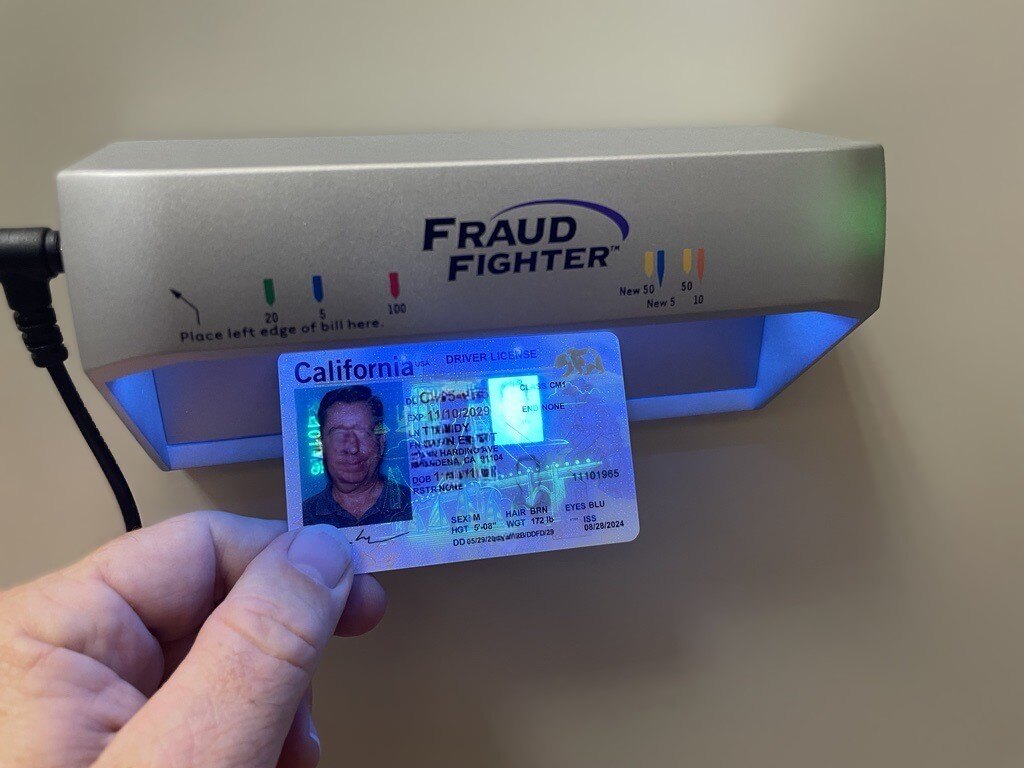
Modern counterfeit and identity fraud prevention tactics are designed to defeat casual review, which makes consistent documented checks essential and reduces reliance on memory and judgment. People’s Alliance Federal Credit Union prevented a potential $43,000 loss on the first day of FraudFighter™ use, which shows how document authentication tools can support front-line staff in catching fraud attempts and making accurate verification decisions. Identity authentication tools can support documented controls inside a broader BSA/AML compliance program by standardizing how document verification is carried out, how verification results are recorded, and how exceptions are flagged for review.
A scanner is not a compliance program, and FraudFighter™ should not be presented as a substitute for legal or compliance counsel. Identity authentication solutions do help standardize verification across channels by applying consistent forensic checks to driver licenses, passports, and other government-issued documents regardless of location or staff experience level. Documentation does not always mean storing full document images, since the rule allows record descriptions and risk-based procedures, so institutions should work with legal and compliance teams to determine what level of documentation is appropriate for their risk profile. Digital identity solutions should be judged on what they record for later review, not only on what they detect at the counter.
ID authentication technology is useful to an audit only when its output is retained in a form a reviewer can read months later. Compliance teams should confirm what the system stores by default, how long records remain available, whether results can be exported for an examiner, and whether the vendor retains any customer data on its own infrastructure. Treating identity authentication as a documented security measure rather than a one-time look at the counter is what makes scanners and biometric systems defensible in an examination.
Staff Training, Quality Reviews, and Vendor Due Diligence
Training documentation strengthens audit-ready identity controls by showing that employees understand CIP requirements, know how to apply documentary and nondocumentary verification methods, and follow escalation procedures when verification fails. Year-end review should confirm that training records exist for all employees involved in account opening, that training content aligns with current procedures, and that refresher training occurs when procedures change or when quality reviews identify gaps. Staff training should cover both the regulatory basis for identity verification and the practical use of verification tools or systems.
Vendor security documentation plays a supporting role in demonstrating compliance when institutions use third-party tools or services for ID verification for business accounts and consumer accounts. Management reviews and sign-offs should be documented at year-end to show that senior management is aware of CIP performance, exception trends, training completion, and any control gaps identified during internal quality reviews. Year-end sign-off creates a formal record that management has reviewed identity authentication controls and determined they are adequate or that remediation plans are in place.
Regulatory Standards Behind the BSA/AML Identity Authentication Audit
31 CFR 1020.220 requires banks to maintain written CIP procedures that include risk-based identity verification methods, collection of required identifying information before account opening, and retention of records for specified periods. The FFIEC Bank Secrecy Act examination manual frames the exam objective as assessing the bank’s compliance with BSA regulatory requirements for CIP and emphasizes that procedures must enable the bank to form a reasonable belief it knows each customer’s true identity. CIP procedures must compare customers against government lists of known or suspected terrorists or terrorist organizations issued by a federal government agency and designated by Treasury in consultation with regulators.
Procedures must also provide customers adequate notice that information is requested to verify identity, typically through account-opening disclosures or customer agreements. Retention periods are defined in regulation: identifying information for five years after account closure, credit-card account information for five years after closure or dormancy, and descriptions of documents and verification methods for five years after the record is made. Institutions should document how customer notices are delivered, how government list checks are conducted, and how retention schedules are applied to different account types.
Common Challenges and Objections Banks Face on Documentation
Policy existence versus operational evidence represents the most common challenge: auditors examine whether procedures are actually followed, not whether a procedure document exists. Banks do not pass BSA/AML reviews by saying they have an identity-verification policy without evidence that branch staff, remote onboarding teams, and exception handlers consistently apply the procedures. Year-end review should produce operational evidence such as completed verification records, exception logs, staff training completion, quality-review findings, and management sign-offs that demonstrate procedures are working in practice.
Required records versus optional document copies is another frequent concern, since the CIP rule does not require copies of identifying documents, though institutions may choose to retain copies based on risk assessment or other regulatory requirements. Credit unions and banks should work with legal and compliance teams to determine what documentation is required versus what is optional, which avoids unnecessary retention of sensitive identity information while meeting regulatory record-keeping obligations. Branch and remote workflows require different documentation approaches because branch staff may visually inspect physical photo IDs while remote onboarding may involve image capture, electronic verification, or mailed document review.
A third objection is cost and workload. Institutions often assume that stronger evidence means more manual note-taking at the counter. In practice, most of the record an examiner wants is produced by the verification step itself, so the work is in defining what the system captures and where it is stored, not in asking staff to write more.
Year-End Identity Authentication Documentation Package for Audit Readiness
Institutions should assemble a year-end documentation package that includes current CIP policy and procedure versions, sample verification records showing collection and verification activity, exception logs with account-opening decisions and SAR escalation trails, staff training records and quality-review results, vendor security documentation, retention schedules, and management sign-off confirming that controls were reviewed.
|
Evidence Item |
What It Demonstrates |
Typical Owner |
|
Current CIP policy and procedure versions |
Written program exists and is current |
BSA/AML compliance officer |
|
Sample verification records by channel |
Procedures are applied in branch and remote workflows |
Branch operations and digital onboarding |
|
Exception log with outcomes |
Failed verifications are handled consistently |
Compliance and account operations |
|
SAR escalation trail |
Escalation decisions follow written procedure |
BSA officer |
|
Training completion records |
Staff understand and apply the procedures |
Training and HR |
|
Quality review findings and remediation |
Gaps are detected and corrected internally |
Internal audit or QC |
|
Vendor security documentation |
Third-party controls are reviewed |
Vendor management |
|
Retention schedule by record type |
Records are kept for required periods |
Records management |
|
Management sign-off memo |
Senior oversight of identity controls |
Executive or board risk committee |
This package should demonstrate that identity authentication is consistent across branch and remote channels, that exceptions are handled according to written procedures, and that records are retained and secured appropriately. Year-end documentation review turns individual identity checks into a cohesive audit-ready compliance package that supports regulatory examinations and internal risk assessments.
Get Year-End Audit Support From FraudFighter™
Preparing identity authentication documentation before auditors or examiners ask for it reduces compliance risk and shows that management takes CIP requirements seriously. Banks and credit unions that complete year-end documentation review enter the audit cycle able to produce operational evidence that supports their written procedures. FraudFighter™ has supported point-of-sale and account-opening fraud prevention since 2000, and our specialists work with financial institutions across the United States on verification controls that are consistent enough to document.
Talk with a FraudFighter™ specialist about the identity authentication tools behind your CIP evidence, including driver license authentication, passport authentication, and remote verification for client-not-present accounts. Call 800-883-8822 Monday through Friday, 8:00 AM to 5:00 PM Pacific Time, or request a quote to review your year-end documentation needs with our team.
Frequently Asked Questions
Q1. What identity authentication records do BSA/AML examiners ask for first?
A. Examiners usually start with the written CIP and then ask for records that prove it is followed. That means account samples showing the four required identifying elements, the verification method applied, the result, and the date and person or system involved. They then move to the exception log to see how failed verifications were resolved. Institutions that can produce both the policy and matched account-level evidence in one package tend to move through this stage quickly.
Q2. Does the CIP rule require banks to keep copies of driver licenses and passports?
A. No. The rule requires a description of the document relied on, including the type, issuing authority, number, and expiration date where applicable, rather than an image of it. Institutions may keep copies if their own risk assessment or another regulation calls for it, but that becomes a documented choice rather than a CIP requirement. Storing images also brings data security and retention obligations, so the decision should be made with legal and compliance input.
Q3. How long does an institution keep identity verification records?
A. Identifying information collected at account opening is retained for five years after the account closes. For credit card accounts, the five-year clock runs from closure or from the point the account becomes dormant. Descriptions of the documents and of any nondocumentary methods used, along with the resolution of substantive discrepancies, are retained for five years after the record is made. Retention schedules should state these periods by record type rather than applying one blanket rule.
Q4. How should exceptions and failed verifications be documented?
Each exception should record what failed, what the institution did next, and who decided. That includes whether the account was opened, restricted while verification continued, or closed after attempts failed, and whether a Suspicious Activity Report was filed. The log should be reviewable as a set so trends are visible, not only as scattered notes in individual account files. Exception evidence carries weight in an examination because it shows the procedure works under pressure.
Q5. What is different about documenting remote account opening?
Remote account opening produces system evidence instead of counter observation, so the record comes from session logs, captured images, and verification responses rather than a teller note. Where a workflow uses biometric authentication or a qualified e-signature, the record should show the result of that step and the time it ran. Institutions should confirm what their platform retains by default and for how long, since some systems purge session data on a short cycle. Procedures should also state the threshold at which a real-time verification becomes an exception and who reviews it. Documenting the remote channel separately from the branch channel avoids gaps that examiners notice.