


 10 minute read
Holiday Convenience Store Counterfeit Defense: A Late-Night Shift Protection Plan
Holiday convenience store counterfeit defense fails in the same place every December: a busy late-night register, a rushed cashier, and a $100 bill nobody has time to check. A record 202.9 million consumers shopped during the 2025 five-day Thanksgiving weekend, with Black Friday drawing 80.3 million in-store shoppers. The National Retail Federation expects November and December sales to pass $1 trillion, and that volume puts more counterfeit money into circulation while understaffed stores absorb cash-heavy late-night visits.
Below, you will find the plan we give store operators: what to prepare before the shift, which bills to verify, how to escalate a flagged note without a confrontation, and what to document afterward. For high-traffic registers, we’d also suggest a dependable money counter machine to keep the count fast and accurate.
Key Takeaways
- Holiday traffic increases register pressure, with 202.9 million shoppers during Thanksgiving weekend creating rushed transaction conditions where counterfeit bills enter circulation
- Late-night convenience store shifts require procedural counterfeit defense combining device checks, denomination thresholds, escalation protocols, and incident documentation
- Official U.S. Currency Education Program guidance supports manual feel-tilt-check authentication, but device-assisted verification removes judgment inconsistency under pressure.
- Point-of-sale counterfeit detection prevents losses at the register rather than during back-office reconciliation when recovery is no longer possible
- FraudFighter's automatic scanners check UV, infrared, magnetic ink, and intaglio features in under two seconds, supporting late-night operations without slowing customer flow
Holiday Convenience Store Counterfeit Defense: Late-Night Risk Factors
Four pressures converge on a holiday late-night shift: heavier traffic, more high-denomination bills, seasonal staffing, and no manager on site. Naming each one lets operators fix causes instead of running generic fraud training.
|
Late-Night Holiday Condition |
Effect at the Register |
Counterfeit Risk Created |
|---|---|---|
|
Peak evening traffic |
Lines build, and cashiers speed up |
Verification steps get skipped to keep the line moving |
|
More $50 and $100 bills |
Larger change, longer transactions |
Each accepted note costs far more per incident |
|
Seasonal and new hires |
Little transaction history to compare |
Staff lack confidence to question a suspect bill |
|
One employee, no manager |
No second opinion available |
Individual judgment becomes the only defense |
|
Dim register lighting |
Security features are hard to see |
Watermarks, threads, and ink shifts go unchecked |
Holiday Traffic Raises Register Speed Pressure on Cashiers
Ninety-one percent of consumers plan to celebrate the 2025 winter holidays, and the NRF projects retail sales growth of 3.7% to 4.2% over 2024. For convenience stores, that arrives as last-minute purchases, higher-denomination bills, and customers expecting fast checkout. A cashier working alone trades speed against thoroughness on every sale, and when lines extend, the checks get dropped.
Common Convenience Store Fraud Risks During the Holiday Season
Three fraud categories drive a late-night plan: counterfeit money, counterfeit payment cards, and fake or stolen identities. Eighty-two percent of organizations reported payment-fraud incidents in 2018, according to the 2019 AFP Survey. Cash-heavy late-night visits give organized retail crime groups a window when no manager is available, and modern counterfeits defeat visual inspection outright.
Late-Night Shifts Carry Higher Counterfeit and Cash-Handling Exposure
Late-night shifts run with reduced supervision, so employees decide alone, and once a counterfeit enters the drawer, the loss is permanent. Poor lighting hides fine security features, and seasonal employees have not handled enough genuine notes to build pattern recognition. A rushed cashier accepts a suspect bill because verification conflicts with service expectations.
Holiday Convenience Store Counterfeit Defense Plan Components
The plan works as a repeatable shift procedure: preparation before the first sale, verification rules at the register, documentation after. It settles which bills get verified, who may override a rejection, and how staff escalates safely.
Pre-Shift Preparations That Improve Detection Readiness
Pre-shift checks confirm that counterfeit detection equipment works before the first transaction. Cashiers verify that UV lamps illuminate, that scanners complete their self-tests, and that a known genuine bill returns the expected result. Placement matters because awkward positioning creates friction employees bypass, so scanners belong between the register and the customer.
|
Pre-Shift Check |
Ready Condition |
|---|---|
|
UV lamp |
Illuminates evenly, bulb not dimmed or failing |
|
Automatic scanner |
Powers on, completes self-test, passes a known genuine bill |
|
Device placement |
Within reach between register and customer, cables clear of the counter edge |
|
Denomination thresholds |
Posted at the register so the rule is visible, not remembered |
|
Incident log |
Forms available with the manager escalation number attached |
|
Drawer and drop policy |
Opening count recorded, drop threshold confirmed for the shift |
Register Rules and Bill-Review Procedures for Transactions
Written denomination rules remove the judgment call about which bills get verified, so every cashier behaves the same way regardless of experience.
|
Denomination |
Late-Night Verification Rule |
Why the Rule Holds |
|---|---|---|
|
$100 |
Scan every note, no exceptions |
Largest single-incident loss and the most frequently copied note at retail |
|
$50 |
Scan every note, no exceptions |
High value and low circulation, so cashiers see too few to judge by feel |
|
$20 |
Scan on late-night shifts and peak holiday hours |
Most common note passed in convenience stores, where speed hides a weak copy |
|
$10 and below |
Visual check, scan on suspicion |
Loss per note does not justify delay, but the cashier keeps the option |
|
Any failed scan |
Hold the bill, call a manager, never override alone |
Protects the employee from liability and the drawer from a known risk |
Never override a failed scan alone. When equipment flags a bill, staff use wording tied to the machine, such as "Our scanner is showing an issue with this bill." The procedure is to hold the note separately, call for manager verification, and document the incident before the customer leaves if the store’s counterfeit detectors cannot authenticate it.
Escalation and Incident Documentation Protect Staff and the Business
An escalation protocol sets the authority chain for the moment a detector flags a bill, so nobody feels pressure to accept questionable currency to end an awkward exchange. A no-solo-override rule routes every rejection through manager approval. Suspected counterfeit currency goes to local police or the store’s bank, following Secret Service guidance.
|
Incident Log Field |
What It Supports |
|---|---|
|
Date, time, and shift |
Shows whether attempts cluster on specific shifts or days |
|
Denomination and serial number |
Links repeat attempts and supports law enforcement follow-up |
|
Device response |
Separates equipment false positives from genuine attempts |
|
Customer description and reaction |
Supports investigation and flags repeat visitors |
|
Manager decision and reason |
Creates a defensible record when a bill is accepted or refused |
|
Disposition of the bill |
Records whether the note was returned, held, or handed to police |
Official U.S. Currency Guidance for Cashier Counterfeit Detection
Official U.S. government currency education gives cashiers a baseline, but it does not replace device-assisted verification under pressure. Use it for training while requiring device checks on high-denomination transactions.
The Feel, Tilt, and Check Method in Practice
The U.S. Currency Education Program defines fast authentication as feel, tilt, and check, taught in about 20 minutes. Feel refers to the paper texture, tilt reveals color-shifting ink on denominations of $10 and higher, and check means examining the watermark and security thread against light, which differ by denomination as the visible security features guides show. It works for employees who have handled thousands of genuine bills.
Practical Banknote Identifiers Cashiers Can Use
Every Federal Reserve note carries printed identifiers that need no equipment: a serial number, Federal Reserve indicators, a note position letter and number, plate numbers, the Treasury seal, and the series year. The eleven-character serial number appears twice on the face in identical form, so a mismatch is immediate grounds for rejection. These identifiers support escalation, not full verification.
Manual Detection Falls Short During High-Pressure Shifts
Manual feel-tilt-check depends on consistent judgment, and late-night conditions take consistency away first. Visual checks fail when a customer is impatient, a poorly lit register hides ink shifts, and speed expectations compete with deliberate examination. Device-assisted verification applies the same tests regardless of who is working or how long the line has grown.
Counterfeit Detection Technology for Late-Night Convenience Stores
Equipment choice depends on transaction volume, denomination mix, counter space, and whether you also verify documents. Late-night shifts need devices that require minimal training and give a clear signal with nothing to interpret.
Manual UV Detectors Compared With Automatic Multi-Feature Scanners
|
Factor |
Manual UV Detector |
Automatic Multi-Feature Scanner |
|---|---|---|
|
Result |
Operator interprets UV-reactive patterns |
Pass or fail signal in under two seconds |
|
Features checked |
Ultraviolet response |
UV, infrared, magnetic ink, and intaglio printing in one pass |
|
Documents covered |
Currency, IDs, passports, checks, and more |
Currency, with models covering ID documents |
|
Training required |
Employee must learn expected patterns |
Insert the bill and read the signal |
|
Late-night fit |
Depends on operator experience and lighting |
Consistent regardless of staff tenure or lighting |
|
Typical use |
Secondary verification and document checks |
Primary register verification on flagged denominations |
Manual UV detectors reveal ultraviolet-reactive features that normal lighting hides across currency, IDs, passports, and checks, and the operator reads the pattern and decides. FraudFighter’s automatic CT-600 and CT-250 scanners return a pass or fail in under two seconds by checking UV light, infrared, magnetic ink, and intaglio printing at once, which suits registers where pressure erodes manual consistency.
Operational Benefits of Point-of-Sale Detection Devices
Point-of-sale detection catches a counterfeit as it reaches the register, not during back-office reconciliation when recovery is impossible, and the customer is still present to settle the sale another way. FraudFighter supports loss prevention through 25,000-plus deployed units across retail, banking, and hospitality, and a Wells Fargo trial of 100 UV units prevented almost $200,000 in losses.
Override and Manager Escalation Rules for Detection Devices
A device rejection should trigger manager notification, not cashier override authority. The no-solo-override policy removes pressure to accept questionable currency and adds a checkpoint for secondary verification, where managers compare serial numbers, check further features, or contact law enforcement. Override records should capture the device response and why the bill was accepted.
Cash Handling Discipline That Supports Counterfeit Defense
Cash handling discipline extends the plan into drawer management, secure storage, and shift-boundary accountability. Run cash policy and counterfeit fraud prevention equipment workflows together so the plan covers both authentication and custody of the cash.
Drawer Count, Drop Timing, and Secure Storage Routines
A drawer closeout at shift end creates immediate accountability for bills accepted during that register period. Cashiers count contents against opening cash plus transaction records and set suspicious bills aside for manager verification. Drop timing limits exposure: excess bills move into a time-delay safe once the drawer passes a set amount, and each drop timestamps when bills entered.
ID Checks Linked to Restricted Product Sales and Fraud Controls
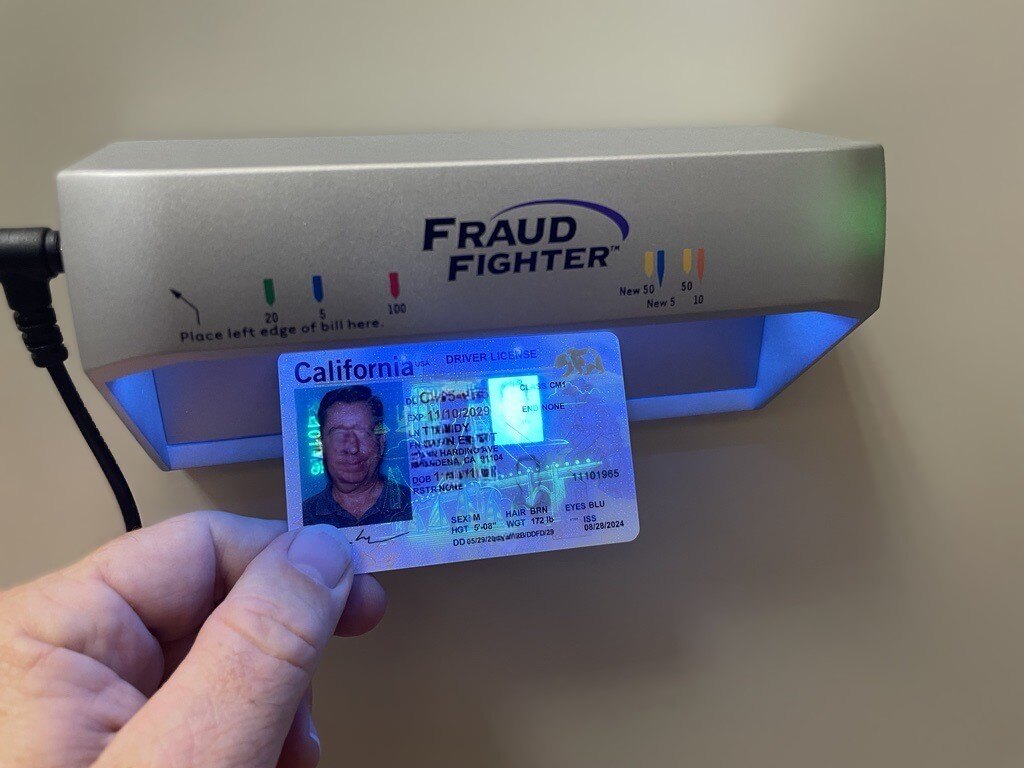
Alcohol and tobacco sales already require ID verification, which creates a natural moment to check document authenticity with the same equipment used for currency. CMEA logging for certain pseudoephedrine purchases builds an audit trail tying identity to the transaction. UV counterfeit detectors verify a driver’s license and a bill inside one workflow.
Safe Customer Communication Reduces Confrontation Risk
Safe communication points at the equipment, not the customer, which keeps the exchange from escalating. Employees should never try to confiscate a bill or detain a customer on a late-night shift. Decline the transaction, offer alternative payment, and notify a manager who decides whether to contact law enforcement, because employee safety outranks currency recovery.
Employee Protections and Procedural Safeguards for Shift Plans
Frontline cashiers should not carry personal accountability for counterfeits built to defeat visual inspection. Safeguards create a documented decision path showing the employee followed protocol, which makes staff more willing to question a suspect note.
Safe Phrasing and No-Solo-Confrontation Rules
Safe phrasing belongs in the written procedure and in pre-shift briefings, and employees need to hear plainly that they are never required to accuse a customer. Standard phrases point to equipment output or store policy, as our retail counterfeit prevention guidance explains. No-solo-confrontation rules prohibit blocking an exit, demanding ID, or holding a bill without manager support.
Training and Procedural Repeatability for Seasonal Staff
Repeatable training keeps counterfeit defense consistent where a seasonal hire may work only a few weeks. Procedures must be simple enough to teach in one shift briefing and complete enough to cover the decisions an employee faces alone: which denominations require scanning, who may override, and when escalation becomes mandatory. Repeatability survives turnover.
Documentation Supports Manager Review of Suspicious Incidents
Documentation gives managers the evidence to spot patterns, support investigations, and defend decisions during an audit. Logs recording device responses, customer descriptions, times, and denominations show whether a store faces random attempts or a coordinated effort, and they separate false positives from genuine counterfeits.
Balancing Register Speed and Security During Holiday Cash Handling
Balance comes from matching verification to risk rather than treating every bill as equally likely to be counterfeit. Equipment, training, and internal controls keep the required steps from feeling like friction.
Bill Scanning Thresholds That Keep Registers Moving
Thresholds weigh a few seconds of delay against the size of a potential loss, which is why most stores scan every $50 and $100 bill and add selective $20 scanning at peak risk periods. With scanners returning results in under two seconds, lower thresholds stay practical. The written policy turns scanning into a step rather than a judgment call.
Training That Maintains Both Speed and Detection Accuracy
Training should make clear that detection technology removes decision complexity rather than adding a task during a holiday rush. Once employees see the device return an objective pass or fail, they treat verification as support for their own speed. Timed exercises show how little time a scan costs, and managers should recognize staff who flag suspicious currency.
Internal Controls That Limit Losses and Protect Confidence
Device verification, manager escalation, and documentation stack into layers that limit losses even when one control fails. The Wells Fargo trial produced more than 2,000 percent ROI within 30 days, a result detailed in our retail fraud prevention case study. FraudFighter has built point-of-sale detection equipment since 2000. Controls only work if staff use them at the busiest hours, so run spot checks and review the logs.
Holiday Convenience Store Counterfeit Defense: Putting the Plan Into Practice
A working plan links pre-shift preparation, register verification, safe escalation, and post-shift documentation into procedures that protect the drawer and the people running it. When you buy counterfeit detector equipment, results depend on matching the device to the operation and giving managers a defined role, so judgment does not sit with a lone employee at 2 a.m.
Stores that balance speed and security set clear denomination thresholds, verify with a device rather than a glance, and hold a no-solo-override policy that keeps employees out of confrontations.
Build Your Holiday Shift Plan With FraudFighter™ Counterfeit Detection
FraudFighter™ has supplied point-of-sale counterfeit detection equipment since 2000, with 25,000-plus units deployed across convenience stores, retail, banking, and hospitality from our Glendora, California headquarters. Our specialists help you set denomination thresholds, place devices where cashiers will use them, and train seasonal staff in one shift.
Call (888) 664-9214 to speak with a counterfeit detection specialist, or request a quote for the CT-600 or CT-250 and get your late-night registers covered before the holiday rush. If fake IDs are part of the problem at your counters, we’d also suggest layering in proven identity verification solutions alongside your currency checks. You can also compare the full range of counterfeit detection products against your store’s volume and counter space.
Frequently Asked Questions
Q1. Which bills should convenience store cashiers scan during holiday late-night shifts?
A. Scan every $50 and $100 bill without exception, and extend the rule to $20 bills during late-night hours and peak holiday periods. Those denominations carry the largest per-incident loss and appear most often in counterfeit attempts at convenience stores. Bills of $10 and under usually clear on a visual check, with a scan any time the cashier has doubts. Post the threshold at the register so the rule stays visible.
Q2. How fast is an automatic counterfeit detector at the register?
A. FraudFighter automatic scanners such as the CT-600 and CT-250 return a pass or fail result in under two seconds while checking UV, infrared, magnetic ink, and intaglio printing in one pass. At that speed, verification adds almost nothing to the transaction, which keeps lower scanning thresholds practical during a rush. The output is a clear signal with nothing for the cashier to interpret. That matters most late at night, when a new employee has no baseline for comparison.
Q3. What should a cashier say when a scanner rejects a customer’s bill?
A. Point at the equipment, not the person. A line such as "Our scanner is showing an issue with this bill" attributes the refusal to device output and keeps the exchange from becoming an accusation. The cashier then holds the bill separately, offers an alternative payment method, and notifies a manager. Staff should never try to confiscate a note or detain a customer, because employee safety outranks recovering the currency.
Q4. Is the feel, tilt, and check method enough for late-night counterfeit defense?
A. The U.S. Currency Education Program method is a solid training baseline and takes about 20 minutes to teach, but it depends on consistent judgment. Late-night conditions remove that consistency through poor lighting, customer impatience, and seasonal staff who have not handled enough genuine notes. Use the method for training and quick checks during transaction pauses, and require device verification on every high-denomination bill.
Q5. What should a convenience store do with a suspected counterfeit bill?
A. Hold the bill separately from the drawer and call a manager for secondary verification. Record the date, time, denomination, serial number, device response, customer description, and the manager’s decision in an incident log. Submit the suspected note to local police or your bank, following Secret Service guidance. The log then supports pattern analysis and gives the store a defensible record if an investigation follows.