


 10 minute read
Department Store Pre-Holiday Counterfeit Training: A 4-Week Implementation Plan
Department stores operate under intense seasonal pressure when holiday traffic compresses decision time at cash wraps, return desks, and pickup counters. A focused pre-holiday training plan reduces preventable fraud by preparing associates to recognize counterfeit money, verify identification, and escalate suspicious transactions before peak weekend volume arrives. Training finished before Thanksgiving week creates consistent operating discipline across registers, customer service, and high-value departments when lines are longest and temporary staff are least experienced.
Below, you'll find a week-by-week plan covering counterfeit money detection, fraudulent ID recognition, receipt verification, and equipment readiness, plus a sample ROI model and the questions loss prevention teams ask most. FraudFighter has manufactured point-of-sale counterfeit detectors since 2000, and the sequence here reflects what holds up in stores that run it every season.
|
Week |
Focus |
Core Deliverables |
Readiness Gate |
|---|---|---|---|
|
Week 1 |
Risk mapping and equipment audit |
Risk-point map, device inventory, one-page escalation path |
100% of devices tested and placed |
|
Week 2 |
Currency and ID verification training |
Security-feature training, ID matching process, escalation script |
All target roles trained |
|
Week 3 |
Scenario drills |
Timed drills by department and desk, exception logging |
Scenario pass rate of 85% or higher |
|
Week 4 |
Readiness certification |
Associate quiz, floor audit, mystery-shop check, device refresh |
90% or more of roles certified |
Key Takeaways
- Department store pre-holiday counterfeit training should finish before Thanksgiving week, when holiday sales pass $1 trillion, and lines are longest.
- Counterfeit risk concentrates at four points: the cash wrap, the returns desk, BOPIS pickup, and high-value departments.
- Week 1 maps risk and audits equipment, Week 2 trains currency and ID checks, Week 3 runs scenario drills, and Week 4 certifies readiness.
- Associates should pause, verify, and escalate using one standard phrase rather than investigate fraud on their own.
- ROI models should count avoided loss from tracked incidents, not industrywide shrink statistics.
Department Store Pre-Holiday Counterfeit Training Protects Peak Season Margin
Department stores combine multiple high-traffic transaction types that create distinct fraud exposure during the holiday season. Training must happen before peak weekend volume, not after preventable losses appear in drawer audits.
Counterfeit Risk in Department Store Operations
Counterfeit currency arrives as fake bills at registers and cash offices, often slipped into a stack of genuine currency so the fake moves through unnoticed. Fraudulent IDs support suspicious returns, order pickups, age-restricted purchases, and financing applications. Counterfeit documentation covers altered receipts and forged proof of purchase, and counterfeit merchandise enters through the return stream as switched goods. Apparel returns, gift-card sales, cash payments, BOPIS pickup, and luxury departments each need different verification steps during compressed holiday timelines.
Holiday Traffic Compresses Verification Time
Holiday sales in 2025 were expected to surpass $1 trillion, with November-December retail sales projected to grow 3.7% to 4.2% over 2024. An estimated 202.9 million consumers shopped the five-day Thanksgiving through Cyber Monday weekend, which is why counterfeit prevention training must be complete before Black Friday. Associates skip verification when lines are long or return queues show visible impatience. Counterfeit bill detectors kept within arm’s reach of the drawer remove that tradeoff, because the check takes seconds instead of a visual inspection under pressure.
Four Counterfeit Types to Address in Training
Training should cover currency, identification documents, purchase receipts, and returned merchandise. Each appears at a different transaction point and needs its own detection step. Define what triggers verification, where the equipment sits, and when escalation to a manager is required. Counterfeit solutions for business should pair currency authentication methods with document, ID, and merchandise checks rather than covering cash alone.
Department Store Pre-Holiday Counterfeit Training Begins With a Week 1 Risk Map
A risk map identifies which store areas handle high-risk transactions and what verification tools belong at each point. Completing it during Week 1 reveals equipment gaps, unclear escalation paths, and transaction types with no consistent verification procedure.
Store Areas and Transaction Points That Need Monitoring
Each area needs specific counterfeit detection equipment within reach of front-line staff. The table pairs each risk point with the trigger that should stop a transaction and the tool that resolves it.
|
Store Area |
Transaction Trigger |
Verification Tool |
|---|---|---|
|
Cash wrap |
Large cash purchases, multiple same-denomination bills |
Automatic counterfeit detector machines, UV light systems |
|
Returns counter |
High-value returns without matching history, altered receipts |
ID scanner, receipt lookup |
|
BOPIS pickup |
Pickup name does not match the presented ID |
ID verification scanner |
|
Customer-service desk |
Serial returns, pressure tactics, requests to bypass equipment |
UV counterfeit bill detectors, manager escalation |
|
High-value and gift-card departments |
Financing applications, large gift-card loads |
ID authentication, counterfeit detector pens |
|
Cash office |
Suspicious note found after drawer close |
Currency counter, bill counter, money handling machines |
|
Seasonal pop-up or kiosk |
New associate cannot locate the device |
Portable ultraviolet detectors |
Detection Tool Audit and Preparation Checklist
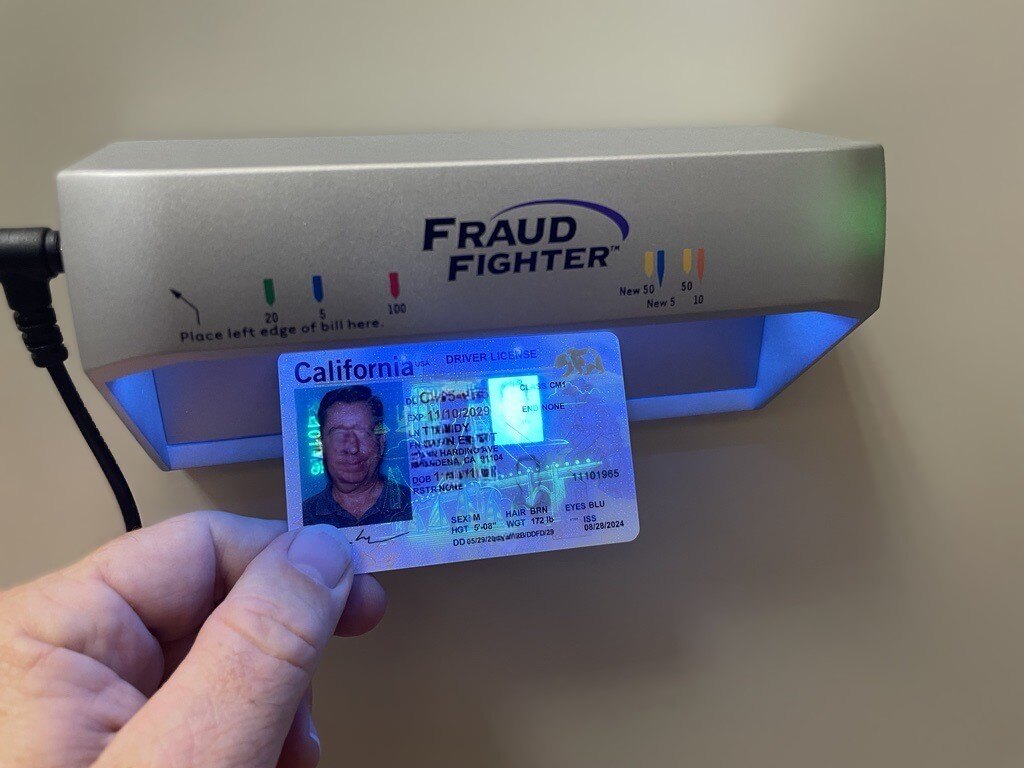
The Week 1 inventory should list ultraviolet detectors, automatic counterfeit detector machines, infrared detectors, ID scanners, guidebooks, counterfeit detector pens, penlights, and money counting machines at each location, then record where devices are missing, broken, or inaccessible during shift changes.
|
Tool Type |
What It Checks |
Week 1 Check |
Week 4 Refresh |
|---|---|---|---|
|
Ultraviolet detectors and UV light systems |
UV security features on cash, IDs, and documents |
Bulb function, placement, motion sensor |
Bulb replacement, cleaning |
|
Automatic counterfeit detector machines |
UV, infrared security marks, magnetic ink detection, intaglio print |
Power, software version, pass/fail display |
Software update, feed-path cleaning |
|
Combination detection systems |
Several features in a single pass |
Which features each unit covers |
Reference card showing coverage |
|
Counterfeit detector pens and penlights |
Paper composition and quick spot checks |
Ink flow, spares at backup registers |
Restock spares |
|
ID verification scanners |
Barcode, magnetic data, document format |
Software version, cloud connection |
Document format library update |
|
Money counting and money handling machines |
Count accuracy and strap verification |
Calibration, cash office placement |
Cleaning and calibration check |
Record which checks each unit performs, since UV light systems, infrared detectors, and magnetic ink detection are not interchangeable. Score device readiness green when 100% of units are tested and placed, yellow for minor gaps, and red for missing or broken devices, which gives regional loss prevention managers comparable metrics across locations.
Escalation Path for Suspected Fraud
Week 1 should produce a one-page escalation path running from associate to lead to manager or loss prevention, then to the cash office, bank, or law enforcement. The standard phrase is simple: “I need a manager to verify this before we complete the transaction.” That neutral wording lets staff pause without accusing a customer. Policies usually fail at the handoff, so naming who owns each step matters more than the policy document itself.
Week 2 Delivers Currency and ID Verification Training
Currency and ID training should focus on recognition, device use, and escalation rather than investigation. Week 2 covers security features, verification equipment, and customer-safe communication.
Currency Security Features Staff Must Recognize
Use U.S. Currency Education Program denomination pages and official training courses as the primary source, which supplies free materials in 24 languages for multilingual seasonal workforces. Associates must not rely on one security feature alone, since features vary by denomination and design series. Training should include tactile and visual checks such as security threading and UV and watermark tests, device-based UV detection, and a clear procedure for suspicious bills. Staff should also understand that infrared security marks and magnetic ink detection are read by the machine, not by the eye. Since November 1, 2024, the Secret Service no longer accepts electronic counterfeit note submissions through the former USDollars system, so escalation must route staff to managers who follow current channels.
Suspicious ID Indicators and Escalation Triggers
Teach ID verification as a structured matching process rather than document forensics. Associates confirm that the name matches, the photo matches, and the dates are consistent. Expired IDs trigger escalation, barcode or magnetic data validates where systems support scanning, and managers are called when discrepancies appear. Training on fake IDs should build process consistency rather than expect cashiers to authenticate holograms without tools. Customer identification program requirements vary by transaction type, so training must specify when ID checks are mandatory.
Customer-Safe Communication Techniques
Never instruct associates to accuse a customer of presenting counterfeit currency or fraudulent identification. Staff pause, verify with available equipment, and escalate when red flags appear. The approved phrase removes personal judgment and moves responsibility to managers trained in fraud response, which protects the associate and the customer at the same time.
Week 3 Scenario Drills Build Counterfeit Detection Skills
Scenario drills convert classroom training into practice that exposes process gaps. Week 3 should run timed drills at every transaction point where fraud risk exists.
Realistic Scenarios by Department and Desk
At the cash wrap, a customer pays with several high-denomination bills during a rush, testing whether the associate uses detection equipment without slowing the line. At the returns desk, a high-value return arrives with a mismatched ID. At BOPIS pickup, the order name differs from the ID. At a seasonal kiosk, the drill checks whether a new associate can find the detector. In the cash office, a suspicious note surfaces after drawer close, testing chain of custody and incident logging.
Associate Performance Measurement During Drills
Measure whether the correct process was followed, how long verification took, whether manager handoff happened, and whether exceptions were logged. Score scenario pass rates green at 85% or higher, yellow at 70-84%, and red under 70%. Those numbers show which departments need more practice before Black Friday weekend, and whether staff know when to reach for UV counterfeit detectors or another device.
Operational Gaps Scenario Training Reveals
UV counterfeit bill detectors and ID scanners go underused when staff are not trained on exactly when and how to deploy them. Drills show whether devices are placed conveniently, whether associates know the escalation phrase, and whether new seasonal hires follow store-specific procedures or fall back on prior retail experience that may not match current policy.
Week 4 Certifies Store Readiness Before Peak Holiday Traffic
Week 4 is the readiness gate for training completion, equipment functionality, and escalation clarity. Certification should finish before Thanksgiving week begins.
Readiness Assessment Through Audits and Testing
Run a 10-minute associate quiz covering currency security features, device locations, escalation steps, and customer-safe language. Managers walk the floor to confirm that equipment and current instructions sit at each register and desk, then run a mystery-shop scenario at each risk point. Score associate coverage green at 90% or more of target roles trained, yellow at 70-89%, and red under 70%.
Ongoing Staff Reinforcement Tools
Week 4 should also produce daily huddle scripts for Black Friday week, with one counterfeit risk reminder per day. Short messages reinforce training without adding classroom time during peak selling periods. ID authentication reminders can rotate with currency verification tips and escalation phrase practice through the season.
Device and Escalation Protocol Maintenance
The refresh checklist covers bulb replacement, device cleaning, visible signage, updated reference cards, current guidebooks, and spare detection pens or penlights, since replacement delays can leave registers without a backup. Post escalation protocols at every register and assign weekly device checks to named shift leads, so broken equipment does not go unreported until an incident forces the issue.
Practical ROI Models for Counterfeit Training Investment
ROI models for fake money detection training should use conservative formulas based on avoided loss rather than unsupported industry benchmarks, accounting for training labor, equipment, and realistic incident-prevention rates.
Components of Avoided Loss Calculations
The FY2022 average shrink rate rose to 1.6% from 1.4% in FY2021, an estimated $112.1 billion when applied to 2022 retail sales. That figure covers shrink broadly and is not counterfeit-specific, since the wider discipline also includes theft, operational error, and vendor fraud. Precise ROI is difficult because not all attempted fraud reaches an incident log, so count known prevention events instead of extrapolating from industry data.
Training and Equipment Costs in the ROI Model
|
Cost Item |
Basis |
Sample Cost |
|---|---|---|
|
Associate training labor |
40 seasonal associates, 45 minutes each, $22 loaded hourly rate |
$660 |
|
Manager preparation time |
8 hours at $35 per hour |
$280 |
|
Equipment refresh and supplies |
Bulbs, cleaning materials, reference cards |
$300 |
|
Total sample program cost |
Break-even denominator for the ROI calculation |
$1,240 |
Divide program cost by the average value of prevented fraud to find how many avoided incidents recover the investment. Replace the figures above with local labor rates and device counts.
Example Break-Even Scenarios
Frame ROI as a conservative formula, not a guaranteed return, and label any exact figure in training materials an example scenario rather than a published benchmark. A transparent break-even model shows retail operators the logic behind the investment without inventing fraud-prevention percentages. Incident tracking during the season supplies real data for the next cycle.
FraudFighter Supports Standardized Counterfeit Prevention at the POS
FraudFighter provides point-of-sale fraud prevention solutions for retailers, banks, casinos, currency exchange offices, and rental agencies handling cash, identification verification, and credit card transactions. The equipment is built for speed at the counter, which is what the four-week plan depends on.
Tools for Cash and ID Verification
Product categories include automatic counterfeit detector machines, manual counterfeit money detectors, counterfeit detection pens, ID verification scanners, and money counters or cash-handling products. These let department stores standardize counterfeit detection for retail across registers, return desks, and customer-service counters. Automatic detectors cut verification time during peak traffic, and shared equipment reduces training complexity by giving every associate the same tools regardless of station.
Integrating FraudFighter Solutions Into Training
Fold the equipment into Week 1 inventory checklists and Week 2 sessions on tool use. Week 3 drills should use the models deployed at each transaction point, and Week 4 audits confirm every device is placed correctly, tested, and reachable without manager intervention. That is what turns equipment spend into operating discipline.
FraudFighter Experience and Capabilities in Retail
FraudFighter has built point-of-sale counterfeit detection and identity authentication equipment since 2000, with more than 25,000 units installed across retail chains, banks, casinos, government agencies, and rental counters. SOC 2 Type II compliance covers the identity authentication systems that handle scan data, and U.S.-based phone support runs Monday through Friday with a one-business-day response commitment. That experience in high-volume retail shapes product decisions around speed, simplicity, and short training time.
Department Store Counterfeit Training Implementation Summary
A pre-holiday counterfeit prevention program completes four phases before Black Friday weekend. Week 1 maps risk points and lists the triggers that require mandatory verification. Week 2 delivers currency and ID training using official government resources and standardized escalation language. Week 3 turns instruction into scenario practice by department and desk. Week 4 certifies readiness through quizzes, floor audits, mystery-shop scenarios, and an equipment refresh.
Associates trained to pause, verify, and escalate protect the store from preventable losses while holding service standards through the busiest retail period of the year.
Equip Every Register for Counterfeit Money Detection Before Black Friday
Four weeks of training holds up only when the equipment behind it is present, tested, and simple enough for a seasonal hire to use on the first shift. FraudFighter™ has manufactured counterfeit bill detectors, automatic counterfeit detector machines, ID authentication scanners, and money handling machines for point-of-sale environments since 2000, with more than 25,000 units installed nationwide.
Call 888.664.9214 in the US or 626.225.0203 internationally, Monday through Friday, or request a quote online to match the right devices to your cash wraps, return desks, BOPIS pickup counters, and cash office. If high-volume cash handling is slowing your team down, we can suggest a high-speed money counter machine to fold into the mix. To size a store-by-store rollout before peak weekend traffic arrives, contact FraudFighter™ and request more information.
Frequently Asked Questions
Q1. When should a department store start pre-holiday counterfeit training?
A. Start four weeks before Thanksgiving so certification finishes before Black Friday weekend. That leaves one week for risk mapping and equipment audits, one for currency and ID instruction, one for scenario drills, and one for readiness testing. Starting later compresses the drills, which is the phase that exposes real process gaps. Stores hiring in waves should repeat the Week 2 module for each intake.
Q2. What counterfeit detection equipment does a department store need at each register?
A. Every cash-handling station needs a UV light system or an automatic counterfeit detector machine plus a current reference card. Returns desks and BOPIS counters need an ID verification scanner instead, since the risk there is identity rather than cash. The cash office needs a currency counter or bill counter and a documented chain of custody. Counterfeit detector pens work as backups, not primary checks, because they test paper composition alone.
Q3. How should an associate handle a suspected counterfeit bill without accusing the customer?
A. Train one neutral phrase and use it every time: “I need a manager to verify this before we complete the transaction.” The associate pauses, keeps the note visible, and calls a manager rather than making a determination. Accusation creates legal and safety exposure and is not the associate’s job. The manager follows the escalation path to the cash office, the bank, or law enforcement and logs the incident for pattern tracking.
Q4. How do you calculate ROI on counterfeit training for a retail store?
A. Add training labor, manager preparation time, and equipment refresh cost to get a total program cost, then divide by the average value of a prevented incident to find the break-even number of catches. A store spending roughly $1,240 on a 40-associate program breaks even after a handful of high-denomination catches. Use your own incident logs rather than industry-wide shrink figures, which bundle theft, operational error, and vendor fraud into one number.
Q5. What is the difference between manual UV detectors and automatic counterfeit detector machines?
A. A manual ultraviolet detector illuminates a note, ID, or check so the user can see whether UV security features appear, which means the employee makes the call. An automatic counterfeit detector machine pulls the banknote through and returns a pass or fail result, checking UV, infrared security marks, magnetic ink, and intaglio printing with no judgment from the cashier. Manual UV light systems are more versatile because they work on documents beyond currency, while automatic machines are faster and more consistent where turnover is high.