

 10 minute read
Credit Union Member Identity Verification: A Q4 Compliance Readiness Plan
Credit union member identity verification is the control examiners test first, and Q4 is the right checkpoint to prove it works. The question is whether the credit union can show that its Customer Identification Program, security procedures, and member-not-present workflows consistently establish reasonable belief, document exceptions, and reduce synthetic or stolen-identity risk.
Reported consumer fraud losses reached $12.5 billion in 2024, with 38% of fraud reporters losing money. Credit unions answer to written CIP requirements, board-approved BSA programs, and security obligations that protect member records from unauthorized access. Below, you’ll find a Q4 plan covering written procedures, channel alignment, document authentication, failed-ID escalation, remote verification, staff training, and the audit evidence examiners ask for. Where branch staff need a defined, repeatable check, we’d suggest a reliable ID scanner to anchor the process. The guidance draws on 25 years of point-of-sale fraud prevention work with banks, credit unions, casinos, and retailers.
Key Takeaways
- Credit unions must maintain a written, risk-based Customer Identification Program under 31 CFR 1020.220
- BSA compliance programs require board approval, internal controls, independent testing, and staff training
- Identity verification supports both fraud prevention and member-information security obligations under 12 CFR 748.0
- Remote and branch identity workflows must apply consistent standards and document every exception
- Q4 readiness reviews should inventory all identity touchpoints and prepare audit evidence before year-end
Credit Union Member Identity Verification Starts With a Written, Risk-Based CIP
A written CIP is a mandatory component of every credit union's AML compliance program. It must include risk-based procedures enabling the institution to form a reasonable belief that it knows the true identity of each customer. The Customer Identification Program framework requires collecting minimum identifying information and adjusting verification methods based on account type, opening channel, and institutional risk profile.
CIP procedures must account for the credit union's size, location, customer base, and account-opening methods. Written procedures must be documented, board-approved, and reflected in minutes to satisfy regulatory expectations during NCUA examinations.
CIP Defines Reasonable Belief in Member Identity
CIP procedures must let the credit union form a reasonable belief in each member's true identity. That standard asks for more than a name and address. Minimum identifying information includes name, date of birth, address, and an identification number.
Identity resolution maps the claimed identity to a single real person in the credit union's records. Identity verification confirms the applicant is connected to the evidence presented, which is what reduces fake, stolen, and synthetic identities.
Regulatory Requirements for Credit Union BSA Programs
CIP is a written program required under 31 CFR 1020.220 as part of the AML compliance program. Federally insured credit unions must develop and administer a BSA compliance program reasonably designed to assure and monitor compliance. The Bank Secrecy Act program must be written, board-approved, and reflected in minutes.
BSA program minimum contents include internal controls, independent testing, a designated responsible individual, and training for appropriate personnel. NCUA reviews BSA compliance during each examination under 12 U.S.C. 1786(q)(2).
Identity Verification Supports Member Information Security
Security programs must ensure the security and confidentiality of member records under 12 CFR 748.0. They must protect against anticipated threats to member-record security or integrity and prevent unauthorized access that could result in substantial harm or serious inconvenience to a member.
Security programs must also respond to incidents and help identify the people behind them. ID verification blocks fake, stolen, synthetic, and compromised identities before account access is granted, so the same control serves BSA/CIP compliance and member protection at once.
Credit Union Member Identity Verification Across Branch, Shared-Branching, and Digital Channels
Credit unions must apply consistent identity standards across every member touchpoint. Branch, shared-branching, lending, and digital workflows tend to evolve separately, which creates gaps wherever procedures vary by location or employee. Alignment means documenting the standard for each channel, testing practice against policy, and logging exceptions the same way everywhere.
Verbal or undocumented exception approvals create audit risk and weaken the credit union's ability to demonstrate reasonable belief. Q4 is the window to inventory every identity-verification touchpoint and close gaps before year-end reviews.
Channels That Require Consistent Identity Controls
Every touchpoint below needs a documented evidence standard and a named exception owner.
|
Channel or Touchpoint |
Identity Evidence Required |
Exception Owner |
|---|---|---|
|
New member onboarding and deposit accounts |
Government-issued photo ID plus the full CIP data set |
Branch manager |
|
Shared branching |
Photo ID plus member-number verification, flagged as non-home branch |
BSA officer |
|
High-value withdrawals, cashier’s checks, money orders |
Photo ID authenticated above a set dollar threshold |
Branch supervisor |
|
HELOC and consumer-loan applications |
Photo ID plus address and income evidence retained in the loan file |
Lending manager |
|
Online account opening and mobile enrollment |
ID document capture plus live selfie with liveness detection |
Fraud team |
|
Address, phone, or email changes |
Photo ID or step-up authentication before the change is saved |
Branch supervisor |
Every touchpoint carries a different risk profile and connects back to the written CIP framework. Credit unions should hold this inventory as the foundation for Q4 readiness testing.
Written Policy Compared to Actual Branch Practice
Failed-ID outcomes that vary by employee or location point to inconsistent controls. Credit unions should sample transactions across branches, shared-branching locations, and digital channels to compare documented procedures with actual staff behavior.
Independent testing under 12 CFR 748.2 asks for more than a read of the policy manual. Mystery-shopper audits, transaction-log reviews, and exception-approval analysis surface control gaps before examiners do.
Common Gaps in Branch and Remote Verification
Manual visual inspection is weaker than multi-layer document authentication because staff cannot see modern security features. Shared branching raises exposure when members transact at non-home branches, and remote onboarding becomes the weak link whenever its standards trail the branch.
Other common gaps include inconsistent handling of expired or damaged IDs, no escalation path for suspicious documents, and separate vendors for branch and digital checks.
Stronger ID Authentication Goes Beyond Visual Checks
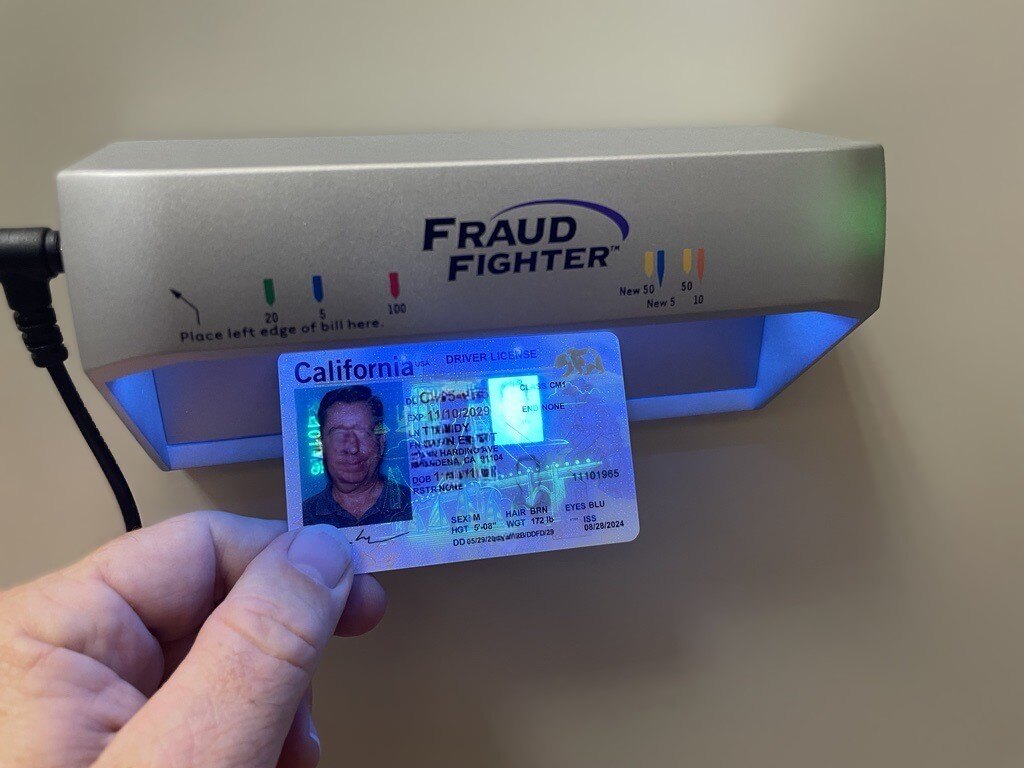
Stronger ID authentication catches counterfeits and stolen documents that pass visual inspection. Modern fake IDs replicate holograms, microprinting, and UV features, which makes manual checks unreliable for high-turnover staff. Multi-layer authentication reads optical, barcode, magnetic stripe, and machine-readable zone data to validate features invisible to the eye.
Document-level authentication also creates audit-ready records with timestamps, pass or fail results, and device logs, which is the evidence that demonstrates reasonable belief after an incident.
Document Authentication Layers That Strengthen Security
Evidence validation confirms the ID document is genuine, current, and consistent with authoritative format and data expectations. The FraudFighter ID system compares barcode, magnetic stripe, machine-readable zones, and visual inspection zones to detect alterations or counterfeits.
|
Authentication Layer |
What It Checks |
What It Catches |
|---|---|---|
|
White light |
Hologram placement, guilloche patterns, card layout |
Reprinted and re-laminated cards |
|
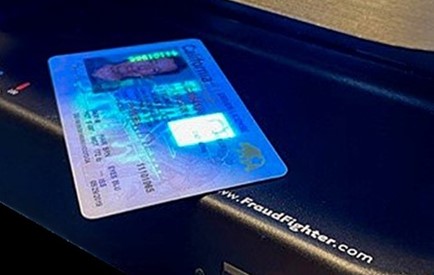
Ultraviolet |
State-specific UV security art |
Blanks missing embedded UV features |
|
Infrared |
Ink and substrate response under IR |
Altered photos and overlays |
|
Barcode (PDF417) |
Encoded data against the printed front |
Edited names, birthdates, addresses |
|
Magnetic stripe |
Track data against the visual zone |
Cloned and re-encoded cards |
|
Machine-readable zone |
Passport and ID check digits |
Fabricated travel documents |
Each layer narrows the gap a sophisticated fake can slip through, and a failure on any one of them flags the document for review.
ID Scanner Technology Supports Audit-Ready Records
FraudFighter™ ID verifies driver's licenses, passports, and government-issued ID cards in under 10 seconds. Every scan logs the timestamp, photo, and pass or fail result in the FraudFighter ID Portal, which is what internal testing, exception analysis, and fraud investigations draw on later.
These records prove procedures were followed across branches and channels, and they surface repeat failed attempts or staff who override results without authorization.
Failed or Suspicious IDs Require Escalation and Logging
One credit union stopped a suspect attempting a $3,000 shared-branching withdrawal and a HELOC application when authentication of a state-issued driver's license came back failed. Failed or suspicious IDs must be escalated immediately to a supervisor, fraud team, or BSA officer, with the reason, the detecting employee, and the resolution documented.
Logs should record whether the ID was expired, altered, counterfeit, or unsupported. Repeat attempts by the same individual, device, or location should trigger enhanced review or a fraud referral.
Remote Member Verification Must Match In-Branch Standards
Remote member verification must apply the same identity-proofing rigor as the branch, or it becomes the weak link. Member-not-present scenarios include online account opening, mobile banking enrollment, and remote loan applications, where no employee can compare the applicant to the ID.
Remote procedures should combine ID-document capture, selfie comparison, liveness detection, and fraud-mitigation controls that match branch standards, with documentation showing how each satisfies reasonable belief.
Remote Identity-Proofing Procedures That Increase Assurance
NIST identity-proofing outcomes cover identity resolution, evidence validation, identity verification, and fraud mitigation. Together they confirm the applicant is a real person who controls the identity claimed.
Credit unions should adopt ID authentication frameworks should combine document checks, biometric comparison, and knowledge-based verification. IAL1 controls limit highly scalable attacks, including automated enrollment attacks using compromised personal information.
Selfie and Liveness Checks in Remote Onboarding
Presentation attack detection covers liveness and biometric anti-spoofing for any workflow comparing a live applicant to identity evidence. WebID sends an email or SMS invitation so a remote member can scan an ID and take a live selfie, then checks the document and compares the ID photo to the selfie.
Liveness detection stops photos, videos, and masks from bypassing facial comparison. Confirm the vendor logs those results for audit review.
Risk Controls That Trigger Enhanced Review
Member-not-present risk concentrates in mobile banking and online account opening, where no employee can intervene. Automated attacks hit identity-proofing systems with synthetic or stolen identities at scale.
Credit unions should define risk triggers for enhanced review: mismatched address data, failed liveness checks, or multiple applications from one device. Remote workflows need real-time authentication and an escalation path that runs before account access is granted.
Failed-ID Exceptions in Fraud and Compliance Reviews
Failed-ID exceptions are evidence for both fraud pattern analysis and compliance audits. The logs show whether procedures caught suspicious identities and whether staff followed escalation protocols. A quarterly review of that data satisfies BSA independent-testing and incident-response obligations.
Failed-ID Overrides Require Documented Approval
Failed-ID overrides need a documented approval workflow naming who can authorize an exception. Verbal approvals eliminate the audit trail that proves reasonable belief. Each override should record the reason, the approver, and any additional verification, and that authority belongs with supervisors or designated compliance staff.
Failed-ID Incidents That Become Fraud Referrals or SAR Inputs
Fake identification documents open deposit accounts used to launder illicit funds and to reach other people's money. A failed-ID incident becomes a fraud referral when it involves suspected identity theft, synthetic identity, or account takeover, and a suspicious-activity report may follow.
Referral and SAR criteria belong in the BSA program. A failed ID paired with a large initial deposit, an immediate wire request, or evasive behavior should escalate on the spot.
Exception Logs Support Training and Internal Controls
Untracked document-library updates lead to outdated security-feature checks and false negatives. Exception logs reveal which ID types fail most often, which branches override most, and which tactics are working, which is what should drive the next procedure update and retraining round.
Staff Training Closes the Gap on Current Fraud Tactics
Staff training must cover both ID-authentication skill and social-engineering awareness, because fraudsters exploit document weaknesses and human trust in equal measure. Train employees on fake-ID detection, synthetic-identity warning signs, shared-branching risk, and escalation before Q4 volume climbs.
Training must be frequent, scenario-based, and documented to satisfy 12 CFR 748.2. Branch turnover makes that hard to sustain, which is why device authentication matters.
Emerging Fake-ID and Synthetic Identity Tactics
Synthetic identity fraud builds a usable identity from a mix of real and fabricated information. Stolen identity fraud uses a real person's data without authorization, usually sourced from breaches or phishing.
Forged documents include cashier's checks, money orders, and licenses altered to change names or birthdates. Modern counterfeits replicate holograms, UV features, and barcodes, so training should pair real examples with hands-on device practice.
Government-Imposter and Social-Engineering Schemes
Government imposter scam losses totaled $789 million in 2024. FinCEN issued a December 18, 2024 alert about schemes abusing its name, insignia, and authorities, including fake forms, fake department names, suspicious URLs or QR codes, and fraudulent payment requests.
Staff should verify any such request through official channels and treat urgency as a red flag rather than a reason to move faster.
Escalation and Privacy Practices That Protect Member Experience
Escalation has to balance fraud prevention with member privacy, especially when a legitimate member presents unusual identification. Staff should escalate calmly, explain that the check protects the member, and offer an alternative verification path where one exists.
Credit unions should document retention periods, access controls, and incident-response procedures in their security policy to satisfy 12 CFR 748.0 member-record protection requirements. Escalation training should emphasize that identity checks protect both the institution and the member from fraud.
Q4 Readiness Checklist for Identity Verification
A Q4 readiness checklist gets the evidence ready before an auditor or examiner asks for it, and completing it confirms the program is written, risk-based, consistently applied, and board-approved.
|
Readiness Area |
Evidence to Prepare |
Suggested Owner |
|---|---|---|
|
Policy documentation |
Written CIP, BSA program, security program, and the board minutes approving each |
Compliance officer |
|
Touchpoint inventory |
Every channel where identity is verified, re-verified, or relied on |
Operations manager |
|
Authentication logs |
Timestamped pass or fail records by branch and channel |
BSA officer |
|
Exception and override logs |
Reason, approver, and resolution for every failed ID |
Branch operations |
|
Independent testing |
Transaction sampling, staff interviews, mystery-shopper results |
Internal audit |
|
Training records |
Attendance, scenario content, and refresh dates |
Training lead |
|
Fraud referrals and SARs |
Referral criteria, filed reports, incident-response notes |
BSA officer |
|
Board reporting |
Failed-ID trends and Q4 readiness status summary |
Compliance officer |
Assign each task an owner and a deadline ahead of year-end reporting. Documenting completion supports compliance obligations and reduces exam findings.
Inventory and Assess All Identity-Verification Touchpoints
List every touchpoint where identity is verified, re-verified, or relied on, then assess each one for required evidence, authentication method, record retention, and exception handling.
Validate Documentation, Procedures, and Exception Management
Confirm the written CIP, BSA program, and security program are current and board-approved, and that procedures for each touchpoint are documented, trained, and tested. Review exception logs to verify failed IDs escalate consistently, and overrides carry proper authorization.
Evidence That Supports Audit Preparation and Board Governance
Audit evidence has to prove procedures were followed, not just written. The strongest file pairs board-approved programs with authentication logs, exception records, fraud-referral documentation, and board reports on failed-ID trends.
Credit Union Member Identity Verification as a Defensible, Risk-Based Compliance Practice
Credit unions that treat identity verification as a documented, risk-based practice rather than a routine task satisfy CIP, BSA, and security-program obligations more easily. Q4 readiness means aligned channels, trained staff, and evidence that demonstrates reasonable belief.
The program should be written, board-approved, tested, and adjusted as fraud trends and channel risk shift. FraudFighter™ closes gaps with device-based authentication, remote identity proofing, and audit-ready records for every ID check, so a credit union enters year-end review with procedures that hold up.
Talk to FraudFighter™ Before Your Q4 Review Closes
Q4 leaves little room to find a gap during an examination. Since 2000, FraudFighter™ has helped credit unions, banks, and casinos authenticate driver's licenses, passports, and ID cards at the counter, then keep the timestamped records examiners ask to see. Our California team reviews your channels and ships the right setup within days.
Call 888.664.9214 in the US or 626.225.0203 internationally, or contact FraudFighter™ and request more information for a quote and a no-obligation consultation on your credit union’s identity-verification program.
Frequently Asked Questions
Q1. What identity documents must a credit union verify under CIP?
A. A. CIP requires a credit union to collect a name, date of birth, address, and identification number for each member, then verify that information through documentary or non-documentary methods. Most credit unions rely on a government-issued photo ID such as a driver's license, state ID card, or passport. The written program should name which documents are acceptable at each channel and what happens when a member cannot produce one.
Q2. How often should a credit union test its identity-verification controls?
A. Independent testing under 12 CFR 748.2 has no fixed frequency, but most credit unions test annually and review exception logs quarterly. A quarterly review catches drift between branches long before an annual audit would. Testing should sample real transactions across branch, shared-branching, lending, and digital channels rather than reading the policy manual.
Q3. Does remote account opening require the same identity checks as a branch?
A. Yes. A risk-based CIP has to reach the same reasonable belief regardless of channel, so remote onboarding cannot run a lighter standard than the teller line. In practice that means ID-document capture, comparison of the ID photo to a live selfie, and liveness detection. Remote workflows also need risk triggers for enhanced review, such as mismatched address data or several applications from one device.
Q4. When does a failed ID scan require a SAR filing?
A. A failed scan on its own is not a filing trigger. It becomes one when the credit union suspects identity theft, synthetic identity, account takeover, money laundering, or another BSA violation, subject to the reporting thresholds in the program. Criteria should be written into the BSA program, so staff is not deciding case by case, and a failed ID paired with other red flags should reach the BSA officer the same day.
Q5. How long should credit unions retain ID verification records?
A. CIP recordkeeping requires identifying information collected at account opening to be kept for five years after the account closes, and records of the verification methods used for five years after the record is made. Authentication logs, exception records, and override approvals should follow the same schedule so the evidence file stays complete. Retention periods, access controls, and disposal steps belong in the written security program under 12 CFR 748.0.