

 10 minute read
Mortgage Document Authentication: Pre-Spring Origination Readiness
Mortgage document authentication protects lenders and check-cashing operators who release funds based on identity documents presented at counters and origination desks. When those documents carry altered information, fabricated security features, or fake IDs, institutions absorb losses that rarely recover once the transaction closes. Pre-spring readiness reviews give lending teams time to verify borrower identity and standardize workflows before seasonal volume raises exposure.
The FBI Internet Crime Complaint Center reported $16.6 billion in total losses for 2024, a 33% increase over 2023, and FinCEN logged more than 680,000 check-fraud-related Suspicious Activity Reports in 2022. Below, you'll find where fraud enters these workflows, how frontline teams verify documents, which regulations authentication supports, and a pre-spring checklist your team can work through before volume climbs.
Key Takeaways
- Authenticate borrower and customer documents before loan processing or cash release moves forward to prevent financial loss
- Check fraud and identity theft generated more than 680,000 FinCEN SARs in 2022 and $16.6 billion in FBI-reported losses in 2024
- Consistent authentication workflows reduce frontline guesswork and support Customer Identification Program, BSA/AML, Red Flags, and GLBA requirements
- UV/IR security feature detection and document scanners deliver repeatable verification that visual inspection alone cannot match
- Pre-spring readiness checklists covering staff training, equipment testing, escalation protocols, and documentation prepare teams before peak transaction volume
Mortgage Document Authentication and Why It Matters to Lenders
Document and ID Fraud in Mortgage Lending and Check Cashing
Document authentication confirms that borrower and customer identity documents are legitimate before a transaction moves into underwriting, account opening, or loan processing. Identity authentication returns a result at the point of sale within seconds, so staff are not relying on visual inspection alone. Fraud reaches these counters as altered checks, fabricated driver licenses, and counterfeit identity cards presented for cash advances or loan applications.
The FBI IC3 recorded 21,403 identity theft complaints in 2024 and $174,354,745 in related losses, and FinCEN's 2022 alert documented mail theft schemes in which legitimate checks were intercepted and modified. Authentication helps mortgage services teams and check cashing locations catch those attempts before funds leave the counter.
The Role of Identity Verification in Preventing Financial Loss
Identity verification lowers loss by confirming document authenticity before credit decisions, cash disbursements, or account access are approved. The FTC reported $12.5 billion in consumer fraud losses for 2024, with 38% of people who reported fraud losing money, up from 27% in 2023. Real estate and mortgage fraud alone accounted for 9,359 FBI IC3 complaints and $173,586,820 in losses. Document verification solutions cut into those figures by flagging fraudulent documents before an institution releases funds or extends credit.
How Document Authentication Supports Compliance Programs
Authentication produces evidence that identity verification happened at the transaction point. The Customer Identification Program requires institutions to verify identity through driver's licenses, passports, or government-issued cards before opening accounts or processing certain transactions, and authentication tools capture that evidence as the transaction runs.
The FACTA Red Flags Rule adds a second obligation: an identity theft prevention program that detects red flags at account opening and during processing. Authentication connects both to CIP, BSA/AML, Red Flags, GLBA, and internal risk policy through one repeatable process that staff run the same way in every branch.
Mortgage Document Authentication Risk Points Across Origination and Check-Cashing Workflows
Key Risk Points in the Mortgage Origination Process
Origination fraud enters at initial application, income verification, identity confirmation, or closing preparation. Authenticating at the front protects underwriting time, credit report costs, and appraisal spend from applications that were never going to close honestly. Pre-closing carries its own exposure, since identity documents resurface for final verification and disbursement. A document scanner for ID verification lets teams inspect security features at each stage rather than once at intake.
Where document fraud enters the workflow:
|
Workflow Stage |
Documents Presented |
Primary Fraud Risk |
Authentication Control |
|---|---|---|---|
|
Initial application |
Driver's license, state ID |
Synthetic or stolen identity |
Scan and authenticate the ID before the credit pull |
|
Income verification |
Pay stubs, employment letters |
Altered or fabricated income records |
Match identity to file, route anomalies to underwriting |
|
Identity confirmation |
Passport, government ID |
Counterfeit with copied surface features |
UV and IR security feature check |
|
Pre-closing and title review |
Reissued ID, notarized forms |
Substituted identity at signing |
Re-authenticate the ID at closing |
|
Funds disbursement |
ID plus wire instructions |
Impersonation of borrower or seller |
Pass or fail check before release |
|
Check-cashing counter |
Check plus driver's license |
Altered payee, amount, or signature |
Authenticate the instrument and the ID |
Fraud Vulnerabilities in Check-Cashing Transactions
Check-cashing operations face two authentication points at once: the check and the customer holding it. Check-fraud SARs reached more than 680,000 in 2022, nearly double the previous year, as mail theft schemes gave criminals legitimate check stock to modify. Staff have to read security features on the instrument and on the driver's license in the same transaction, which manual inspection rarely handles consistently once volume rises.
Altered checks combine document fraud with identity theft, so a single visual pass is a weak control. Authentication tools take the judgment call away from the cashier.
Common Types of Fraudulent Documents and IDs
What arrives at these counters clusters into a few recurring types: fabricated driver licenses, altered government identification cards, modified checks with changed payee details, and counterfeits that copy visible security features. Current counterfeits reproduce holograms and microprint convincingly but fail on ultraviolet and infrared elements, which need equipment to see. Altered checks follow the same pattern, with chemicals or digital tools used to change payee names, amounts, or signatures on genuine stock. Authentication systems inspect several security layers within seconds and return a result instead of an opinion.
Frontline Identity Verification and Document Inspection Methods
Standards for Front-Door Identity Verification
Front-door verification confirms documents are authentic before a transaction moves deeper into processing. Driver license authentication starts with confirming the document matches the expected security features for its issuing state. Teams should then scan and inspect using standardized steps that hold across branches and shifts: a written checklist, a clear escalation path when red flags appear, and a record of each action for the audit trail. Identity authentication equipment carries most of that load once the procedure is set.
Utilizing Scanners and UV/IR Tools for Document Inspection
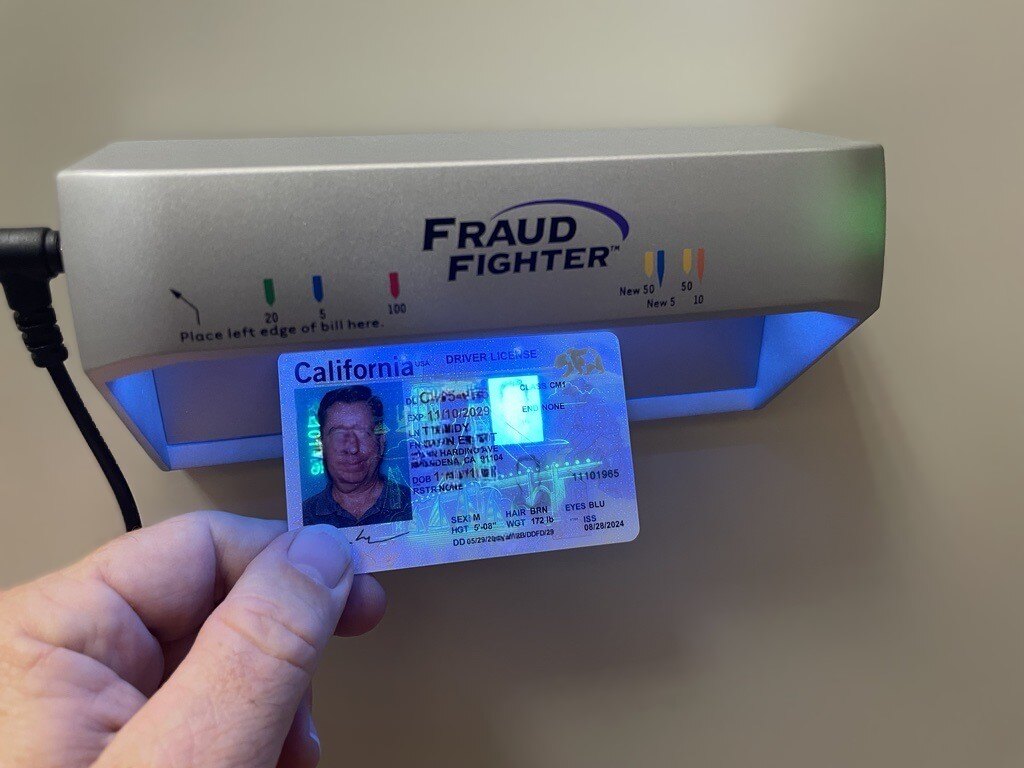
UV and infrared inspection reveals security features that stay invisible under counter lighting, which is exactly where sophisticated counterfeits fail. The ID-150 scanner captures images at 600 dpi and checks multiple data and security points in visible and infrared light, giving staff a tool-supported decision rather than a judgment call.
UV, IR, and magnetic security feature detection looks for ultraviolet-reactive ink, infrared-visible patterns, and magnetic stripe encoding that counterfeiters struggle to reproduce. The check finishes in seconds, and the outcome stays consistent across locations when transaction pressure rises.
Red Flags and Signs That Require Escalation
Red flags include mismatched security features, unusual card texture or thickness, blurred text, and inconsistent responses under UV or IR inspection. Name these anomalies in written procedure and state which ones trigger automatic escalation, rather than leaving each cashier to decide. Escalation protocols also protect employees, who should never have to accuse a customer on a hunch.
Red flags and the required frontline response:
|
Red Flag Observed |
What It Suggests |
Required Frontline Action |
|---|---|---|
|
Security feature missing under UV |
Counterfeit or altered document |
Fail the check and pause the transaction |
|
Unusual card texture or thickness |
Reprinted card or laminated overlay |
Record the finding and escalate to a supervisor |
|
Blurred text or misaligned microprint |
Low-quality forgery |
Fail the check and retain the scan image |
|
Front data does not match the barcode |
Tampered or spliced document |
Escalate to the fraud specialist on call |
|
Customer hesitates on basic identity details |
Impersonation or a coached presenter |
Follow the scripted escalation, make no accusation |
|
Check and ID names do not match |
Check fraud with an identity element |
Hold the transaction and file an exception report |
Walk a mock escalation end to end during a low-volume week. It surfaces process gaps and documentation weaknesses while there is still time to fix them.
Processes That Keep Verification Consistent and Reduce Frontline Guesswork
Designing Repeatable Pass/Fail Authentication Workflows
Repeatable pass/fail workflows produce the same outcome across branches, shifts, and employees. Manual review does not: visual-only inspection varies with employee experience, training recency, lighting, and how many customers are waiting, while a UV/IR scan returns a standardized result. Define one pass, fail, or exception path and apply it whether the transaction lands at 9:00 a.m. or during the afternoon rush.
Staff Training and Escalation Protocols
Frontline staff are not forensic examiners, yet many institutions still ask them to make forensic calls without tools or specialist backup. Training should cover operating the equipment, reading the results, and escalating anything uncertain, rather than teaching employees to spot counterfeits by eye. Escalation protocols then set out when staff pauses a transaction, how they record what they saw, and who receives the customer next.
Documenting Exceptions and Maintaining Audit Trails
Exception documentation shows procedures were followed even when a transaction needed escalation. Suspicious Activity Reports, the filings institutions submit when activity looks fraudulent, should record the documents presented, the authentication steps taken, and the investigation outcome. Programs built under the FACTA Red Flags Rule depend on that evidence trail.
Maintaining audit trails means capturing document images, recording results, logging staff actions, and preserving exception reports in compliance systems. Tools that do this automatically beat handwritten logs and spreadsheet tracking in terms of accuracy.
Regulatory Compliance Support From Document Authentication
Integrating Authentication with Customer Identification Programs (CIP)
Customer Identification Programs require institutions to verify identity using driver licenses, passports, or government-issued cards before establishing accounts or processing certain transactions. Authentication provides evidence that verification happened at the account opening or transaction point, with captured images and recorded results available at examination time. Fold it into the existing CIP procedure rather than running it alongside.
Aligning Controls with the Bank Secrecy Act (BSA) and Anti-Money Laundering (AML)
BSA and AML controls require risk-based procedures that detect and prevent money laundering and terrorist financing. Authentication supports them by verifying identity, detecting suspicious documents, and creating the records behind a SAR filing when fraudulent activity surfaces. The output is objective evidence that verification happened, not a note that someone looked.
Applying FACTA Red Flags and Gramm-Leach-Bliley Act (GLBA) Guidelines
The FACTA Red Flags Rule requires identity theft prevention programs that detect red flags during account opening and transaction processing. Authentication identifies them directly: documents that fail a security feature check, altered identity data, inconsistent UV or IR response. GLBA sits alongside it, requiring safeguards against unauthorized access to personal financial data, which starts with confirming the person at the counter is who the document says.
How document authentication maps to each requirement:
|
Requirement |
What It Asks For |
Authentication Contribution |
|---|---|---|
|
CIP under BSA/AML |
Verify identity before account opening |
Captured document images and recorded verification results |
|
Bank Secrecy Act and AML |
Risk-based detection and SAR filing |
Objective evidence supporting suspicious activity reports |
|
FACTA Red Flags Rule |
Detect and respond to identity theft red flags |
Repeatable detection steps staff run without forensic training |
|
Gramm-Leach-Bliley Act |
Safeguard customer financial information |
Verified identity before access to personal financial data |
|
Internal risk policy |
Consistent controls across every branch |
One pass or fail workflow with timestamped records |
Pre-Spring Readiness Checklist for Mortgage and Check-Cashing Teams
Reviewing Acceptable IDs and Documentation Standards
Start with the acceptable document list. Confirm it reflects current regulatory guidance, state-specific requirements, and internal risk policy before volume rises. ID-1 documents, the driver-license-sized ICAO format, make up most of what arrives at the counter, so driver license and government ID verification sit at the center of the review, alongside a check that standards still line up with CIP, Red Flags, and GLBA safeguards. This pass usually surfaces the quiet problems: procedures never updated and branches running different practices.
Testing and Verifying Authentication Equipment
Equipment testing confirms that scanners, UV and IR sources, and inspection devices work before reliance on them spikes. Check backup devices, support contacts, and replacement procedure for each location, not just the flagship branch, and include functionality checks, light source verification, software updates, and a short competency assessment. Verifying ahead of spring keeps an equipment failure from being mistaken for document fraud.
Training, Escalation, and Documentation Preparedness
Audit staff process on a set schedule. Confirm that employees follow the written procedure, operate equipment correctly, and escalate uncertainty instead of making a call they are not trained to make. Then check that systems capture the required fields, audit trails stay intact, and exception reports reach a named compliance reviewer.
Pre-spring readiness checklist:
|
Readiness Area |
What to Confirm |
Suggested Owner |
Timing |
|---|---|---|---|
|
Acceptable documents |
ID list matches current CIP and state guidance |
Compliance |
8 weeks out |
|
Equipment |
Scanners, UV/IR sources, and software tested at every branch |
Operations |
6 weeks out |
|
Backup coverage |
Spare devices and support contacts on file per location |
Operations |
6 weeks out |
|
Staff competency |
Each frontline employee completes a supervised live scan |
Branch management |
4 weeks out |
|
Escalation paths |
Pause, document, and route steps tested end to end |
Compliance |
4 weeks out |
|
Documentation |
Audit trails capture images, results, and timestamps |
Compliance |
2 weeks out |
|
Exception routing |
Reports reach a named reviewer within one business day |
Compliance |
2 weeks out |
FraudFighter Tools for Point-of-Transaction Document Authentication
Features of the ID-150 Scanner and UV/IR Detection Tools
The ID-150 authenticates ID-1 documents by capturing images at 600 dpi and checking multiple data and security points in visible and infrared light. UV, IR, and magnetic detection reveal what manual inspection cannot assess: ultraviolet-reactive ink, infrared-visible text, and magnetic stripe encoding. Staff receive a pass or fail based on whether those features are present, and the image is captured as part of the process.
Real-Time Authentication Benefits for Mortgage and Check-Cashing Operators
Real-time authentication returns a decision at the point of sale, the only moment the loss is still preventable. FraudFighter has 25+ years of fraud-prevention experience and protects 25,000+ point-of-sale locations across North America, with authentication that fits inside existing transaction flow rather than beside it.
For mortgage operators, catching a fraudulent document early keeps underwriting time and processing costs out of an application that will not survive review. For check-cashing operators across financial services, verification happens before cash leaves the drawer.
Supporting Consistent Workflow and Compliance Documentation
Authentication tools standardize the workflow and take subjective decision-making out of frontline verification. They do not, on their own, make an institution compliant. CIP, BSA/AML, Red Flags, and GLBA all require written programs, and FraudFighter supports ID verification workflows without claiming to deliver legal compliance, which still rests on policy, training, risk assessment, and ongoing monitoring. What consistency does deliver is less variation between locations and a record showing procedure was followed over time, with automated image capture and timestamped events feeding SAR filings, examinations, and internal audits.
Operational Readiness for Mortgage Document Authentication Before Peak Origination Periods
Pre-spring readiness reviews prepare mortgage and check-cashing teams for higher volume by confirming that workflows, equipment, training, and escalation protocols all work before demand arrives. Handling it in a quiet month beats reacting after a loss.
Peak origination raises legitimate volume and fraudster opportunity together, because busy staff under time pressure skip steps. Reviews done now reduce financial loss, support compliance, and keep frontline employees from making forensic decisions without the tools to make them.
Get Your Document Authentication Workflow Ready Before Spring Volume Arrives
FraudFighter™ has spent more than 25 years on point-of-transaction fraud prevention and protects over 25,000 point-of-sale locations across North America. Our specialists will review your ID verification workflow, recommend equipment for each counter, and help your compliance team document the process before origination volume climbs.
Call (888) 664-9214 to speak with a fraud prevention specialist, or request a quote for pricing based on your branch count and transaction volume. If counterfeit losses are a concern across your branches, we’d suggest reliable counterfeit detection as a first line of defense.
Frequently Asked Questions on Mortgage Document Authentication
Q1. What documents should mortgage lenders authenticate before underwriting?
A. Authenticate every government-issued identity document the borrower presents, starting with the driver's license or state ID at application. Those ID-1 documents carry the UV and IR features counterfeits fail to reproduce. Income and employment records should be verified through their issuing source instead, since they carry no standardized security features. Re-authenticate the ID at pre-closing, because that is where substituted identities enter the file.
Q2. How does UV and IR inspection differ from a visual ID check?
A. A visual check reads the surface: photo, holograms, microprint, and card feel. Current counterfeits reproduce all of that well enough to pass at a counter. UV and IR inspection reads the layers underneath, including ultraviolet-reactive ink and infrared-visible text that require issuing-authority equipment to produce correctly. The difference matters most under pressure, since a scan returns the same result however long the line has grown.
Q3. Does authentication equipment make an institution compliant?
A. No. Equipment supports a compliance program but does not constitute one. CIP, BSA/AML, FACTA Red Flags, and GLBA all require written policies, staff training, risk assessments, and ongoing monitoring. What authentication contributes is evidence: captured images, recorded results, and timestamps showing the verification step happened as policy describes. Examiners look for both the program and the proof it was followed.
Q4. How far ahead of peak origination season should readiness testing start?
A. Begin about eight weeks out with the acceptable document list, since revisions there affect everything downstream. Equipment testing and backup coverage follow at roughly six weeks, staff competency and escalation testing at four, and documentation and exception routing at two. That sequence leaves room to order replacement hardware or retrain a branch before volume is already rising.
Q5. What should frontline staff do when an identity document fails authentication?
A. Follow the written escalation procedure rather than improvising. Staff should pause the transaction, record what the scan returned, retain the captured image, and route the customer to the designated specialist. They should not accuse the customer or say which security feature failed, since that information helps a fraudster refine the next attempt. The exception report should reach a named compliance reviewer within one business day.